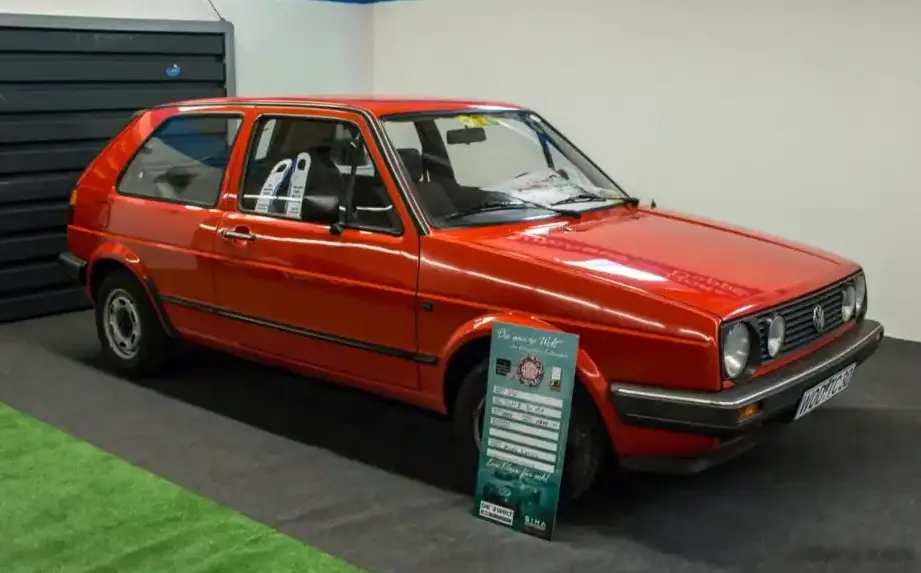
The Volkswagen Golf II 1.6 TD (70 hp) was a popular variant of the second-generation Golf, produced between 1983 and 1987. Positioned as an economy-focused option within the Golf II range, it offered a diesel-powered alternative to the gasoline engines, appealing to drivers prioritizing fuel efficiency. This 3-door hatchback played a significant role in establishing the Golf as a versatile and practical vehicle in the European market, offering a balance between affordability and everyday usability. It was a key model in Volkswagen’s strategy to provide a modern, efficient, and accessible car to a broad customer base.
Technical Specifications
| Brand | Volkswagen |
| Model | Golf |
| Generation | Golf II (3-door) |
| Type (Engine) | 1.6 TD (70 Hp) |
| Start of production | 1983 |
| End of production | 1987 |
| Powertrain Architecture | Internal Combustion engine |
| Body type | Hatchback |
| Seats | 5 |
| Doors | 3 |
| Fuel consumption (urban) | 6.1 l/100 km (38.6 US mpg, 46.3 UK mpg, 16.4 km/l) |
| Fuel consumption (extra urban) | 4.3 l/100 km (54.7 US mpg, 65.7 UK mpg, 23.3 km/l) |
| Fuel Type | Diesel |
| Acceleration 0 – 100 km/h | 14.5 sec |
| Acceleration 0 – 62 mph | 14.5 sec |
| Acceleration 0 – 60 mph | 13.8 sec |
| Maximum speed | 160 km/h (99.42 mph) |
| Weight-to-power ratio | 13.1 kg/Hp, 76.1 Hp/tonne |
| Weight-to-torque ratio | 6.9 kg/Nm, 144.6 Nm/tonne |
| Power | 70 Hp @ 4500 rpm |
| Power per litre | 44.1 Hp/l |
| Torque | 133 Nm @ 2600 rpm (98.1 lb.-ft. @ 2600 rpm) |
| Engine layout | Front, Transverse |
| Engine Model/Code | JR |
| Engine displacement | 1588 cm3 (96.91 cu. in.) |
| Number of cylinders | 4 |
| Engine configuration | Inline |
| Cylinder Bore | 76.5 mm (3.01 in.) |
| Piston Stroke | 86.4 mm (3.4 in.) |
| Compression ratio | 23:1 |
| Number of valves per cylinder | 2 |
| Fuel injection system | Precombustion chamber injection |
| Engine aspiration | Turbocharger |
| Valvetrain | SOHC |
| Engine oil capacity | 3 l (3.17 US qt | 2.64 UK qt) |
| Coolant capacity | 6.5 l (6.87 US qt | 5.72 UK qt) |
| Kerb Weight | 920 kg (2028.25 lbs.) |
| Max. weight | 1430 kg (3152.61 lbs.) |
| Max load | 510 kg (1124.36 lbs.) |
| Trunk (boot) space – minimum | 345 l (12.18 cu. ft.) |
| Trunk (boot) space – maximum | 1145 l (40.44 cu. ft.) |
| Fuel tank capacity | 55 l (14.53 US gal | 12.1 UK gal) |
| Permitted trailer load with brakes (12%) | 1000 kg (2204.62 lbs.) |
| Permitted trailer load without brakes | 490 kg (1080.27 lbs.) |
| Length | 3985 mm (156.89 in.) |
| Width | 1665-1680 mm (65.55 – 66.14 in.) |
| Height | 1415 mm (55.71 in.) |
| Wheelbase | 2475 mm (97.44 in.) |
| Front track | 1427 mm (56.18 in.) |
| Rear track | 1422 mm (55.98 in.) |
| Front overhang | 810 mm (31.89 in.) |
| Rear overhang | 700 mm (27.56 in.) |
| Drag coefficient (Cd) | 0.34 |
| Minimum turning circle | 10.5 m (34.45 ft.) |
| Drivetrain | Front wheel drive |
| Number of gears | 5 |
| Gearbox type | Manual transmission |
| Front suspension | Independent type McPherson, Transverse stabilizer |
| Rear suspension | Elastic beam |
| Front brakes | Disc |
| Rear brakes | Drum |
| Steering type | Steering rack and pinion |
| Tires size | 175/70 R13 |
| Wheel rims size | 5.5J x 13 |
INTRODUCTION
The Volkswagen Golf II 1.6 TD, produced from 1983 to 1987, was a crucial variant within the highly successful Golf II range. Built on the 1HX0/A3 platform, this model aimed to provide economical transportation, particularly in European markets where diesel fuel was becoming increasingly popular due to its lower cost and better fuel economy. The 1.6 TD offered a practical and affordable entry point into the Golf II lineup, appealing to buyers who prioritized efficiency over outright performance. It was a common sight on European roads, known for its durability and relatively low running costs.
Powertrain & Engine Architecture
The heart of the Golf II 1.6 TD was the JR engine code, a 1.6-liter inline-four diesel engine. This engine utilized a precombustion chamber injection system, a common technology for diesel engines of the era. This system involved injecting fuel into a small precombustion chamber connected to the main cylinder, promoting more complete combustion and reducing engine noise. The engine featured a single overhead camshaft (SOHC) valvetrain operating two valves per cylinder. A turbocharger was added to increase power output to 70 hp. The engine’s relatively low compression ratio of 23:1 contributed to its durability. The engine was transversely mounted, driving the front wheels. The transmission was a 5-speed manual gearbox, chosen for its efficiency and cost-effectiveness.
Driving Characteristics
The Golf II 1.6 TD with a manual transmission offered a driving experience focused on practicality and fuel economy rather than sporty performance. With 70 hp and 133 Nm (98.1 lb-ft) of torque, acceleration was modest, taking around 14.5 seconds to reach 62 mph. However, the turbocharger provided a noticeable boost in power at lower engine speeds, making it reasonably capable for everyday driving. The 5-speed gearbox allowed for efficient cruising on highways, while the relatively long gear ratios prioritized fuel economy. Compared to the gasoline-powered Golf II models, the 1.6 TD offered significantly better fuel economy, but at the expense of acceleration and overall refinement. It was noticeably slower than the GTI or even the 1.8-liter gasoline versions.
Equipment & Trim Levels
The Golf II 1.6 TD typically came with a fairly basic level of equipment, reflecting its position as an economy-focused model. Standard features generally included cloth upholstery, a basic instrument cluster, and manual windows and door locks. Optional extras included a sunroof, upgraded stereo systems, and central locking. The interior design was functional and durable, prioritizing practicality over luxury. Trim levels varied slightly depending on the market, but generally, the 1.6 TD was positioned below the more luxurious GL and GTI models.
Chassis & Braking
The Golf II 1.6 TD utilized a McPherson strut front suspension with a transverse stabilizer bar, providing a comfortable and predictable ride. The rear suspension employed a simple elastic beam setup, which was cost-effective and space-efficient. The braking system consisted of disc brakes on the front wheels and drum brakes on the rear. This configuration was typical for vehicles in this weight class and price range during the 1980s. The steering was a rack and pinion system, offering precise and responsive handling.
Market Reception & Comparison
The Golf II 1.6 TD was well-received in the European market, particularly by drivers seeking an economical and reliable vehicle. Critics praised its fuel efficiency and durability, but noted its relatively modest performance. Compared to the gasoline-powered Golf II models, the 1.6 TD offered significantly better fuel economy, making it a popular choice for high-mileage drivers. However, it lacked the sporty character and refinement of the GTI or the more powerful gasoline engines. The 1.6 TD was often compared to other diesel-powered hatchbacks of the era, such as the Peugeot 205 Diesel and the Fiat Uno Diesel, generally holding its own in terms of fuel economy and reliability.
Legacy
The Volkswagen Golf II 1.6 TD has proven to be a remarkably durable and reliable vehicle. Many examples are still on the road today, testament to the quality of its engineering and construction. The JR engine, while not particularly powerful, is known for its longevity and relatively simple maintenance requirements. In the used car market, the Golf II 1.6 TD remains a popular choice for those seeking a classic, affordable, and economical vehicle. Its simplicity and durability make it a relatively easy car to maintain and repair, appealing to enthusiasts and budget-conscious buyers alike. It represents a significant chapter in the Golf’s history, solidifying its reputation as a versatile and practical car for the masses.