Technical Specifications
| Brand | Volkswagen |
| Model | Golf |
| Generation | Golf II (3-door) |
| Type (Engine) | 1.8 (90 Hp) Syncro |
| Start of production | 1986 |
| End of production | 1987 |
| Powertrain Architecture | Internal Combustion engine |
| Body type | Hatchback |
| Seats | 5 |
| Doors | 3 |
| Fuel consumption (urban) | 9.9 l/100 km (23.8 US mpg) |
| Fuel consumption (extra urban) | 6.2 l/100 km (37.9 US mpg) |
| Fuel Type | Petrol (Gasoline) |
| Acceleration 0 – 100 km/h | 11.3 sec |
| Acceleration 0 – 62 mph | 11.3 sec |
| Acceleration 0 – 60 mph | 10.7 sec |
| Maximum speed | 178 km/h (110.6 mph) |
| Weight-to-power ratio | 11.7 kg/Hp |
| Weight-to-torque ratio | 7.2 kg/Nm |
| Power | 90 Hp @ 5200 rpm |
| Torque | 145 Nm @ 3300 rpm (106.95 lb.-ft. @ 3300 rpm) |
| Engine layout | Front, Transverse |
| Engine Model/Code | GX, GU |
| Engine displacement | 1781 cm3 (108.68 cu. in.) |
| Number of cylinders | 4 |
| Engine configuration | Inline |
| Cylinder Bore | 81 mm (3.19 in.) |
| Piston Stroke | 86.4 mm (3.4 in.) |
| Compression ratio | 10:1 |
| Number of valves per cylinder | 2 |
| Fuel injection system | Carburettor |
| Engine aspiration | Naturally aspirated engine |
| Valvetrain | SOHC |
| Engine oil capacity | 4 l (4.23 US qt | 3.52 UK qt) |
| Coolant capacity | 6.5 l (6.87 US qt | 5.72 UK qt) |
| Kerb Weight | 1050 kg (2314.85 lbs.) |
| Max. weight | 1540 kg (3395.12 lbs.) |
| Max load | 490 kg (1080.27 lbs.) |
| Trunk (boot) space – minimum | 230 l (8.12 cu. ft.) |
| Trunk (boot) space – maximum | 1030 l (36.37 cu. ft.) |
| Fuel tank capacity | 55 l (14.53 US gal | 12.1 UK gal) |
| Permitted trailer load with brakes (12%) | 1500 kg (3306.93 lbs.) |
| Permitted trailer load without brakes | 570 kg (1256.63 lbs.) |
| Permitted towbar download | 75 kg (165.35 lbs.) |
| Length | 3985 mm (156.89 in.) |
| Width | 1665-1680 mm (65.55 – 66.14 in.) |
| Height | 1415 mm (55.71 in.) |
| Wheelbase | 2475 mm (97.44 in.) |
| Front track | 1427 mm (56.18 in.) |
| Rear track | 1432 mm (56.38 in.) |
| Front overhang | 810 mm (31.89 in.) |
| Rear overhang | 700 mm (27.56 in.) |
| Drag coefficient (Cd) | 0.34 |
| Minimum turning circle | 10.5 m (34.45 ft.) |
| Drivetrain Architecture | All wheel drive (4×4) |
| Number of gears and type of gearbox | 5 gears, manual transmission |
| Front suspension | Independent type McPherson, Transverse stabilizer |
| Rear suspension | Transverse stabilizer, Trailing arm |
| Front brakes | Disc |
| Rear brakes | Drum |
| Steering type | Steering rack and pinion |
| Tires size | 175/70 R13 |
| Wheel rims size | 5.5J x 13 |
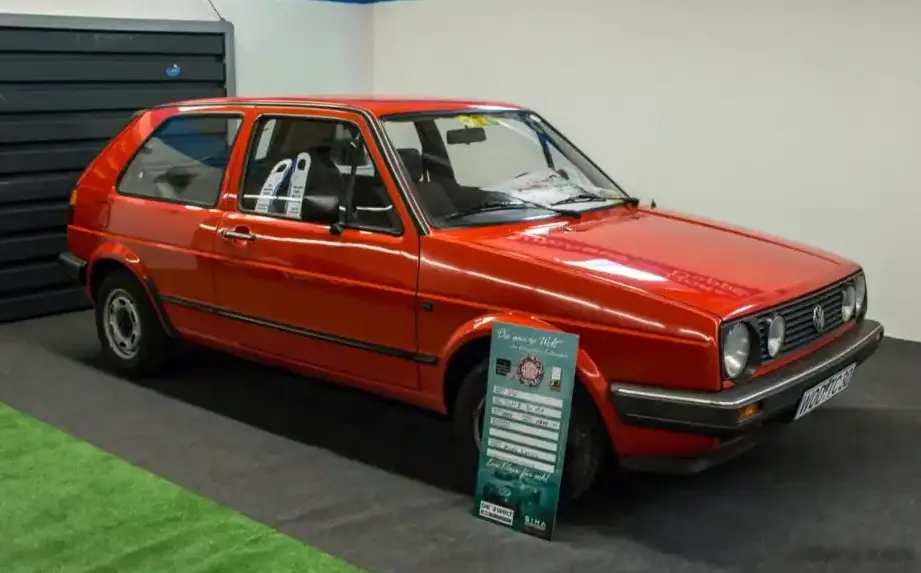
The Volkswagen Golf II 1.8 (90 hp) Syncro, produced from 1986 to 1987, represents a specialized offering within the highly successful second-generation Golf lineup (the 19X series). This 3-door hatchback combined the practicality and affordability of the Golf II with Volkswagen’s Syncro all-wheel-drive system, and a relatively modest 1.8-liter engine paired with an automatic transmission. It occupied a niche position, appealing to buyers in regions with inclement weather or those desiring added stability without the performance focus of the GTI or the fuel economy of the diesel models. The Syncro system, while adding weight and complexity, broadened the Golf’s appeal beyond purely urban environments.
Powertrain & Engine Architecture
The 1.8-liter engine, designated GX or GU depending on the specific production run, was a naturally aspirated inline-four cylinder unit. It featured a single overhead camshaft (SOHC) valvetrain with two valves per cylinder. Unlike the later fuel-injected Golf models, this variant utilized a carburetor for fuel delivery, a cost-saving measure that impacted performance and emissions compared to more modern systems. The engine produced 90 horsepower at 5200 rpm and 145 Nm (107 lb-ft) of torque at 3300 rpm. The automatic transmission was typically a three-speed unit, designed for smooth operation rather than outright speed. This transmission was chosen to provide ease of use, particularly in urban driving conditions, but at the expense of acceleration and fuel efficiency compared to the available five-speed manual.
Driving Characteristics
The 1.8L automatic Syncro Golf II offered a comfortable, if not particularly sporty, driving experience. Acceleration was modest, taking around 11.3 seconds to reach 60 mph. The automatic transmission, while convenient, resulted in noticeable power loss and a less engaging driving feel. The Syncro all-wheel-drive system provided enhanced traction, especially on slippery surfaces, making it a more confident vehicle in adverse weather conditions. However, the added weight of the Syncro components (approximately 150-200 lbs over a standard Golf II) further diminished performance. Gear ratios were optimized for fuel economy and everyday drivability, rather than spirited acceleration.
Equipment & Trim Levels
The 1.8 Syncro automatic typically came with a fairly basic level of equipment. Standard features included cloth upholstery, a basic instrument cluster, and manual windows and door locks. Optional extras included a sunroof, upgraded stereo system, and central locking. The interior trim was generally functional and durable, reflecting the Golf’s reputation for practicality. The Syncro models often featured a slightly more robust interior trim to withstand the demands of off-road or challenging driving conditions.
Chassis & Braking
The Golf II’s chassis featured an independent McPherson strut front suspension and a trailing arm rear suspension. The Syncro models benefited from a slightly stiffer suspension setup to compensate for the added weight of the all-wheel-drive system. Braking was accomplished via disc brakes on the front wheels and drum brakes on the rear. The braking system was adequate for everyday use, but lacked the stopping power of the GTI or later Golf models with upgraded brakes. A stabilizer bar was fitted to both the front and rear axles to reduce body roll during cornering.
Market Reception & Comparison
The 1.8 Syncro automatic Golf II received mixed reviews. Critics praised the added security of the all-wheel-drive system, particularly in regions prone to snow or ice. However, the combination of the carburetor engine and automatic transmission was often criticized for its lack of performance and relatively poor fuel economy. Compared to the more popular 1.8 GTI, the Syncro automatic was significantly slower and less engaging to drive. The 1.6-liter diesel models offered better fuel economy, while the GTI provided a more thrilling driving experience. The Syncro automatic appealed to a specific niche of buyers who prioritized practicality and all-weather capability over performance.
Legacy
The Volkswagen Golf II 1.8 Syncro automatic, while not the most sought-after variant, holds a unique place in the Golf lineage. The GX and GU engine codes are known for reasonable reliability, although carburetor maintenance can be more frequent than fuel-injected engines. The Syncro system itself is generally robust, but requires periodic maintenance to ensure proper operation. Today, these models are becoming increasingly collectible, particularly those in good original condition. The combination of all-wheel drive and a relatively simple mechanical setup makes them appealing to enthusiasts who appreciate classic Volkswagen engineering. Finding parts can be challenging, but a dedicated aftermarket and online community support the preservation of these iconic vehicles.