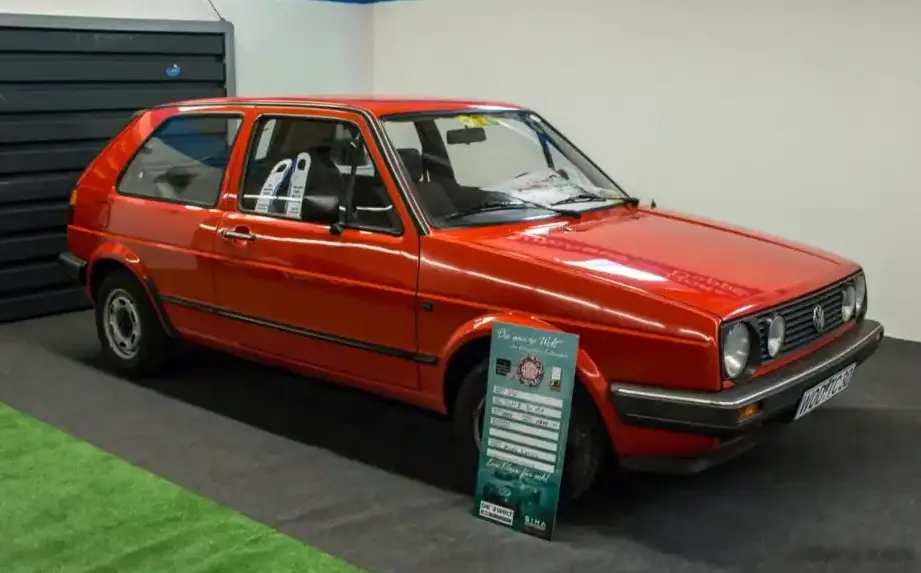
The Volkswagen Golf Mk2 1.8 GTI 16V, produced between 1986 and 1987, represents a significant evolution of the original Golf GTI. Positioned as a performance-oriented variant within the Mk2 Golf range, it aimed to deliver a more sophisticated and powerful driving experience than the earlier 8-valve GTI models. This 3-door hatchback was a key player in the hot hatch segment during its time, building upon the success of the Mk1 Golf GTI and establishing the Golf as a benchmark for affordable performance. It was built on the 1HX0/A3 platform, shared with other Volkswagen Group vehicles like the Jetta, Scirocco, and Corrado.
Technical Specifications
| Brand | Volkswagen |
| Model | Golf |
| Generation | Golf II (3-door) |
| Type (Engine) | 1.8 GTI 16V (139 Hp) |
| Start of production | 1986 |
| End of production | 1987 |
| Powertrain Architecture | Internal Combustion engine |
| Body type | Hatchback |
| Seats | 5 |
| Doors | 3 |
| Fuel consumption (urban) | 11 l/100 km (21.4 US mpg, 25.7 UK mpg, 9.1 km/l) |
| Fuel consumption (extra urban) | 7 l/100 km (33.6 US mpg, 40.4 UK mpg, 14.3 km/l) |
| Fuel consumption (combined) | 8.6 l/100 km (27.4 US mpg, 32.8 UK mpg, 11.6 km/l) |
| Fuel Type | Petrol (Gasoline) |
| Acceleration 0 – 100 km/h | 8.6 sec |
| Acceleration 0 – 62 mph | 8.6 sec |
| Acceleration 0 – 60 mph | 8.2 sec |
| Maximum speed | 208 km/h (129.25 mph) |
| Weight-to-power ratio | 7.4 kg/Hp, 134.3 Hp/tonne |
| Weight-to-torque ratio | 6.2 kg/Nm, 162.3 Nm/tonne |
| Power | 139 Hp @ 6100 rpm |
| Power per litre | 78 Hp/l |
| Torque | 168 Nm @ 4600 rpm (123.91 lb.-ft. @ 4600 rpm) |
| Engine layout | Front, Transverse |
| Engine Model/Code | KR |
| Engine displacement | 1781 cm3 (108.68 cu. in.) |
| Number of cylinders | 4 |
| Engine configuration | Inline |
| Cylinder Bore | 81 mm (3.19 in.) |
| Piston Stroke | 86.4 mm (3.4 in.) |
| Compression ratio | 10:1 |
| Number of valves per cylinder | 4 |
| Fuel injection system | Multi-port manifold injection |
| Engine aspiration | Naturally aspirated engine |
| Engine oil capacity | 4 l (4.23 US qt | 3.52 UK qt) |
| Coolant capacity | 6.3 l (6.66 US qt | 5.54 UK qt) |
| Kerb Weight | 1035 kg (2281.78 lbs.) |
| Max. weight | 1400 kg (3086.47 lbs.) |
| Max load | 365 kg (804.69 lbs.) |
| Trunk (boot) space – minimum | 320 l (11.3 cu. ft.) |
| Fuel tank capacity | 55 l (14.53 US gal | 12.1 UK gal) |
| Length | 3985 mm (156.89 in.) |
| Width | 1665 mm (65.55 in.) |
| Height | 1405 mm (55.31 in.) |
| Wheelbase | 2475 mm (97.44 in.) |
| Front overhang | 810 mm (31.89 in.) |
| Rear overhang | 700 mm (27.56 in.) |
| Drag coefficient (Cd) | 0.34 |
| Minimum turning circle | 10.5 m (34.45 ft.) |
| Drivetrain Architecture | The Internal combustion engine (ICE) drives the front wheels of the vehicle. |
| Drive wheel | Front wheel drive |
| Number of gears and type of gearbox | 5 gears, manual transmission |
| Front suspension | Independent type McPherson |
| Rear suspension | Coil spring |
| Front brakes | Ventilated discs |
| Rear brakes | Disc |
| Steering type | Steering rack and pinion |
| Power steering | Hydraulic Steering |
| Tires size | 185/55 R15 |
| Wheel rims size | 6.5J x 15 |
Powertrain & Engine Architecture
The heart of the Golf GTI 16V is the KR engine, a 1.8-liter inline-four cylinder gasoline engine. This engine featured a cylinder head with two camshafts and four valves per cylinder (hence the “16V” designation), a significant upgrade over the earlier 8-valve GTI. This configuration allowed for improved breathing and higher engine speeds, resulting in increased power output. The KR engine utilized Bosch Motronic fuel injection, a sophisticated system for its time, which precisely controlled fuel delivery based on various engine parameters. The engine produced 139 horsepower at 6100 rpm and 168 Nm (124 lb-ft) of torque at 4600 rpm. The engine was transversely mounted, a common layout for front-wheel-drive vehicles, contributing to a more compact engine bay and improved weight distribution. The standard transmission was a 5-speed manual gearbox, optimized for the engine’s power band.
Driving Characteristics
The 1.8 GTI 16V offered a noticeably more engaging driving experience compared to the standard Golf or the earlier 8-valve GTI. The increased horsepower and improved torque curve provided quicker acceleration and a more responsive feel. The 0-60 mph time was around 8.2 seconds, and it could achieve a top speed of approximately 129 mph. The 5-speed manual transmission allowed drivers to fully exploit the engine’s power, while the relatively short gear ratios contributed to its lively acceleration. Compared to the later 16V models with larger engines, this 1.8L version offered a good balance between performance and fuel economy. While not as brutally fast as the larger displacement engines, it was still a capable and enjoyable hot hatch.
Equipment & Trim Levels
The GTI 16V typically came with a fairly comprehensive equipment list for its era. Standard features included sports seats with patterned upholstery, a leather-wrapped steering wheel, central locking, electric windows, and a basic stereo system. Optional extras included a sunroof, alloy wheels (often BBS RM), and upgraded audio systems. The interior trim was generally more refined than the base Golf models, with a focus on providing a sporty and comfortable environment for the driver and passengers. The dashboard featured a unique instrument cluster with additional gauges, including an oil temperature gauge and a voltmeter.
Chassis & Braking
The Golf GTI 16V featured a modified chassis compared to the standard Golf. It benefited from a stiffer suspension setup, with upgraded shock absorbers and springs, to improve handling and reduce body roll. The front suspension utilized independent McPherson struts, while the rear suspension employed a twist beam axle. Braking was handled by ventilated disc brakes on the front wheels and disc brakes on the rear, providing adequate stopping power for its performance level. Power steering was standard, making the car easier to maneuver at low speeds.
Market Reception & Comparison
The Golf GTI 16V was generally well-received by automotive critics. It was praised for its responsive engine, improved handling, and overall refinement. Compared to the 8-valve GTI, the 16V version offered a significant performance upgrade. However, it was also more expensive to purchase and maintain. Compared to rivals like the Peugeot 205 GTI and the Ford Escort RS Turbo, the Golf GTI 16V offered a more mature and comfortable driving experience, although some critics found it less raw and exciting than its competitors. Fuel economy was reasonable for a performance car of its time, averaging around 27 mpg in combined driving.
Legacy
The Volkswagen Golf Mk2 GTI 16V remains a popular classic car today. The KR engine, while not without its quirks, is generally considered to be a reliable unit when properly maintained. Common issues include oil leaks and wear on the timing belt. The 16V models are highly sought after by enthusiasts, and well-maintained examples can command high prices in the used car market. The Golf GTI 16V played a crucial role in solidifying the Golf’s reputation as a benchmark for hot hatches and continues to be celebrated as a classic of the 1980s.