Technical Specifications
| Brand | Volkswagen |
| Model | Golf |
| Generation | Golf II (3-door, facelift 1987) |
| Type (Engine) | 1.6 D (54 Hp) Manual 4-speed |
| Start of production | 1987 |
| End of production | 1991 |
| Powertrain Architecture | Internal Combustion engine |
| Body type | Hatchback |
| Seats | 5 |
| Doors | 3 |
| Fuel consumption (urban) | 6.5 l/100 km (36.2 US mpg, 43.5 UK mpg, 15.4 km/l) |
| Fuel consumption (extra urban) | 4.8 l/100 km (49 US mpg, 58.9 UK mpg, 20.8 km/l) |
| Fuel Type | Diesel |
| Acceleration 0 – 100 km/h | 18.7 sec |
| Acceleration 0 – 62 mph | 18.7 sec |
| Acceleration 0 – 60 mph | 17.8 sec |
| Maximum speed | 148 km/h (91.96 mph) |
| Weight-to-power ratio | 17.3 kg/Hp, 57.8 Hp/tonne |
| Weight-to-torque ratio | 9.4 kg/Nm, 107 Nm/tonne |
| Power | 54 Hp @ 4800 rpm |
| Power per litre | 34 Hp/l |
| Torque | 100 Nm @ 2300-2900 rpm (73.76 lb.-ft. @ 2300-2900 rpm) |
| Engine layout | Front, Transverse |
| Engine Model/Code | JP |
| Engine displacement | 1588 cm3 (96.91 cu. in.) |
| Number of cylinders | 4 |
| Engine configuration | Inline |
| Cylinder Bore | 76.5 mm (3.01 in.) |
| Piston Stroke | 86.4 mm (3.4 in.) |
| Compression ratio | 23:1 |
| Number of valves per cylinder | 2 |
| Fuel injection system | Precombustion chamber injection |
| Engine aspiration | Naturally aspirated engine |
| Valvetrain | SOHC |
| Engine oil capacity | 4.5 l (4.76 US qt | 3.96 UK qt) |
| Coolant | 6.3 l (6.66 US qt | 5.54 UK qt) |
| Kerb Weight | 935 kg (2061.32 lbs.) |
| Max. weight | 1465 kg (3229.77 lbs.) |
| Max load | 530 kg (1168.45 lbs.) |
| Trunk (boot) space – minimum | 330 l (11.65 cu. ft.) |
| Trunk (boot) space – maximum | 1145 l (40.44 cu. ft.) |
| Fuel tank capacity | 55 l (14.53 US gal | 12.1 UK gal) |
| Permitted trailer load with brakes (12%) | 800 kg (1763.7 lbs.) |
| Permitted trailer load without brakes | 480 kg (1058.22 lbs.) |
| Length | 3985-4040 mm (156.89 – 159.06 in.) |
| Width | 1665 mm (65.55 in.) |
| Height | 1415 mm (55.71 in.) |
| Wheelbase | 2475 mm (97.44 in.) |
| Front track | 1427 mm (56.18 in.) |
| Rear (Back) track | 1422 mm (55.98 in.) |
| Drag coefficient (Cd) | 0.34 |
| Minimum turning circle (turning diameter) | 10.5 m (34.45 ft.) |
| Drivetrain Architecture | The Internal combustion engine (ICE) drives the front wheels of the vehicle. |
| Drive wheel | Front wheel drive |
| Number of gears and type of gearbox | 4 gears, manual transmission |
| Front suspension | Independent type McPherson |
| Rear suspension | Elastic beam |
| Front brakes | Disc |
| Rear brakes | Drum |
| Steering type | Steering rack and pinion |
| Tires size | 155/65 R13 |
| Wheel rims size | 5J x 13 |
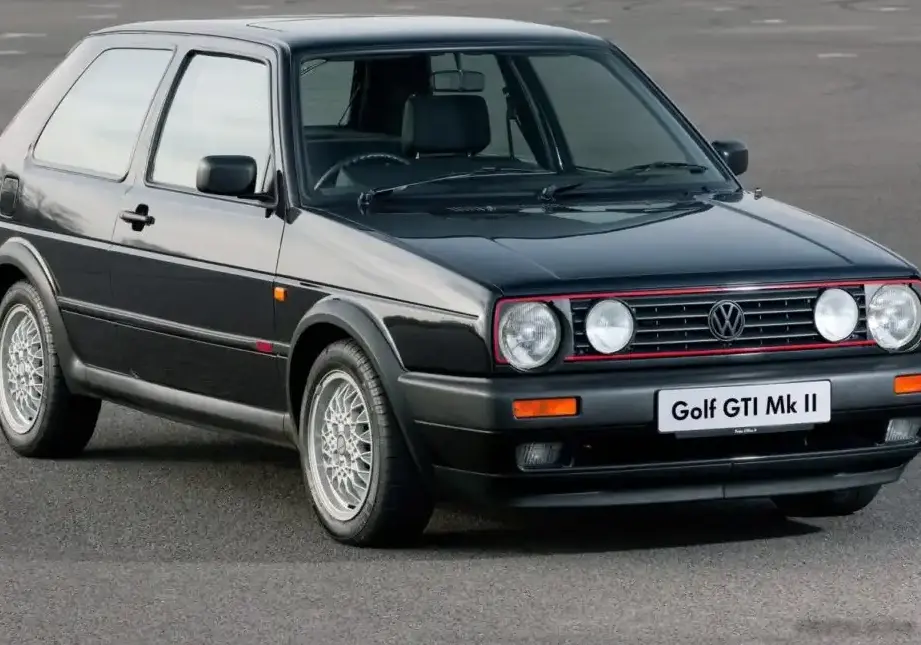
The Volkswagen Golf II 1.6 D, produced from 1987 to 1991, represents a significant entry point into the second-generation Golf lineup. This 3-door hatchback, popular in Europe, offered fuel-efficient diesel power in a compact and versatile package. Positioned as the base diesel model, it catered to buyers prioritizing economy and reliability over outright performance. The “facelift” designation refers to the cosmetic and minor mechanical updates applied to the Golf II range in 1987, including revised grilles, bumpers, and interior trim. This variant played a crucial role in solidifying the Golf’s reputation as a dependable and affordable family car in a competitive market.
Powertrain & Engine Architecture
The heart of the Golf II 1.6 D is the JP engine, a 1.6-liter inline four-cylinder diesel. This engine utilized a precombustion chamber injection system, a common technology for diesel engines of the era. This system involved injecting fuel into a small precombustion chamber within the cylinder head, where it was partially ignited before entering the main combustion chamber. This improved cold-starting performance and reduced engine noise compared to direct injection systems. The engine featured a single overhead camshaft (SOHC) valvetrain operating two valves per cylinder. The 4-speed manual transmission was a standard offering, chosen for its simplicity and cost-effectiveness. The transmission’s gear ratios were geared towards fuel efficiency rather than rapid acceleration, reflecting the car’s intended purpose.
Driving Characteristics
The 1.6 D with the 4-speed manual transmission delivered modest performance. With only 54 horsepower, acceleration was leisurely, taking approximately 18.7 seconds to reach 62 mph. The engine’s torque peak of 100 Nm (73.76 lb-ft) arrived at a relatively low 2300-2900 rpm, providing adequate pulling power for everyday driving. However, the limited horsepower meant that overtaking maneuvers required careful planning. Compared to the more powerful Golf II variants, such as the GTI or even the 1.8-liter gasoline models, the 1.6 D felt significantly slower. The 4-speed gearbox, while reliable, lacked the versatility of a 5-speed, requiring more frequent gear changes, especially on inclines. The focus was clearly on maximizing fuel economy, and in that regard, the 1.6 D excelled.
Equipment & Trim Levels
The Golf II 1.6 D was typically equipped with basic but functional features. Standard equipment included cloth upholstery, a simple dashboard layout, and manual windows and door locks. Power steering and central locking were generally optional extras. The interior trim was typically dark colored and durable, designed to withstand the rigors of daily use. Optional extras could include a sunroof, upgraded stereo systems, and different wheel covers. The trim level was generally considered the entry-level offering, appealing to buyers seeking a no-frills, reliable vehicle.
Chassis & Braking
The Golf II 1.6 D utilized an independent McPherson strut suspension at the front, providing a reasonable level of ride comfort and handling. The rear suspension employed a torsion beam setup, which was cost-effective and space-efficient. The braking system featured disc brakes on the front wheels and drum brakes on the rear. This configuration was typical for vehicles in this class at the time. The steering was a rack and pinion system, offering precise control. The tires were typically 155/65 R13, prioritizing fuel efficiency and ride comfort over ultimate grip.
Market Reception & Comparison
The Golf II 1.6 D was well-received in the European market as an affordable and economical option. Critics praised its fuel efficiency and reliability, but noted its lack of performance. Compared to the gasoline-powered Golf II models, the 1.6 D offered significantly better fuel economy but considerably slower acceleration. Against competitors like the Ford Escort Diesel or the Opel Kadett Diesel, the Golf II 1.6 D held its own in terms of fuel efficiency and build quality. Its reputation for reliability made it a popular choice for fleet operators and private buyers alike.
Legacy
The Volkswagen Golf II 1.6 D powertrain, while not known for its performance, proved to be remarkably durable. Many examples remain on the road today, a testament to its robust construction and simple design. The JP engine is generally considered reliable, although regular maintenance is essential to prevent issues such as injector clogging and wear on the precombustion chambers. In the used car market, these Golfs are often sought after by enthusiasts looking for a classic, affordable, and easy-to-maintain vehicle. They represent a piece of automotive history, embodying the practicality and dependability that made the Golf II such a success.