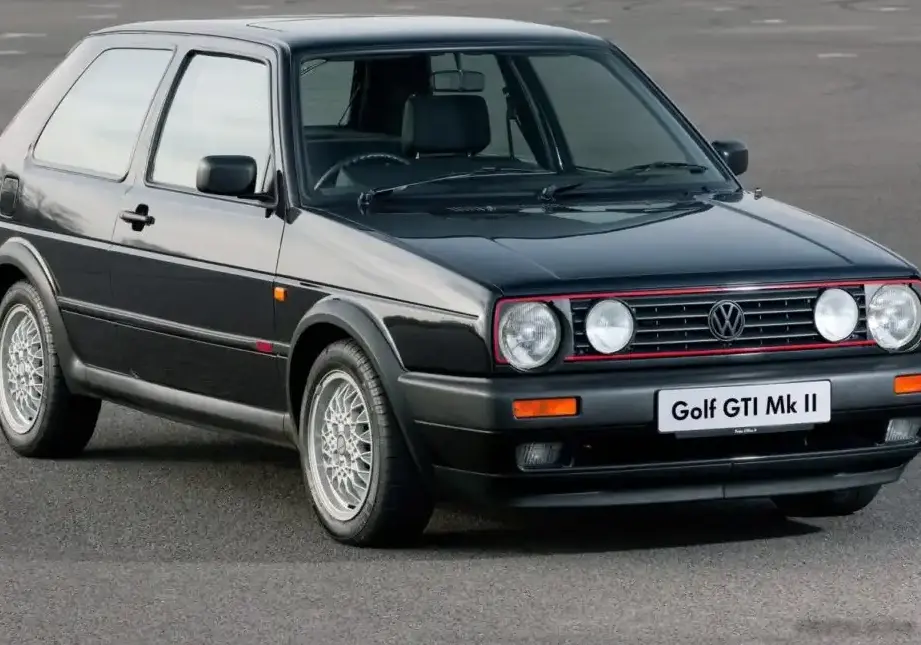
The Volkswagen Golf II 1.8 (90 hp) Automatic, produced from 1987 to 1991, represents a significant iteration within the highly successful second-generation Golf lineup (the 19E series). This particular variant, often found in the 3-door hatchback body style following the 1987 facelift, was positioned as an entry-to-mid-range offering, prioritizing comfort and ease of use over outright performance. It served as a practical and affordable option for buyers seeking a well-rounded family car in the European market, and later gained some traction in other regions through grey imports. The Golf II platform (1HX0/A3) was a watershed moment for Volkswagen, solidifying its reputation for build quality and engineering excellence.
Technical Specifications
| Brand | Volkswagen |
| Model | Golf |
| Generation | Golf II (3-door, facelift 1987) |
| Type (Engine) | 1.8 (90 Hp) Automatic |
| Start of production | 1987 |
| End of production | 1991 |
| Powertrain Architecture | Internal Combustion engine |
| Body type | Hatchback |
| Seats | 5 |
| Doors | 3 |
| Fuel consumption (urban) | 11.5 l/100 km (20.5 US mpg) |
| Fuel consumption (extra urban) | 7.4 l/100 km (31.8 US mpg) |
| Fuel Type | Petrol (Gasoline) |
| Acceleration 0 – 100 km/h | 13.7 sec |
| Acceleration 0 – 62 mph | 13.7 sec |
| Acceleration 0 – 60 mph | 13 sec |
| Maximum speed | 170 km/h (105.63 mph) |
| Weight-to-power ratio | 10.4 kg/Hp |
| Weight-to-torque ratio | 6.6 kg/Nm |
| Power | 90 Hp @ 5250 rpm |
| Torque | 142 Nm @ 3000 rpm (104.73 lb.-ft. @ 3000 rpm) |
| Engine layout | Front, Transverse |
| Engine Model/Code | RP |
| Engine displacement | 1781 cm3 (108.68 cu. in.) |
| Number of cylinders | 4 |
| Engine configuration | Inline |
| Cylinder Bore | 81 mm (3.19 in.) |
| Piston Stroke | 86.4 mm (3.4 in.) |
| Compression ratio | 9:1 |
| Number of valves per cylinder | 2 |
| Fuel injection system | Single-point injection |
| Engine aspiration | Naturally aspirated engine |
| Valvetrain | SOHC |
| Engine oil capacity | 4 l (4.23 US qt | 3.52 UK qt) |
| Coolant capacity | 6.3 l (6.66 US qt | 5.54 UK qt) |
| Kerb Weight | 935 kg (2061.32 lbs.) |
| Max. weight | 1440 kg (3174.66 lbs.) |
| Max load | 505 kg (1113.33 lbs.) |
| Trunk (boot) space – minimum | 330 l (11.65 cu. ft.) |
| Trunk (boot) space – maximum | 1145 l (40.44 cu. ft.) |
| Fuel tank capacity | 55 l (14.53 US gal | 12.1 UK gal) |
| Permitted trailer load with brakes (12%) | 1200 kg (2645.55 lbs.) |
| Permitted trailer load without brakes | 470 kg (1036.17 lbs.) |
| Length | 3985-4040 mm (156.89 – 159.06 in.) |
| Width | 1665 mm (65.55 in.) |
| Height | 1415 mm (55.71 in.) |
| Wheelbase | 2475 mm (97.44 in.) |
| Front track | 1427 mm (56.18 in.) |
| Rear (Back) track | 1422 mm (55.98 in.) |
| Drag coefficient (Cd) | 0.34 |
| Minimum turning circle | 10.5 m (34.45 ft.) |
| Drivetrain Architecture | Front wheel drive |
| Number of gears and type of gearbox | 3 gears, automatic transmission |
| Front suspension | Independent type McPherson, Transverse stabilizer |
| Rear suspension | Elastic beam |
| Front brakes | Disc |
| Rear brakes | Drum |
| Steering type | Steering rack and pinion |
| Tires size | 175/70 R13 |
| Wheel rims size | 5.5J x 13 |
Powertrain & Engine Architecture
The heart of this Golf variant is the Volkswagen RP engine, an inline four-cylinder, 1.8-liter (1781cc) gasoline engine. This engine utilized a single-point fuel injection system (Bosch Mono-Jetronic), a relatively simple and cost-effective system for the time. The engine featured a single overhead camshaft (SOHC) valvetrain with two valves per cylinder. The RP engine was known for its durability, but its power output was modest, reflecting its positioning in the Golf lineup. The automatic transmission was a three-speed unit, designed for smooth operation and ease of driving rather than sporty performance. This transmission was a common choice for drivers prioritizing comfort and convenience.
Driving Characteristics
The 1.8L Automatic Golf II offered a comfortable, if not particularly exhilarating, driving experience. Acceleration from 0-60 mph took around 13 seconds, and top speed was approximately 105 mph. The three-speed automatic transmission, while smooth, resulted in noticeable gear changes and a lack of the responsiveness found in manual transmission models. Compared to the more powerful 1.8L 16V or the diesel variants, this version felt noticeably slower. However, the automatic transmission made it ideal for city driving and commuting, reducing driver fatigue. The gear ratios were optimized for fuel efficiency and everyday usability, rather than outright performance.
Equipment & Trim Levels
The 1.8 Automatic Golf II typically came equipped with basic features such as cloth upholstery, a simple dashboard layout, and manual windows and locks. Power steering was often an optional extra, as was air conditioning. Higher trim levels might include upgraded interior materials, a sunroof, and alloy wheels. The standard radio was a basic AM/FM unit, with cassette players being a popular upgrade. Safety features were relatively basic for the era, consisting primarily of seatbelts and a steering column-mounted hazard warning switch.
Chassis & Braking
The Golf II utilized a McPherson strut front suspension and a torsion beam rear suspension. This setup provided a good balance of ride comfort and handling. The front brakes were disc brakes, while the rear brakes were drum brakes – a common configuration for this class of vehicle and weight. Stabilizer bars were typically fitted to the front suspension to reduce body roll. The steering was a rack and pinion system, providing reasonably precise steering feel.
Market Reception & Comparison
The 1.8 Automatic Golf II was generally well-received as a practical and affordable family car. Critics noted its comfortable ride and ease of use, but also pointed out its lack of performance compared to other Golf variants. Fuel economy was reasonable for the time, but not exceptional. Compared to the 1.6L base model, the 1.8 offered a noticeable power increase, while remaining more affordable than the sportier 1.8 16V or the more economical diesel options. Reliability was generally good, although the automatic transmission could require more maintenance than the manual gearbox.
Legacy
The Volkswagen Golf II 1.8 Automatic remains a popular choice among classic car enthusiasts and collectors. The RP engine is known for its durability, and parts availability is generally good. While not a performance icon, this variant represents a significant piece of automotive history, embodying the practicality and engineering excellence that made the Golf II such a success. Today, well-maintained examples command reasonable prices in the used car market, appealing to those seeking a classic hatchback with a comfortable and reliable driving experience.