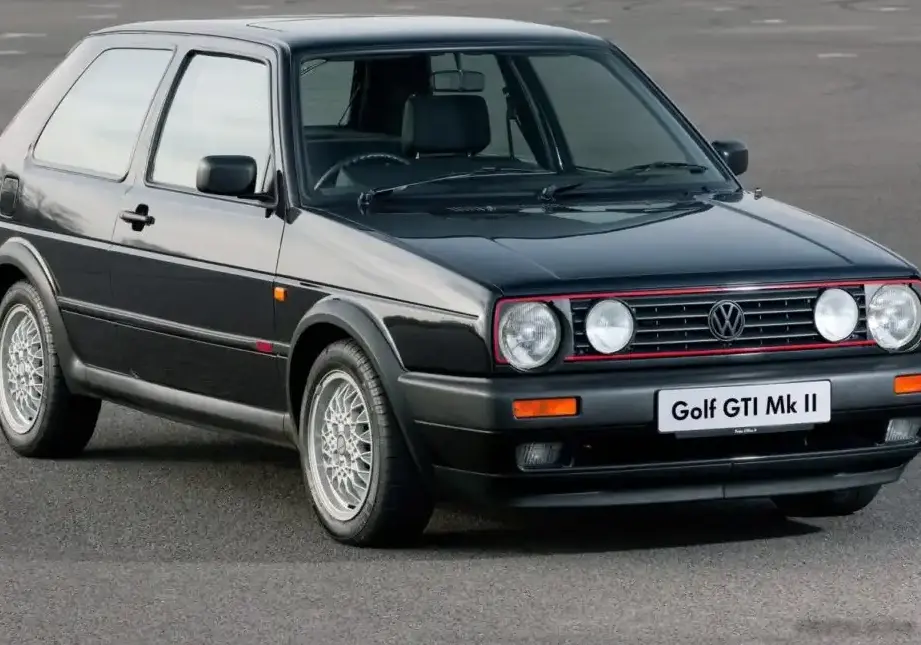
The Volkswagen Golf II 1.8 GT (90 hp) represented a popular and accessible entry point into the second-generation Golf lineup, produced from 1987 to 1991. This 3-door hatchback, part of the facelifted Golf II series (internally designated 1HX0/A3), offered a balance of practicality, affordability, and reasonable performance. Positioned as a mid-range offering, it sat below the more potent GTI and VR6 models, but above the base-level trims. The 1.8 GT aimed to provide a comfortable and economical driving experience for everyday use, appealing to a broad customer base in Europe and other markets where the Golf II was sold.
Technical Specifications
| Brand | Volkswagen |
| Model | Golf |
| Generation | Golf II (3-door, facelift 1987) |
| Type (Engine) | 1.8 GT (90 Hp) |
| Start of production | 1987 |
| End of production | 1991 |
| Powertrain Architecture | Internal Combustion engine |
| Body type | Hatchback |
| Seats | 5 |
| Doors | 3 |
| Fuel consumption (urban) | 10.8 l/100 km (21.8 US mpg, 26.2 UK mpg, 9.3 km/l) |
| Fuel consumption (extra urban) | 6.7 l/100 km (35.1 US mpg, 42.2 UK mpg, 14.9 km/l) |
| Fuel Type | Petrol (Gasoline) |
| Acceleration 0 – 100 km/h | 11.7 sec |
| Acceleration 0 – 62 mph | 11.7 sec |
| Acceleration 0 – 60 mph | 11.1 sec |
| Maximum speed | 175 km/h (108.74 mph) |
| Weight-to-power ratio | 10.4 kg/Hp, 96.3 Hp/tonne |
| Weight-to-torque ratio | 6.6 kg/Nm, 151.9 Nm/tonne |
| Power | 90 Hp @ 5250 rpm |
| Power per litre | 50.5 Hp/l |
| Torque | 142 Nm @ 3000 rpm (104.73 lb.-ft. @ 3000 rpm) |
| Engine layout | Front, Transverse |
| Engine Model/Code | RP |
| Engine displacement | 1781 cm3 (108.68 cu. in.) |
| Number of cylinders | 4 |
| Engine configuration | Inline |
| Cylinder Bore | 81 mm (3.19 in.) |
| Piston Stroke | 86.4 mm (3.4 in.) |
| Compression ratio | 9:1 |
| Number of valves per cylinder | 2 |
| Fuel injection system | Single-point injection |
| Engine aspiration | Naturally aspirated engine |
| Valvetrain | SOHC |
| Engine oil capacity | 4 l (4.23 US qt | 3.52 UK qt) |
| Coolant | 6.3 l (6.66 US qt | 5.54 UK qt) |
| Kerb Weight | 935 kg (2061.32 lbs.) |
| Max. weight | 1440 kg (3174.66 lbs.) |
| Max load | 505 kg (1113.33 lbs.) |
| Trunk (boot) space – minimum | 330 l (11.65 cu. ft.) |
| Trunk (boot) space – maximum | 1145 l (40.44 cu. ft.) |
| Fuel tank capacity | 55 l (14.53 US gal | 12.1 UK gal) |
| Permitted trailer load with brakes (12%) | 1200 kg (2645.55 lbs.) |
| Permitted trailer load without brakes | 470 kg (1036.17 lbs.) |
| Length | 3985 mm (156.89 in.) |
| Width | 1680 mm (66.14 in.) |
| Height | 1405 mm (55.31 in.) |
| Wheelbase | 2475 mm (97.44 in.) |
| Front track | 1427 mm (56.18 in.) |
| Rear (Back) track | 1422 mm (55.98 in.) |
| Drag coefficient (Cd) | 0.34 |
| Minimum turning circle (turning diameter) | 10.5 m (34.45 ft.) |
| Drivetrain Architecture | The Internal combustion engine (ICE) drives the front wheels of the vehicle. |
| Drive wheel | Front wheel drive |
| Number of gears and type of gearbox | 5 gears, manual transmission |
| Front suspension | Independent type McPherson, Transverse stabilizer |
| Rear suspension | Transverse stabilizer, Elastic beam |
| Front brakes | Ventilated discs |
| Rear brakes | Disc |
| Steering type | Steering rack and pinion |
| Tires size | 185/60 R14 |
| Wheel rims size | 6J x 14 |
Powertrain & Engine Architecture
The heart of the Golf II 1.8 GT was the RP engine, a 1781cc inline-four cylinder gasoline engine. This engine utilized a single-point fuel injection system (Bosch Mono-Jetronic), which was a relatively simple and cost-effective system for the time. The engine featured a single overhead camshaft (SOHC) valvetrain with two valves per cylinder. The 9:1 compression ratio was typical for the era, balancing performance and fuel efficiency. The RP engine was known for its relative simplicity and durability, though it lacked the sophistication of later multi-point injection systems. The engine’s 90 horsepower output at 5250 rpm and 142 Nm (104.73 lb-ft) of torque at 3000 rpm provided adequate, if not exhilarating, performance. The engine was transversely mounted, a layout common in front-wheel-drive vehicles, contributing to efficient packaging.
Driving Characteristics
The 1.8 GT, with its 90 hp and manual transmission, offered a reasonably sprightly driving experience. Acceleration from 0 to 60 mph took around 11.1 seconds, and it could reach a top speed of 175 km/h (108.74 mph). Compared to the more powerful GTI models, the 1.8 GT felt noticeably less responsive, particularly during overtaking maneuvers. However, it provided a more relaxed and fuel-efficient driving experience. The five-speed manual transmission was well-matched to the engine’s characteristics, offering a good balance between usability and efficiency. The gear ratios were geared towards economy, making it a comfortable cruiser on the highway. The 1.8 GT’s handling was typical of the Golf II – predictable and safe, but not particularly sporty.
Equipment & Trim Levels
The 1.8 GT trim level offered a step up in equipment compared to the base Golf models. Standard features typically included cloth upholstery, a basic stereo system, and power steering. The interior was functional and well-built, reflecting Volkswagen’s reputation for quality. Optional extras included a sunroof, upgraded stereo systems, and alloy wheels. The dashboard layout was typical of the Golf II, with clearly labeled controls and a straightforward design. The 3-door configuration prioritized practicality and a slightly sportier aesthetic compared to the 5-door models.
Chassis & Braking
The Golf II 1.8 GT utilized an independent McPherson strut suspension at the front, providing a comfortable ride and decent handling. The rear suspension employed a torsion beam setup, which was a cost-effective solution that offered a good compromise between ride comfort and handling. Braking duties were handled by ventilated discs at the front and discs at the rear, providing adequate stopping power for the vehicle’s weight and performance. The steering was a rack-and-pinion system, offering precise and responsive steering feel.
Market Reception & Comparison
The Golf II 1.8 GT was generally well-received by automotive critics as a practical and affordable hatchback. It was praised for its build quality, comfortable ride, and fuel efficiency. However, it was often criticized for its relatively modest performance compared to the GTI and VR6 models. Compared to other cars in its class, such as the Ford Escort and Opel Astra, the Golf II 1.8 GT offered a more refined driving experience and a higher level of build quality. Fuel economy was competitive, making it an attractive option for budget-conscious buyers.
Legacy
The Volkswagen Golf II 1.8 GT, while not the most powerful or exciting variant of the second-generation Golf, remains a popular choice among classic car enthusiasts. The RP engine is known for its reliability and relative simplicity, making it relatively easy to maintain. Parts availability is generally good, although some components may be becoming increasingly difficult to find. Today, well-maintained examples of the Golf II 1.8 GT are sought after by collectors and enthusiasts who appreciate its classic styling, practicality, and enduring appeal. It represents a significant chapter in Volkswagen’s history and a testament to the enduring popularity of the Golf model.