Technical Specifications
| Brand | Volkswagen |
| Model | Golf |
| Generation | Golf II (5-door, facelift 1987) |
| Type (Engine) | 1.6 D (54 Hp) Manual 4-speed |
| Start of production | 1987 |
| End of production | 1991 |
| Powertrain Architecture | Internal Combustion engine |
| Body type | Hatchback |
| Seats | 5 |
| Doors | 5 |
| Fuel consumption (urban) | 6.5 l/100 km (36.2 US mpg, 43.5 UK mpg, 15.4 km/l) |
| Fuel consumption (extra urban) | 4.8 l/100 km (49 US mpg, 58.9 UK mpg, 20.8 km/l) |
| Fuel Type | Diesel |
| Acceleration 0 – 100 km/h | 18.7 sec |
| Acceleration 0 – 62 mph | 18.7 sec |
| Acceleration 0 – 60 mph | 17.8 sec |
| Maximum speed | 148 km/h (91.96 mph) |
| Weight-to-power ratio | 17.8 kg/Hp, 56.3 Hp/tonne |
| Weight-to-torque ratio | 9.6 kg/Nm, 104.2 Nm/tonne |
| Power | 54 Hp @ 4800 rpm |
| Power per litre | 34 Hp/l |
| Torque | 100 Nm @ 2300-2900 rpm (73.76 lb.-ft. @ 2300-2900 rpm) |
| Engine layout | Front, Transverse |
| Engine Model/Code | JP |
| Engine displacement | 1588 cm3 (96.91 cu. in.) |
| Number of cylinders | 4 |
| Engine configuration | Inline |
| Cylinder Bore | 76.5 mm (3.01 in.) |
| Piston Stroke | 86.4 mm (3.4 in.) |
| Compression ratio | 23:1 |
| Number of valves per cylinder | 2 |
| Fuel injection system | Precombustion chamber injection |
| Engine aspiration | Naturally aspirated engine |
| Valvetrain | SOHC |
| Engine oil capacity | 4.5 l (4.76 US qt | 3.96 UK qt) |
| Coolant | 6.3 l (6.66 US qt | 5.54 UK qt) |
| Kerb Weight | 960 kg (2116.44 lbs.) |
| Max. weight | 1465 kg (3229.77 lbs.) |
| Max load | 505 kg (1113.33 lbs.) |
| Trunk (boot) space – minimum | 330 l (11.65 cu. ft.) |
| Trunk (boot) space – maximum | 1145 l (40.44 cu. ft.) |
| Fuel tank capacity | 55 l (14.53 US gal | 12.1 UK gal) |
| Permitted trailer load with brakes (12%) | 800 kg (1763.7 lbs.) |
| Permitted trailer load without brakes | 480 kg (1058.22 lbs.) |
| Length | 3985-4040 mm (156.89 – 159.06 in.) |
| Width | 1665 mm (65.55 in.) |
| Height | 1415 mm (55.71 in.) |
| Wheelbase | 2475 mm (97.44 in.) |
| Front track | 1427 mm (56.18 in.) |
| Rear (Back) track | 1422 mm (55.98 in.) |
| Drag coefficient (Cd) | 0.34 |
| Minimum turning circle (turning diameter) | 10.5 m (34.45 ft.) |
| Drivetrain Architecture | The Internal combustion engine (ICE) drives the front wheels of the vehicle. |
| Drive wheel | Front wheel drive |
| Number of gears and type of gearbox | 4 gears, manual transmission |
| Front suspension | Independent type McPherson |
| Rear suspension | Elastic beam |
| Front brakes | Disc |
| Rear brakes | Drum |
| Steering type | Steering rack and pinion |
| Tires size | 155/65 R13 |
| Wheel rims size | 5J x 13 |
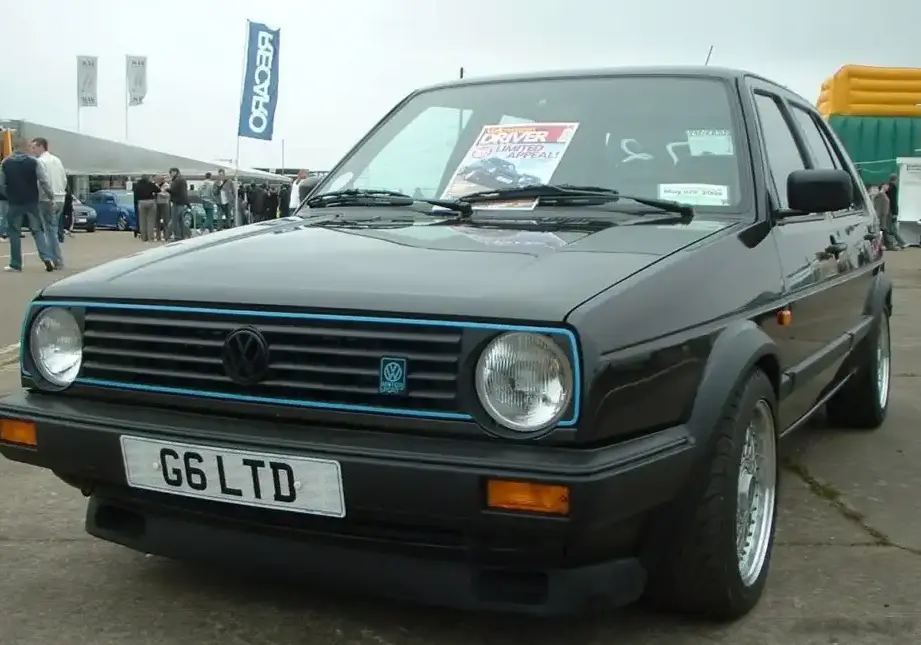
The Volkswagen Golf II 1.6 D, produced from 1987 to 1991, represents a significant iteration of Volkswagen’s hugely successful Golf lineage. This particular variant, frequently seen in the five-door body style after the 1987 facelift, was targeted towards the budget-conscious European driver prioritizing fuel efficiency and practicality. It occupied the entry-level position within the Golf II range, positioned below the more powerful gasoline engine options and the later, more refined diesel variants. The 1.6 D was a common sight, offering dependable, if unhurried, transportation.
Powertrain & Engine Architecture
The heart of the Golf II 1.6 D is the JP engine, a 1.6-liter inline four-cylinder diesel. This engine employed a precombustion chamber injection system, a prevalent design for diesel engines of the time. This system involved injecting fuel into a small precombustion chamber within the cylinder head, where it was partially ignited before entering the main combustion chamber. This aided in cold starting and reduced engine noise. The engine featured a single overhead camshaft (SOHC) valvetrain operating two valves per cylinder. The 54 horsepower output was modest, but the engine was known for its durability and relatively simple mechanical design. A four-speed manual transmission was standard, chosen for its cost-effectiveness and suitability for the engine’s torque characteristics.
Driving Characteristics
The 1.6 D with a manual transmission offered a utilitarian driving experience. Acceleration was slow, with 0-60 mph taking approximately 17.8 seconds. The engine’s torque peak between 2300-2900 rpm meant it was reasonably flexible in everyday driving, but required frequent gear changes to maintain momentum, especially when loaded or on inclines. Compared to the gasoline-powered Golf II variants, the 1.6 D lacked outright performance, but it excelled in fuel economy. The four-speed gearbox was well-matched to the engine, providing usable ratios for both city and highway driving. It wasn’t a sporty car, but it was predictable and easy to drive.
Equipment & Trim Levels
The 1.6 D typically represented the base trim level of the Golf II range. Standard equipment included cloth upholstery, basic instrumentation, and manual windows and door locks. Optional extras, such as a sunroof, upgraded stereo, and central locking, were available, but were often sparingly specified by buyers focused on affordability. The interior was functional and durable, prioritizing practicality over luxury. The five-door body style was particularly popular, offering enhanced passenger access and cargo space.
Chassis & Braking
The Golf II 1.6 D utilized a McPherson strut front suspension and an elastic beam rear suspension. This setup provided a comfortable ride, although it wasn’t particularly sporty. The front brakes were discs, while the rear brakes were drums – a cost-saving measure common on base models. The steering was a rack and pinion system, offering reasonable precision. The car’s relatively light weight (around 960 kg or 2116 lbs) helped to mitigate the effects of the modest engine power.
Market Reception & Comparison
The Golf II 1.6 D was well-received in Europe as an affordable and economical family car. Critics praised its fuel efficiency and reliability, but noted its lack of performance. Compared to the more powerful Golf II variants, such as the GTI or the 1.8-liter gasoline models, the 1.6 D was significantly slower. However, it offered a lower purchase price and substantially better fuel economy. Against competitors like the Ford Escort Diesel or the Opel Kadett Diesel, the Golf II 1.6 D held its own in terms of build quality and overall refinement.
Legacy
The Volkswagen Golf II 1.6 D has proven to be a remarkably durable vehicle. Many examples are still on the road today, a testament to the robustness of the engine and the overall build quality of the Golf II. In the used car market, these models are often sought after by enthusiasts looking for a simple, reliable, and affordable classic car. While not a performance icon, the 1.6 D represents a significant chapter in the Golf’s history, embodying Volkswagen’s commitment to providing practical and economical transportation to a wide range of drivers. Its simplicity makes it relatively easy to maintain, and parts availability, while diminishing, remains reasonable. The 1.6 D stands as a reminder of a time when fuel efficiency and durability were prioritized over outright speed and luxury.