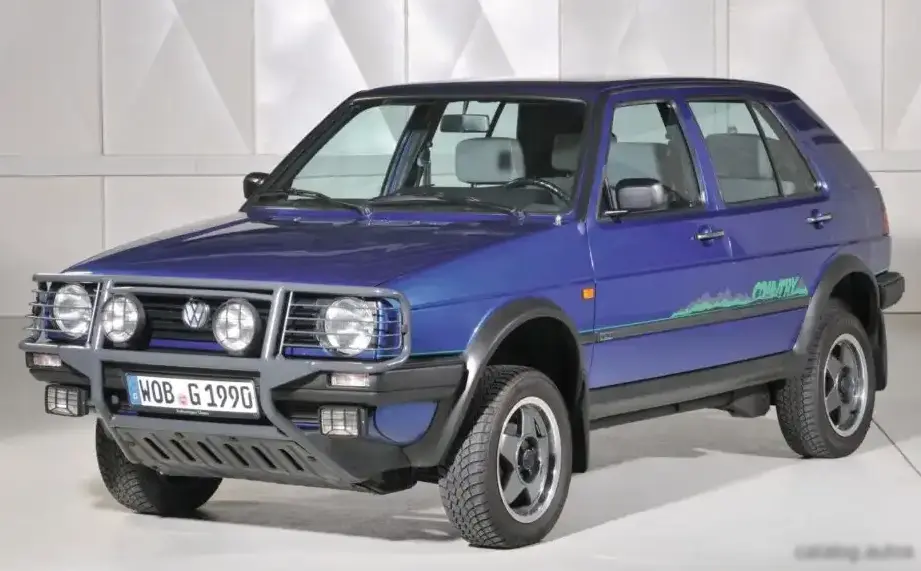
The Volkswagen Golf II Country 1.8 (98 hp) Syncro, produced from 1990 to 1991, represents a unique and relatively rare variant within the highly successful Golf II generation (1983-1991). Positioned as a quasi-crossover before the segment truly existed, the Country aimed to offer all-wheel drive capability and a more rugged aesthetic to Golf buyers. It was built on the A2 platform, sharing its core mechanicals with other Golf II models but distinguished by its increased ride height, plastic body cladding, and standard Syncro all-wheel drive system. This model filled a niche for those seeking a practical, economical, and capable vehicle for varied road conditions, particularly in regions with inclement weather or unpaved roads.
Technical Specifications
| Brand | Volkswagen |
| Model | Golf |
| Generation | Golf II Country |
| Type (Engine) | 1.8 (98 Hp) Syncro |
| Start of production | 1990 |
| End of production | 1991 |
| Powertrain Architecture | Internal Combustion engine |
| Body type | Hatchback, Crossover |
| Seats | 4 |
| Doors | 5 |
| Fuel consumption (urban) | 11.9 l/100 km (19.8 US mpg, 23.7 UK mpg, 8.4 km/l) |
| Fuel consumption (extra urban) | 8.5 l/100 km (27.7 US mpg, 33.2 UK mpg, 11.8 km/l) |
| Fuel Type | Petrol (Gasoline) |
| Acceleration 0 – 100 km/h | 12.3 sec |
| Acceleration 0 – 62 mph | 12.3 sec |
| Acceleration 0 – 60 mph | 11.7 sec |
| Maximum speed | 155 km/h (96.31 mph) |
| Weight-to-power ratio | 12.7 kg/Hp, 78.7 Hp/tonne |
| Weight-to-torque ratio | 8.7 kg/Nm, 114.9 Nm/tonne |
| Power | 98 Hp @ 5400 rpm |
| Power per litre | 55 Hp/l |
| Torque | 143 Nm @ 3000 rpm (105.47 lb.-ft. @ 3000 rpm) |
| Engine layout | Front, Transverse |
| Engine Model/Code | 1P |
| Engine displacement | 1781 cm3 (108.68 cu. in.) |
| Number of cylinders | 4 |
| Engine configuration | Inline |
| Cylinder Bore | 81 mm (3.19 in.) |
| Piston Stroke | 86.4 mm (3.4 in.) |
| Compression ratio | 10:1 |
| Number of valves per cylinder | 2 |
| Fuel injection system | Multi-port manifold injection |
| Engine aspiration | Naturally aspirated engine |
| Valvetrain | SOHC |
| Engine oil capacity | 4 l (4.23 US qt | 3.52 UK qt) |
| Coolant capacity | 6.3 l (6.66 US qt | 5.54 UK qt) |
| Kerb Weight | 1245 kg (2744.76 lbs.) |
| Max. weight | 1640 kg (3615.58 lbs.) |
| Max load | 395 kg (870.83 lbs.) |
| Trunk (boot) space – minimum | 230 l (8.12 cu. ft.) |
| Trunk (boot) space – maximum | 1030 l (36.37 cu. ft.) |
| Fuel tank capacity | 55 l (14.53 US gal | 12.1 UK gal) |
| Max. roof load | 75 kg (165.35 lbs.) |
| Permitted trailer load with brakes (12%) | 1500 kg (3306.93 lbs.) |
| Permitted trailer load without brakes | 560 kg (1234.59 lbs.) |
| Permitted towbar download | 50 kg (110.23 lbs.) |
| Length | 4255 mm (167.52 in.) |
| Width | 1705 mm (67.13 in.) |
| Height | 1555 mm (61.22 in.) |
| Wheelbase | 2480 mm (97.64 in.) |
| Front track | 1435 mm (56.5 in.) |
| Rear track | 1443 mm (56.81 in.) |
| Front overhang | 860 mm (33.86 in.) |
| Rear overhang | 915 mm (36.02 in.) |
| Ride height (ground clearance) | 180 mm (7.09 in.) |
| Minimum turning circle | 10.5 m (34.45 ft.) |
| Approach angle | 29° |
| Departure angle | 36° |
| Ramp-over angle | 20° |
| Drivetrain Architecture | The Internal combustion engine (ICE) drives the front wheels permanently, and the rear wheels are driven through an electrically or mechanically operated clutch if necessary. |
| Drive wheel | All wheel drive (4×4) |
| Number of gears and type of gearbox | 5 gears, manual transmission |
| Front suspension | Independent type McPherson |
| Front brakes | Disc |
| Rear brakes | Disc |
| Steering type | Steering rack and pinion |
| Power steering | Hydraulic Steering |
| Tires size | 195/60 R15; 205/60 R15 |
| Wheel rims size | 6J x 15; 7J x 15 |
Powertrain & Engine Architecture
The Golf II Country 1.8 Syncro utilized Volkswagen’s 1.8-liter inline four-cylinder engine, designated as the 1P engine code. This engine was a common sight in various Golf II and Jetta models of the era. It featured a single overhead camshaft (SOHC) valvetrain operating two valves per cylinder. Fuel delivery was managed by a Bosch multi-port fuel injection system, providing a balance between efficiency and performance. The engine produced 98 horsepower at 5400 rpm and 143 Nm (105 lb-ft) of torque at 3000 rpm. The engine’s relatively modest output was paired with a five-speed manual transmission as standard. While an automatic transmission was available, it was less common and impacted performance further. The Syncro system itself was a viscous coupling-based all-wheel drive system, providing automatic engagement of the rear wheels when front wheel slip was detected. This system wasn’t a full-time all-wheel drive, but rather a reactive system designed to enhance traction in challenging conditions.
Driving Characteristics
The 1.8-liter engine in the Country, particularly when paired with the five-speed manual, offered adequate, though not exhilarating, performance. Acceleration from 0-60 mph took around 11.7 seconds, and top speed was approximately 155 km/h (96 mph). The added weight of the Syncro system and the increased ride height did detract from the Golf’s typically nimble handling. However, the all-wheel drive system provided significantly improved traction on loose surfaces like gravel, snow, or mud. The gear ratios were geared towards fuel economy and everyday usability rather than outright performance. Compared to the more powerful Golf II GTI models, the Country 1.8 felt noticeably slower, but it offered a different kind of driving experience – one focused on stability and capability in adverse conditions. The automatic transmission option further dulled performance, increasing 0-60 times to around 13 seconds.
Equipment & Trim Levels
The Golf II Country was generally well-equipped for its time, though not as lavishly as some of the higher-end Golf II variants. Standard features included power steering, central locking, and a basic stereo system. The interior typically featured cloth upholstery, and the dashboard layout was consistent with other Golf II models. The Country trim distinguished itself with unique exterior plastic cladding, roof rails, and often, a more robust suspension setup. Optional extras included a sunroof, upgraded stereo systems, and alloy wheels. The interior trim was functional and durable, reflecting the vehicle’s intended use as a practical and capable all-weather vehicle.
Chassis & Braking
The Golf II Country featured a McPherson strut front suspension and a twist-beam rear suspension. The suspension was often slightly stiffer than standard Golf II models to cope with the added weight and the demands of off-road use. Braking was handled by disc brakes on all four wheels, providing adequate stopping power for the vehicle’s weight and performance. The increased ride height provided greater ground clearance, enhancing the Country’s ability to navigate rough terrain. The tires were typically all-season or all-terrain tires, further contributing to the vehicle’s all-weather capability.
Market Reception & Comparison
The Golf II Country was generally well-received by critics as a unique and practical vehicle. It was praised for its all-wheel drive capability, rugged styling, and overall versatility. However, some critics noted that the 1.8-liter engine was somewhat underpowered for the vehicle’s weight and intended use. Compared to other Golf II variants, the Country 1.8 offered a different proposition. It wasn’t as sporty as the GTI or as economical as the diesel models, but it provided a unique combination of practicality, capability, and all-weather performance. Fuel economy was reasonable for the time, averaging around 28 mpg on the highway and 20 mpg in the city.
Legacy
The Golf II Country, while not a high-volume seller, has gained a cult following among Volkswagen enthusiasts. The 1.8-liter engine, while not known for its exceptional durability, is generally reliable with proper maintenance. The Syncro all-wheel drive system is robust and capable, but can require occasional maintenance to ensure proper operation. Today, well-maintained examples of the Golf II Country are becoming increasingly collectible. The vehicle represents a unique chapter in Volkswagen’s history, showcasing the brand’s willingness to experiment with new concepts and cater to niche markets. Its blend of practicality, capability, and retro charm continues to appeal to enthusiasts seeking a distinctive and versatile classic car.