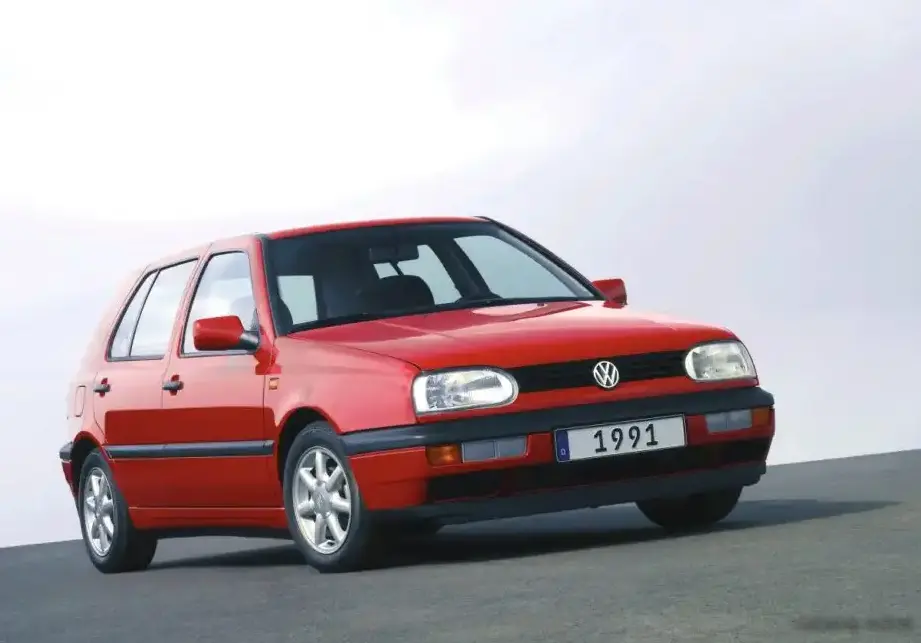
The Volkswagen Golf Mk3 1.4, producing 60 horsepower, was an entry-level variant of the Golf III, manufactured between 1991 and 1997. Positioned as the most affordable option in the Mk3 Golf lineup, it served as a practical and economical choice for first-time buyers and those prioritizing fuel efficiency. This model was a key part of Volkswagen’s strategy to offer a broad range of Golf configurations, catering to diverse customer needs within the A-segment hatchback market. It utilized the Volkswagen Group’s A2 platform, shared with models like the SEAT Ibiza Mk2 and the Škoda Felicia.
Technical Specifications
| Brand | Volkswagen |
| Model | Golf |
| Generation | Golf III |
| Type (Engine) | 1.4 (60 Hp) |
| Start of production | 1991 |
| End of production | 1997 |
| Powertrain Architecture | Internal Combustion engine |
| Body type | Hatchback |
| Seats | 5 |
| Doors | 3-5 |
| Fuel consumption (urban) | 8 l/100 km (29.4 US mpg) |
| Fuel consumption (extra urban) | 5 l/100 km (47 US mpg) |
| Fuel consumption (combined) | 6.5 l/100 km (36.2 US mpg) |
| Fuel Type | Petrol (Gasoline) |
| Acceleration 0 – 100 km/h | 15.9 sec |
| Acceleration 0 – 62 mph | 15.9 sec |
| Acceleration 0 – 60 mph | 15.1 sec |
| Maximum speed | 157 km/h (97.56 mph) |
| Weight-to-power ratio | 17.2 kg/Hp |
| Weight-to-torque ratio | 8.9 kg/Nm |
| Power | 60 Hp @ 5200 rpm |
| Power per litre | 43.1 Hp/l |
| Torque | 116 Nm @ 2800 rpm (85.56 lb.-ft. @ 2800 rpm) |
| Engine layout | Front, Transverse |
| Engine Model/Code | AEX, ABD |
| Engine displacement | 1391 cm3 (84.88 cu. in.) |
| Number of cylinders | 4 |
| Engine configuration | Inline |
| Cylinder Bore | 76.5 mm (3.01 in.) |
| Piston Stroke | 75.6 mm (2.98 in.) |
| Compression ratio | 10:1 |
| Number of valves per cylinder | 2 |
| Fuel injection system | Single-point injection |
| Engine aspiration | Naturally aspirated engine |
| Valvetrain | OHC |
| Engine oil capacity | 3.4 l (3.59 US qt | 2.99 UK qt) |
| Coolant | 5.6 l (5.92 US qt | 4.93 UK qt) |
| Kerb Weight | 1030 kg (2270.76 lbs.) |
| Max. weight | 1505 kg (3317.96 lbs.) |
| Max load | 475 kg (1047.2 lbs.) |
| Trunk (boot) space – minimum | 330 l (11.65 cu. ft.) |
| Trunk (boot) space – maximum | 687 l (24.26 cu. ft.) |
| Fuel tank capacity | 55 l (14.53 US gal | 12.1 UK gal) |
| Length | 4020 mm (158.27 in.) |
| Width | 1695 mm (66.73 in.) |
| Height | 1425 mm (56.1 in.) |
| Wheelbase | 2475 mm (97.44 in.) |
| Front track | 1478 mm (58.19 in.) |
| Rear (Back) track | 1448 mm (57.01 in.) |
| Drivetrain Architecture | The Internal combustion engine (ICE) drives the front wheels of the vehicle. |
| Drive wheel | Front wheel drive |
| Number of gears and type of gearbox | 5 gears, manual transmission |
| Front suspension | Wishbone |
| Rear suspension | Suspension with traction connecting levers |
| Front brakes | Disc |
| Rear brakes | Drum |
| Steering type | Steering rack and pinion |
| Power steering | Hydraulic Steering |
| Tires size | 175/65 R13 |
| Wheel rims size | 13 |
INTRODUCTION
The Volkswagen Golf Mk3 1.4 (60 hp) was introduced in 1991 as the base model of the third-generation Golf. It represented a significant step forward in terms of refinement and features compared to its Mk2 predecessor, while maintaining the Golf’s reputation for practicality and build quality. The 1.4-liter engine, designated with engine codes AEX and ABD, was specifically tuned for economy and accessibility, making the Mk3 Golf available to a wider range of buyers. This variant was typically offered with a five-speed manual transmission, though a four-speed automatic was also available, albeit less common.
Powertrain & Engine Architecture
The heart of the Golf Mk3 1.4 is a 1.4-liter, inline-four cylinder engine. The AEX and ABD engine codes represent minor variations within the same basic design. These engines utilize a single-point fuel injection system, a relatively simple and cost-effective technology for the time. The engine features an overhead camshaft (OHC) valvetrain with two valves per cylinder. This configuration prioritized simplicity and reliability over outright performance. The 1.4-liter engine produced 60 horsepower at 5200 rpm and 85.56 lb-ft of torque at 2800 rpm. The available four-speed automatic transmission was a conventional hydraulic unit, offering smooth but not particularly quick shifts. The automatic transmission was geared for fuel economy, resulting in a noticeable difference in acceleration compared to the manual version.
Driving Characteristics
The Golf Mk3 1.4 with the automatic transmission offered a comfortable, if uninspiring, driving experience. Acceleration was leisurely, taking approximately 15.1 seconds to reach 60 mph. The automatic gearbox, while providing convenience, emphasized fuel efficiency over performance. Gear ratios were relatively tall, prioritizing highway cruising over quick acceleration. The engine felt strained when attempting to accelerate briskly, particularly when fully loaded. Compared to the more powerful 1.8-liter and VR6 variants, the 1.4 automatic lacked the punch needed for confident overtaking maneuvers. However, for urban driving and commuting, the 1.4 provided adequate performance and excellent fuel economy.
Equipment & Trim Levels
The Golf Mk3 1.4 typically came with a basic level of equipment. Standard features included power steering, central locking, and a basic stereo system. Interior upholstery was typically cloth, with a simple dashboard layout. Optional extras included power windows, a sunroof, and upgraded stereo systems. The trim level was generally considered the entry point to the Mk3 Golf range, and as such, it lacked many of the luxury features found in higher-spec models. The focus was on providing a functional and affordable vehicle.
Chassis & Braking
The Golf Mk3 1.4 utilized a MacPherson strut front suspension and a torsion beam rear suspension. The braking system consisted of disc brakes on the front wheels and drum brakes on the rear. This configuration was typical for vehicles in this weight class and price range during the early 1990s. The suspension provided a comfortable ride, absorbing bumps and imperfections in the road surface effectively. The braking performance was adequate for normal driving conditions, but lacked the stopping power of higher-spec models equipped with rear disc brakes.
Market Reception & Comparison
The Golf Mk3 1.4 was generally well-received as an affordable and practical hatchback. Critics praised its build quality, comfortable ride, and fuel efficiency. However, the 1.4-liter engine was often criticized for its lack of power, particularly when paired with the automatic transmission. Compared to the 1.8-liter Golf, the 1.4 offered significantly less performance but boasted better fuel economy. The 1.9 TDI diesel variant provided even better fuel economy and more torque, but at a higher initial cost. The 1.4 automatic appealed to buyers prioritizing ease of use and low running costs over driving excitement.
Legacy
The Golf Mk3 1.4, while not the most sought-after variant, remains a relatively common sight on used car markets. The 1.4-liter engine and automatic transmission combination proved to be reasonably reliable, although regular maintenance is crucial. The single-point injection system can be prone to issues if not properly maintained. Today, these cars are often appreciated for their simplicity and affordability, making them attractive options for budget-conscious buyers or those seeking a classic Volkswagen experience. Parts availability is generally good, and the relatively simple mechanical design makes them relatively easy to repair.