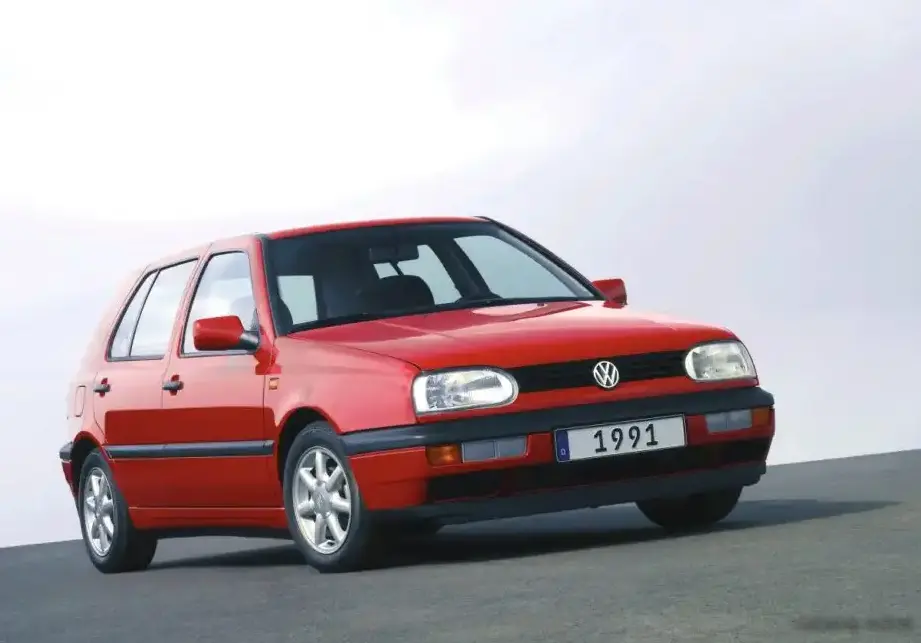
The Volkswagen Golf Mk3 1.6, produced between 1992 and 1997, represented a significant step forward for Volkswagen’s iconic hatchback. Positioned as the entry-level model in the Mk3 Golf range, it offered a balance of affordability, practicality, and Volkswagen’s renowned build quality. This variant, powered by the ABU, AEA, or AEE engine code, served as a popular choice for buyers seeking economical transportation within the 1HX0/A3 platform family. It was available in both 3-door and 5-door body styles, catering to a wide range of customer needs. The 1.6-liter engine, paired with a five-speed manual transmission, was designed to provide reliable and efficient motoring, though an automatic transmission option was also available.
Technical Specifications
| Brand | Volkswagen |
| Model | Golf |
| Generation | Golf III |
| Type (Engine) | 1.6 (75 Hp) |
| Start of production | 1992 |
| End of production | 1997 |
| Powertrain Architecture | Internal Combustion engine |
| Body type | Hatchback |
| Seats | 5 |
| Doors | 3-5 |
| Fuel consumption (combined) | 8.8 l/100 km |
| Fuel consumption (US mpg) | 26.7 US mpg |
| Fuel consumption (UK mpg) | 32.1 UK mpg |
| Fuel consumption (km/l) | 11.4 km/l |
| Fuel Type | Petrol (Gasoline) |
| Acceleration 0 – 100 km/h | 14 sec |
| Acceleration 0 – 62 mph | 14 sec |
| Acceleration 0 – 60 mph | 13.3 sec |
| Maximum speed | 168 km/h (104.39 mph) |
| Weight-to-power ratio | 14.5 kg/Hp |
| Weight-to-torque ratio | 8.1 kg/Nm |
| Power | 75 Hp @ 5200 rpm |
| Power per litre | 46.9 Hp/l |
| Torque | 135 Nm @ 2800 rpm (99.57 lb.-ft. @ 2800 rpm) |
| Engine layout | Front, Transverse |
| Engine Model/Code | ABU, AEA, AEE |
| Engine displacement | 1598 cm3 (97.52 cu. in.) |
| Number of cylinders | 4 |
| Engine configuration | Inline |
| Cylinder Bore | 76.5 mm (3.01 in.) |
| Piston Stroke | 86.9 mm (3.42 in.) |
| Compression ratio | 9.3:1 |
| Number of valves per cylinder | 2 |
| Fuel injection system | Multi-port manifold injection |
| Engine aspiration | Naturally aspirated engine |
| Valvetrain | OHC |
| Engine oil capacity | 3.4 l (3.59 US qt | 2.99 UK qt) |
| Coolant capacity | 5.6 l (5.92 US qt | 4.93 UK qt) |
| Kerb Weight | 1090 kg (2403.04 lbs.) |
| Max. weight | 1525 kg (3362.05 lbs.) |
| Max load | 435 kg (959.01 lbs.) |
| Trunk (boot) space – minimum | 330 l (11.65 cu. ft.) |
| Trunk (boot) space – maximum | 687 l (24.26 cu. ft.) |
| Fuel tank capacity | 55 l (14.53 US gal | 12.1 UK gal) |
| Length | 4020 mm (158.27 in.) |
| Width | 1695 mm (66.73 in.) |
| Height | 1425 mm (56.1 in.) |
| Wheelbase | 2475 mm (97.44 in.) |
| Front track | 1478 mm (58.19 in.) |
| Rear track | 1448 mm (57.01 in.) |
| Drivetrain Architecture | Front wheel drive |
| Number of gears | 5 |
| Type of gearbox | Manual transmission |
| Front suspension | Wishbone |
| Rear suspension | Suspension with traction connecting levers |
| Front brakes | Disc |
| Rear brakes | Drum |
| Assisting systems | ABS (Anti-lock braking system) |
| Steering type | Steering rack and pinion |
| Power steering | Hydraulic Steering |
| Tires size | 175/70 R13 |
| Wheel rims size | 13 |
Powertrain & Engine Architecture
The heart of the Golf Mk3 1.6 was the 1.6-liter inline-four cylinder engine, available in several iterations denoted by the engine codes ABU, AEA, and AEE. These engines were largely similar, featuring a cast iron block and an aluminum cylinder head. The ABU version, often considered the most refined, utilized Bosch Motronic engine management. The engine employed a single overhead camshaft (SOHC) valvetrain operating two valves per cylinder. Fuel delivery was handled by a multi-port fuel injection system, providing a balance between efficiency and performance. The five-speed manual transmission was the most common pairing, offering a relatively direct and engaging driving experience. A four-speed automatic transmission was also available, though it noticeably impacted acceleration and fuel economy. The engine’s relatively simple design contributed to its reliability and ease of maintenance.
Driving Characteristics
The 1.6-liter Golf Mk3 offered modest but adequate performance for everyday driving. With 75 horsepower and 99.57 lb-ft of torque, acceleration from 0 to 60 mph took around 13.3 seconds, and top speed was approximately 104 mph. Compared to the more powerful Golf variants, such as the VR6 or the 1.9 TDI, the 1.6 felt noticeably slower, particularly when fully loaded or tackling inclines. The five-speed manual transmission allowed drivers to keep the engine in its optimal power band, while the automatic transmission, though convenient, resulted in a more sluggish response. The gear ratios were geared towards fuel efficiency rather than outright performance. Handling was typical of front-wheel-drive hatchbacks of the era – safe and predictable, but not particularly sporty.
Equipment & Trim Levels
The Golf Mk3 1.6 typically came with a basic but functional equipment list. Standard features included power steering, central locking, and an adjustable steering column. Interior upholstery was typically cloth, with a simple dashboard layout. Optional extras included power windows, a sunroof, alloy wheels, and upgraded audio systems. Trim levels varied depending on the market, but generally, the 1.6 represented the entry point to the Mk3 Golf range. Higher trim levels added features like air conditioning, upgraded interior trim, and more sophisticated audio systems.
Chassis & Braking
The Golf Mk3 1.6 utilized a MacPherson strut front suspension and a torsion beam rear suspension. This setup provided a comfortable ride quality, suitable for everyday use. Braking duties were handled by disc brakes at the front and drum brakes at the rear. ABS (Anti-lock Braking System) was available as an option, enhancing safety in emergency braking situations. The suspension was tuned for comfort rather than sporty handling, and stabilizer bars were relatively thin compared to those found on higher-performance Golf models.
Market Reception & Comparison
The Golf Mk3 1.6 was generally well-received as an affordable and practical hatchback. Critics praised its build quality, comfortable ride, and fuel efficiency. However, its relatively low power output was often cited as a drawback, particularly when compared to more powerful Golf variants. The 1.9 TDI diesel offered significantly better fuel economy and more torque, while the VR6 provided a substantial performance boost. The 1.6 appealed to buyers prioritizing economy and reliability over outright performance. Maintenance costs were relatively low due to the engine’s simple design.
Legacy
The Golf Mk3 1.6 has proven to be a remarkably durable and reliable vehicle. Many examples are still on the road today, testament to Volkswagen’s engineering and build quality. The 1.6-liter engine is known for its longevity, and parts availability remains good. In the used car market, the Mk3 1.6 represents an affordable entry point into classic Volkswagen ownership. While not as sought-after as the VR6 or GTI models, it remains a popular choice for those seeking a practical and reliable hatchback with a touch of retro charm. Its simplicity makes it a relatively easy car to maintain and repair, appealing to DIY enthusiasts.