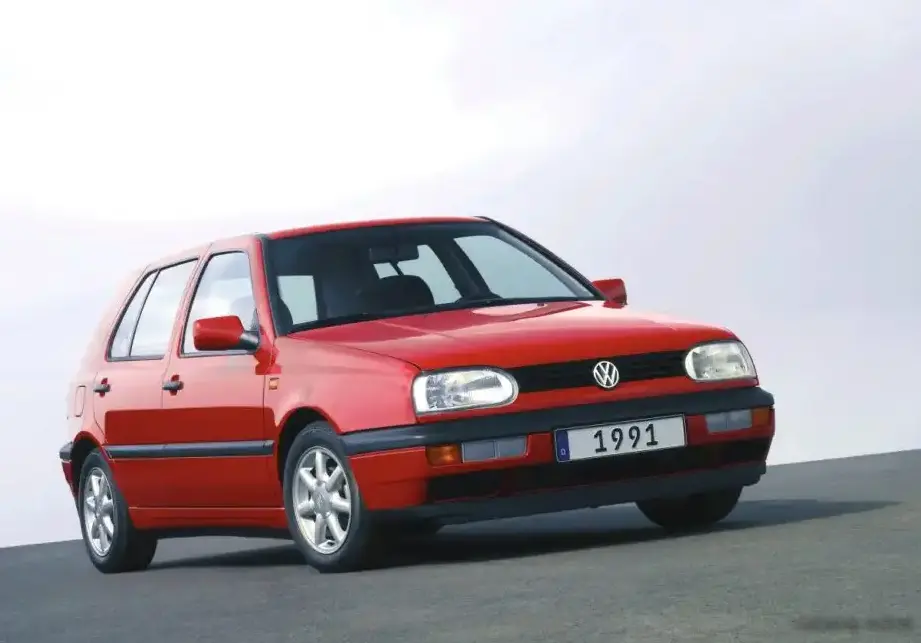
The Volkswagen Golf Mk3 1.8 (90 hp) was a mainstay of the Golf lineup from 1991 to 1997, representing an entry-level offering within the broader Mk3 generation (Typ 1H1). Built on the A3 platform, this variant aimed to provide affordable and practical transportation, appealing to a wide range of buyers. It was available in both 3-door and 5-door hatchback configurations, becoming a common sight on European roads and gaining some traction in other markets. This specific engine and transmission combination was positioned as the most economical option, prioritizing fuel efficiency over outright performance.
Technical Specifications
| Brand | Volkswagen |
| Model | Golf |
| Generation | Golf III |
| Type (Engine) | 1.8 (90 Hp) |
| Start of production | 1991 |
| End of production | 1997 |
| Powertrain Architecture | Internal Combustion engine |
| Body type | Hatchback |
| Seats | 5 |
| Doors | 3-5 |
| Fuel consumption (combined) | 7.6 l/100 km |
| Fuel consumption (US mpg) | 30.9 US mpg |
| Fuel consumption (UK mpg) | 37.2 UK mpg |
| Fuel consumption (km/l) | 13.2 km/l |
| Fuel Type | Petrol (Gasoline) |
| Acceleration 0 – 100 km/h | 12.1 sec |
| Acceleration 0 – 62 mph | 12.1 sec |
| Acceleration 0 – 60 mph | 11.5 sec |
| Maximum speed | 178 km/h (110.6 mph) |
| Weight-to-power ratio | 12.2 kg/Hp |
| Weight-to-torque ratio | 7.6 kg/Nm |
| Power | 90 Hp @ 5500 rpm |
| Power per litre | 50.5 Hp/l |
| Torque | 145 Nm @ 2500 rpm (106.95 lb.-ft. @ 2500 rpm) |
| Engine layout | Front, Transverse |
| Engine Model/Code | ABS, ACC, ADD, ADZ |
| Engine displacement | 1781 cm3 (108.68 cu. in.) |
| Number of cylinders | 4 |
| Engine configuration | Inline |
| Cylinder Bore | 81 mm (3.19 in.) |
| Piston Stroke | 86.4 mm (3.4 in.) |
| Compression ratio | 10:1 |
| Number of valves per cylinder | 2 |
| Fuel injection system | Single-point injection |
| Engine aspiration | Naturally aspirated engine |
| Valvetrain | OHC |
| Engine oil capacity | 3.8 l (4.02 US qt | 3.34 UK qt) |
| Coolant capacity | 5.5 l (5.81 US qt | 4.84 UK qt) |
| Kerb Weight | 1100 kg (2425.08 lbs.) |
| Max. weight | 1540 kg (3395.12 lbs.) |
| Max load | 440 kg (970.03 lbs.) |
| Trunk (boot) space – minimum | 330 l (11.65 cu. ft.) |
| Trunk (boot) space – maximum | 687 l (24.26 cu. ft.) |
| Fuel tank capacity | 55 l (14.53 US gal | 12.1 UK gal) |
| Length | 4020 mm (158.27 in.) |
| Width | 1695 mm (66.73 in.) |
| Height | 1425 mm (56.1 in.) |
| Wheelbase | 2475 mm (97.44 in.) |
| Front track | 1478 mm (58.19 in.) |
| Rear track | 1448 mm (57.01 in.) |
| Drivetrain Architecture | Front wheel drive |
| Number of gears | 5 gears, manual transmission |
Powertrain & Engine Architecture
The heart of the Golf Mk3 1.8 was the ABS, ACC, ADD, or ADZ engine code, a 1.8-liter inline-four cylinder engine. This engine utilized a single-point fuel injection system (also known as mono-point injection), where a single injector delivered fuel into the intake manifold. This was a cost-effective solution compared to multi-point injection, contributing to the lower price point of this Golf variant. The engine featured an overhead camshaft (OHC) valvetrain with two valves per cylinder. The automatic transmission offered with this engine was typically a four-speed unit, designed for smooth and economical operation rather than sporty performance. The engine’s relatively simple design made it relatively easy to maintain, though the single-point injection system could be prone to issues with fuel distribution and cold-start performance.
Driving Characteristics
The 90 hp output and the four-speed automatic transmission resulted in a driving experience focused on practicality and ease of use. Acceleration was modest, taking around 12.1 seconds to reach 62 mph (100 km/h). The automatic transmission’s gear ratios were optimized for fuel economy, meaning the engine often felt strained during quick acceleration or when climbing hills. Compared to the more powerful 1.9 TDI diesel or the sportier VR6 models, the 1.8 automatic lacked responsiveness. However, it provided a comfortable and relaxed driving experience, particularly well-suited for urban commuting and longer journeys where outright speed wasn’t a priority. The automatic transmission smoothed out gear changes, making it a popular choice for drivers unfamiliar with manual transmissions.
Equipment & Trim Levels
The 1.8 (90 hp) automatic Golf Mk3 typically came with a basic level of equipment. Standard features generally included power steering, central locking, and a basic stereo system. Interior upholstery was typically cloth, with a simple dashboard layout. Optional extras included power windows, a sunroof, and upgraded stereo systems. Trim levels varied slightly depending on the market, but this variant generally represented the entry-level offering. It was often seen as a blank canvas for buyers who wanted to add options to personalize their vehicle.
Chassis & Braking
The Golf Mk3 1.8 utilized a front independent suspension with wishbones and a rear suspension with torsion beam. This setup provided a reasonable balance between comfort and handling. Braking was typically comprised of front disc brakes and rear drum brakes, adequate for the vehicle’s weight and performance. Anti-lock Braking System (ABS) was often available as an option, enhancing safety. Stabilizer bars were fitted to both the front and rear axles, helping to reduce body roll during cornering. The suspension was tuned for comfort, prioritizing a smooth ride over sporty handling.
Market Reception & Comparison
The Golf Mk3 1.8 (90 hp) automatic was generally well-received as an affordable and practical family car. Critics praised its fuel efficiency and comfortable ride, but noted its lack of performance compared to other Golf variants. The 1.9 TDI diesel offered significantly better fuel economy and more torque, making it a popular choice for high-mileage drivers. The VR6 models provided a much more engaging driving experience, but at a higher price point. The 1.8 automatic appealed to buyers who prioritized affordability and ease of use over performance and driving dynamics. Its fuel economy of around 30.9 US mpg was competitive for its time.
Legacy
The Golf Mk3 1.8 (90 hp) automatic has proven to be a relatively reliable powertrain, with many examples still on the road today. The engine’s simple design and robust construction contribute to its longevity. However, age-related issues such as corrosion and wear on rubber components are common. The single-point injection system can require occasional maintenance. In the used car market, this variant remains an affordable option for those seeking a classic Volkswagen Golf. It’s often favored by first-time car owners or those looking for a reliable and economical runabout. While not the most desirable Golf Mk3 variant among enthusiasts, it represents a significant part of the model’s history and continues to provide affordable transportation for many.