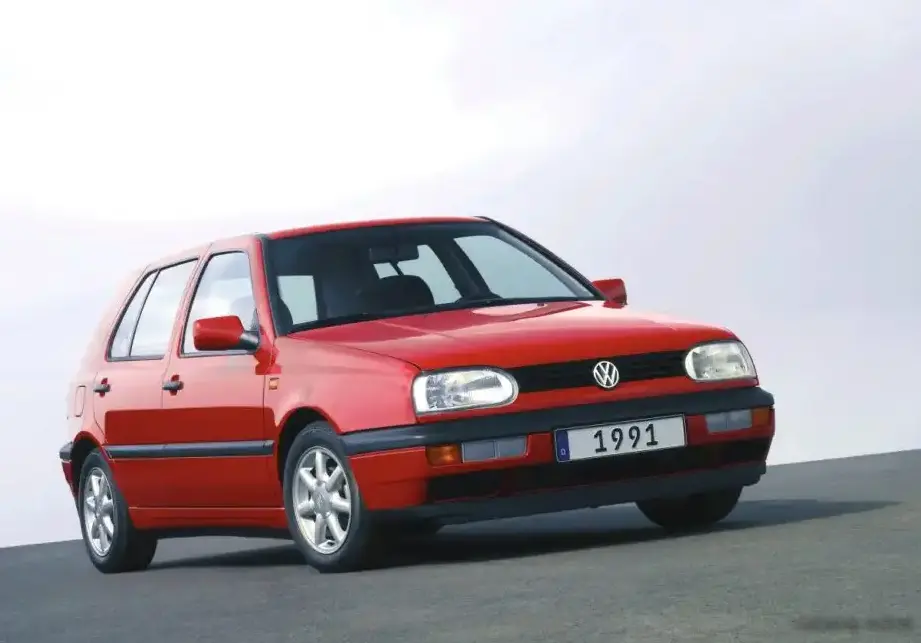
The Volkswagen Golf III 2.0 GTI 16V, produced between 1992 and 1997, represented a significant evolution of the iconic Golf GTI lineage. Positioned as the performance flagship of the Golf III range, it offered a substantial upgrade over the base models and served as a more accessible alternative to the more expensive and specialized VR6 variant. Built on the Volkswagen Group’s A2 platform (internally designated 1HX0/A3), the 2.0 GTI 16V aimed to deliver a compelling blend of sporty handling, respectable acceleration, and everyday practicality. This model was primarily marketed in Europe, where the Golf held a dominant position in the compact hatchback segment, but also saw limited import into North America.
Technical Specifications
| Brand | Volkswagen |
| Model | Golf |
| Generation | Golf III |
| Type (Engine) | 2.0 GTI 16V (150 Hp) |
| Start of production | 1992 |
| End of production | 1997 |
| Powertrain Architecture | Internal Combustion engine |
| Body type | Hatchback |
| Seats | 5 |
| Doors | 3-5 |
| Fuel consumption (combined) | 10.8 l/100 km |
| Fuel consumption (US mpg) | 21.8 US mpg |
| Fuel consumption (UK mpg) | 26.2 UK mpg |
| Fuel consumption (km/l) | 9.3 km/l |
| Fuel Type | Petrol (Gasoline) |
| Acceleration 0 – 100 km/h | 8.3 sec |
| Acceleration 0 – 62 mph | 8.3 sec |
| Acceleration 0 – 60 mph | 7.9 sec |
| Maximum speed | 215 km/h (133.59 mph) |
| Weight-to-power ratio | 7.8 kg/Hp, 128.9 Hp/tonne |
| Weight-to-torque ratio | 6.5 kg/Nm, 154.6 Nm/tonne |
| Power | 150 Hp @ 6000 rpm |
| Power per litre | 75.6 Hp/l |
| Torque | 180 Nm @ 3500 rpm (132.76 lb.-ft. @ 3500 rpm) |
| Engine layout | Front, Transverse |
| Engine Model/Code | ABF |
| Engine displacement | 1984 cm3 (121.07 cu. in.) |
| Number of cylinders | 4 |
| Engine configuration | Inline |
| Cylinder Bore | 82.5 mm (3.25 in.) |
| Piston Stroke | 92.8 mm (3.65 in.) |
| Compression ratio | 10.5:1 |
| Number of valves per cylinder | 4 |
| Fuel injection system | Multi-port manifold injection |
| Engine aspiration | Naturally aspirated engine |
| Valvetrain | DOHC |
| Engine oil capacity | 4.3 l (4.54 US qt | 3.78 UK qt) |
| Coolant capacity | 5.5 l (5.81 US qt | 4.84 UK qt) |
| Kerb Weight | 1164 kg (2566.18 lbs.) |
| Max. weight | 1645 kg (3626.6 lbs.) |
| Max load | 481 kg (1060.42 lbs.) |
| Trunk (boot) space – minimum | 330 l (11.65 cu. ft.) |
| Trunk (boot) space – maximum | 1160 l (40.97 cu. ft.) |
| Fuel tank capacity | 55 l (14.53 US gal | 12.1 UK gal) |
| Length | 4020 mm (158.27 in.) |
| Width | 1710 mm (67.32 in.) |
| Height | 1405 mm (55.31 in.) |
| Wheelbase | 2475 mm (97.44 in.) |
| Front track | 1450 mm (57.09 in.) |
| Rear track | 1434 mm (56.46 in.) |
| Drivetrain Architecture | The Internal combustion engine (ICE) drives the front wheels of the vehicle. |
| Drive wheel | Front wheel drive |
| Number of gears | 5 gears, manual transmission |
| Front suspension | Wishbone |
| Rear suspension | Suspension with traction connecting levers |
| Front brakes | Ventilated discs |
| Rear brakes | Disc |
| Assisting systems | ABS (Anti-lock braking system) |
| Steering type | Steering rack and pinion |
| Power steering | Hydraulic Steering |
| Tires size | 205/50 R15 |
| Wheel rims size | 15 |
Powertrain & Engine Architecture
The heart of the Golf III 2.0 GTI 16V was the ABF engine, a 1.984-liter, naturally aspirated inline-four cylinder powerplant. This engine was a derivative of the earlier 1.8-liter GTI engines, but featured a larger displacement and, crucially, a 16-valve cylinder head (four valves per cylinder). This design allowed for improved breathing and higher engine speeds, contributing to the increased power output. The ABF utilized Bosch Motronic fuel injection, a multi-port system that precisely controlled fuel delivery for optimal combustion. The double overhead camshaft (DOHC) valvetrain further enhanced the engine’s efficiency and responsiveness. The five-speed manual transmission was standard, providing precise gear changes and a direct connection to the engine. The transmission featured ratios geared towards spirited driving, while still offering reasonable fuel economy for everyday use.
Driving Characteristics
The 2.0 GTI 16V offered a noticeable step up in performance compared to the base Golf models. With 150 horsepower and 133 lb-ft of torque, it could accelerate from 0 to 60 mph in around 7.9 seconds and achieve a top speed of 133.59 mph. While not as brutally fast as the VR6, the 2.0 GTI 16V provided a more balanced driving experience. The engine felt eager to rev, and the manual transmission allowed drivers to fully exploit its powerband. The chassis, while shared with other Golf III models, benefited from a slightly stiffer suspension setup, resulting in improved handling and reduced body roll. The steering was precise and communicative, providing good feedback to the driver. Compared to the 1.8L versions, the 2.0 GTI 16V offered a more substantial surge of power throughout the rev range, making it more enjoyable for enthusiastic drivers.
Equipment & Trim Levels
The 2.0 GTI 16V typically came well-equipped, reflecting its position as the performance variant. Standard features included power windows and locks, central locking, a basic stereo system, and sport seats upholstered in patterned fabric. Optional extras included a sunroof, air conditioning, alloy wheels (often BBS), and upgraded audio systems. Interior trim was generally functional and well-built, though not overly luxurious. The dashboard layout was typical of the Golf III, with clearly marked gauges and intuitive controls. The GTI badge was prominently displayed on the steering wheel, gearshift knob, and exterior, signifying its performance pedigree.
Chassis & Braking
The Golf III 2.0 GTI 16V utilized a MacPherson strut front suspension and a torsion beam rear suspension. This setup provided a good balance of ride comfort and handling. The front brakes were ventilated discs, offering excellent stopping power, while the rear brakes were solid discs. ABS (Anti-lock Braking System) was standard, enhancing safety and stability during hard braking. The chassis was reinforced compared to the base models to handle the increased power and stresses of spirited driving. Stabilizer bars were fitted to both the front and rear axles to further reduce body roll.
Market Reception & Comparison
The Golf III 2.0 GTI 16V was generally well-received by automotive critics. It was praised for its lively performance, engaging handling, and practicality. Compared to the VR6, the 2.0 GTI 16V was considered a more affordable and accessible option, while still offering a significant performance upgrade over the base models. Fuel economy was reasonable for a performance car of its era, averaging around 21.8 US mpg in combined driving. Reliability was generally good, although the 16-valve engine required regular maintenance, including valve adjustments. The 1.8L versions were cheaper to run and maintain, but lacked the outright performance of the 2.0 GTI 16V.
Legacy
The Golf III 2.0 GTI 16V remains a popular choice among enthusiasts today. Its combination of performance, practicality, and affordability has made it a sought-after classic. The ABF engine is known for its durability and tunability, and many examples have been modified for increased power. While finding well-maintained examples can be challenging, the Golf III 2.0 GTI 16V continues to offer a rewarding driving experience and a connection to Volkswagen’s rich GTI heritage. Parts availability is generally good, although some specific components may be becoming increasingly scarce. The car’s enduring appeal is a testament to its well-rounded design and its place in automotive history.