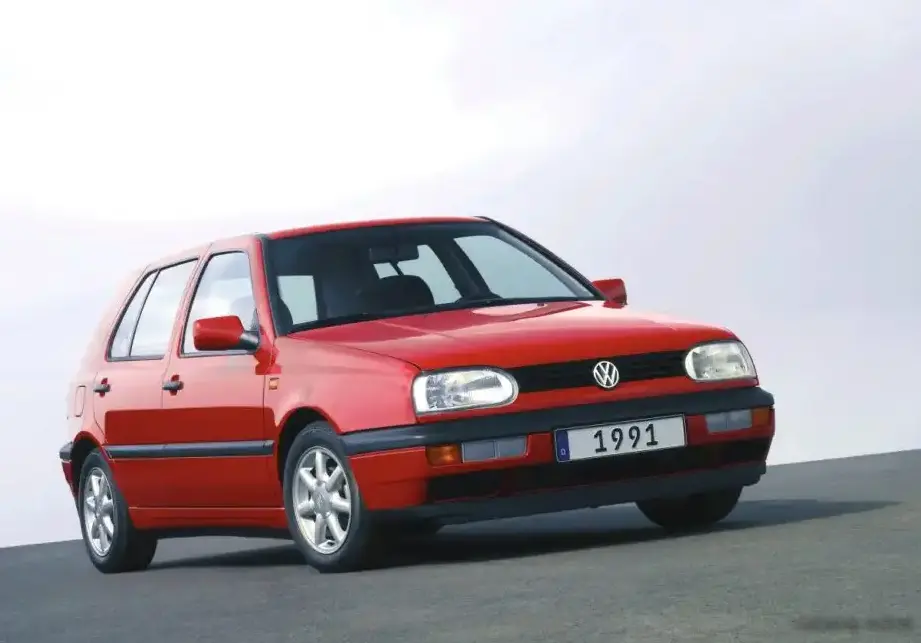
The Volkswagen Golf III 2.8 VR6, produced between 1992 and 1997, represents a significant evolution in the Golf lineage. Positioned as the performance variant within the Mk3 Golf range, it offered a compelling blend of practicality, refinement, and spirited driving. This model was primarily aimed at the European market, where compact hatchbacks were – and continue to be – a dominant force. The VR6 engine, a Volkswagen exclusive, provided a unique alternative to the more common inline-four configurations, offering a smoother power delivery and a distinctive exhaust note. It sat at the top of the Golf III performance hierarchy, above the 1.8 and 2.0 liter inline-four models, and offered a more accessible performance option compared to the emerging hot hatch segment.
Technical Specifications
| Brand | Volkswagen |
| Model | Golf |
| Generation | Golf III |
| Type (Engine) | 2.8 VR6 (174 Hp) |
| Start of production | 1992 |
| End of production | 1997 |
| Powertrain Architecture | Internal Combustion engine |
| Body type | Hatchback |
| Seats | 5 |
| Doors | 3-5 |
| Fuel consumption (combined) | 9.6 l/100 km |
| Fuel consumption (US mpg) | 24.5 US mpg |
| Fuel consumption (UK mpg) | 29.4 UK mpg |
| Fuel consumption (km/l) | 10.4 km/l |
| Fuel Type | Petrol (Gasoline) |
| Acceleration 0 – 100 km/h | 7.8 sec |
| Acceleration 0 – 62 mph | 7.8 sec |
| Acceleration 0 – 60 mph | 7.4 sec |
| Maximum speed | 224 km/h (139.19 mph) |
| Weight-to-power ratio | 7.4 kg/Hp, 135.4 Hp/tonne |
| Weight-to-torque ratio | 5.5 kg/Nm, 182.9 Nm/tonne |
| Power | 174 Hp @ 5800 rpm |
| Power per litre | 62.3 Hp/l |
| Torque | 235 Nm @ 4200 rpm (173.33 lb.-ft. @ 4200 rpm) |
| Engine layout | Front, Transverse |
| Engine Model/Code | AAA |
| Engine displacement | 2792 cm3 (170.38 cu. in.) |
| Number of cylinders | 6 |
| Engine configuration | VR-engine |
| Cylinder Bore | 81 mm (3.19 in.) |
| Piston Stroke | 90.3 mm (3.56 in.) |
| Compression ratio | 10:1 |
| Number of valves per cylinder | 2 |
| Fuel injection system | Multi-port manifold injection |
| Engine aspiration | Naturally aspirated engine |
| Valvetrain | OHC |
| Engine oil capacity | 5.5 l (5.81 US qt | 4.84 UK qt) |
| Coolant capacity | 8.2 l (8.66 US qt | 7.21 UK qt) |
| Kerb Weight | 1285 kg (2832.94 lbs.) |
| Max. weight | 1685 kg (3714.79 lbs.) |
| Max load | 400 kg (881.85 lbs.) |
| Trunk (boot) space – minimum | 320 l (11.3 cu. ft.) |
| Trunk (boot) space – maximum | 677 l (23.91 cu. ft.) |
| Fuel tank capacity | 65 l (17.17 US gal | 14.3 UK gal) |
| Length | 4020 mm (158.27 in.) |
| Width | 1695 mm (66.73 in.) |
| Height | 1405 mm (55.31 in.) |
| Wheelbase | 2475 mm (97.44 in.) |
| Front track | 1450 mm (57.09 in.) |
| Rear track | 1434 mm (56.46 in.) |
| Drivetrain Architecture | Front wheel drive |
| Number of gears | 5 gears, manual transmission |
| Front suspension | Wishbone |
| Rear suspension | Suspension with traction connecting levers |
| Front brakes | Ventilated discs |
| Rear brakes | Disc |
| Assisting systems | ABS (Anti-lock braking system) |
| Steering type | Steering rack and pinion |
| Power steering | Hydraulic Steering |
| Tires size | 205/50 R15 |
| Wheel rims size | 15 |
INTRODUCTION
The Golf III VR6, launched in 1992, quickly gained a reputation as a driver’s car. It built upon the solid foundation of the Mk3 Golf, which introduced significant improvements in refinement, safety, and interior space compared to its predecessor. The VR6 variant distinguished itself with its unique engine, offering a more premium experience than the standard Golf models. Available in both 3-door and 5-door body styles, the VR6 catered to a broad range of buyers seeking a practical yet engaging hatchback. The engine code AAA was commonly found in early models, later superseded by ABV.
Powertrain & Engine Architecture
The heart of the Golf III VR6 is its 2.8-liter VR6 engine. This engine, a narrow-angle V6 (15 degrees between cylinder banks), was designed to offer the smoothness and power of a V6 in a package that was more compact than a traditional V6. This allowed it to be transversely mounted in the Golf’s engine bay. The AAA engine featured multi-port fuel injection and a single overhead camshaft (OHC) per cylinder bank. The engine produced 174 horsepower at 5800 rpm and 235 Nm (173 lb-ft) of torque at 4200 rpm. The engine’s distinctive sound, a result of its firing order and exhaust design, became a hallmark of the VR6. The standard transmission was a 5-speed manual, although a 4-speed automatic transmission was also available, albeit at the expense of some performance. The automatic transmission, while offering convenience, was often criticized for its relatively slow shift times and tendency to hunt for gears.
Driving Characteristics
The Golf III VR6 offered a noticeably more engaging driving experience than its lower-powered siblings. The 2.8-liter VR6 provided ample power for spirited driving, with a 0-60 mph time of around 7.4 seconds. The engine’s torque delivery was smooth and linear, making it easy to drive in everyday situations. The manual transmission allowed for precise control, while the automatic, though less responsive, provided a comfortable driving experience. The suspension, while tuned for comfort, offered a good balance between ride quality and handling. The VR6’s front-wheel-drive configuration meant that it was susceptible to torque steer under hard acceleration, but this was generally considered a minor drawback. Compared to the 1.8 and 2.0 liter models, the VR6 felt significantly more powerful and refined.
Equipment & Trim Levels
The Golf III VR6 typically came well-equipped, reflecting its position as the range-topping model. Standard features included power windows, central locking, power steering, and ABS brakes. Interior upholstery was typically cloth, although leather options were available. The dashboard featured a sporty design with clear instrumentation. Optional extras included a sunroof, air conditioning, and upgraded audio systems. The VR6 was often identified by its unique badging, alloy wheels, and sometimes, a subtle rear spoiler. Trim levels varied depending on the market, but generally, the VR6 offered a higher level of standard equipment than other Golf III models.
Chassis & Braking
The Golf III VR6 utilized a MacPherson strut front suspension and a torsion beam rear suspension. The braking system consisted of ventilated disc brakes at the front and solid disc brakes at the rear. ABS was standard, providing enhanced braking performance and stability. The chassis was reinforced compared to the lower-powered Golf models to handle the increased power and torque of the VR6 engine. The suspension was tuned to provide a comfortable ride while maintaining good handling characteristics. Stabilizer bars were fitted front and rear to reduce body roll during cornering.
Market Reception & Comparison
The Golf III VR6 was generally well-received by automotive critics. It was praised for its smooth and powerful engine, refined ride, and practical hatchback body style. However, some critics noted the relatively high price compared to other compact hatchbacks. Compared to the 1.8 and 2.0 liter Golf models, the VR6 offered significantly more performance and refinement, but at a higher cost. Fuel economy was also lower with the VR6, averaging around 24.5 mpg. The VR6 was often compared to other performance hatchbacks of the era, such as the Ford Escort Cosworth and the Renault Clio Williams, but it offered a more balanced and practical package.
Legacy
The Golf III VR6 remains a popular choice among enthusiasts today. The VR6 engine is known for its durability and reliability, although regular maintenance is essential. Parts availability is generally good, although some specific VR6 components can be difficult to find. The Golf III VR6 has become a sought-after classic, with well-maintained examples commanding premium prices. Its unique engine, engaging driving dynamics, and practical hatchback body style have cemented its place as a significant model in Volkswagen’s history. The engine itself has become a cult classic, with many enthusiasts continuing to modify and restore VR6-powered vehicles.