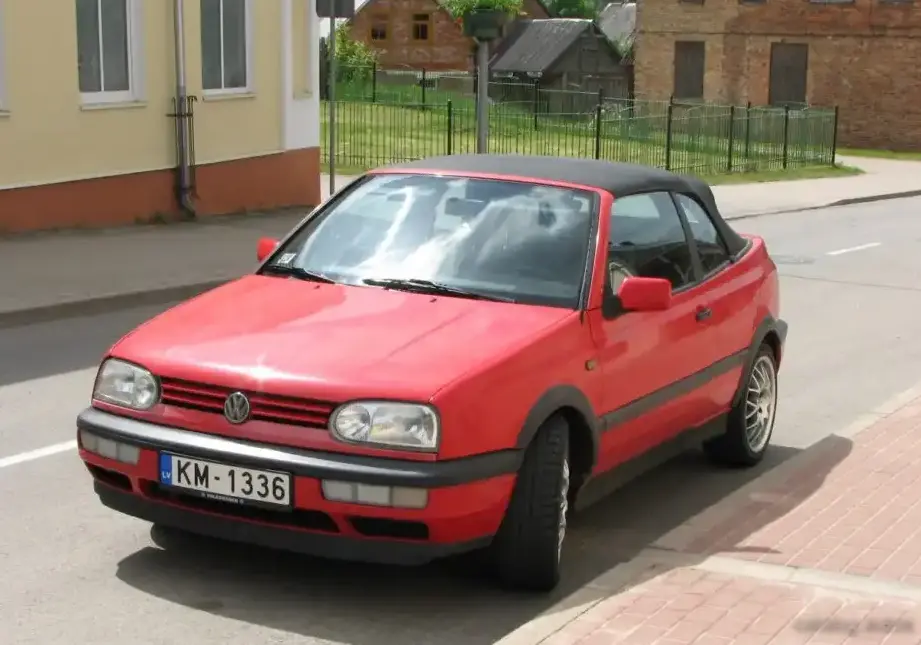
The Volkswagen Golf III Cabrio 1.9 TDI (90 hp) was a variant of the third-generation Golf Cabriolet, produced between 1995 and 1998. Positioned as a fuel-efficient and practical open-top option, it offered a diesel alternative to the gasoline-powered models in the Golf III Cabrio range. This model was primarily aimed at the European market, where diesel engines enjoyed significant popularity due to favorable taxation and fuel economy. It represented a blend of Golf Cabriolet style with the robust and economical characteristics of Volkswagen’s TDI (Turbocharged Direct Injection) technology.
Technical Specifications
| Brand | Volkswagen |
| Model | Golf |
| Generation | Golf III Cabrio |
| Type (Engine) | 1.9 TDI (90 Hp) |
| Start of production | 1995 |
| End of production | 1998 |
| Powertrain Architecture | Internal Combustion engine |
| Body type | Cabriolet |
| Seats | 4 |
| Doors | 2 |
| Fuel consumption (combined) | 5.2 l/100 km (45.2 US mpg, 54.3 UK mpg, 19.2 km/l) |
| Fuel Type | Diesel |
| Acceleration 0 – 100 km/h | 13.3 sec |
| Acceleration 0 – 62 mph | 13.3 sec |
| Acceleration 0 – 60 mph | 12.6 sec |
| Maximum speed | 172 km/h (106.88 mph) |
| Weight-to-power ratio | 14.8 kg/Hp (67.7 Hp/tonne) |
| Weight-to-torque ratio | 6.6 kg/Nm (151.9 Nm/tonne) |
| Power | 90 Hp @ 4000 rpm |
| Power per litre | 47.5 Hp/l |
| Torque | 202 Nm @ 1900 rpm (148.99 lb.-ft. @ 1900 rpm) |
| Engine layout | Front, Longitudinal |
| Engine Model/Code | 1Z, AHU, ALE |
| Engine displacement | 1896 cm3 (115.7 cu. in.) |
| Number of cylinders | 4 |
| Engine configuration | Inline |
| Cylinder Bore | 79.5 mm (3.13 in.) |
| Piston Stroke | 95.5 mm (3.76 in.) |
| Compression ratio | 19.5:1 |
| Number of valves per cylinder | 2 |
| Fuel injection system | Direct injection |
| Engine aspiration | Turbocharger, Intercooler |
| Valvetrain | OHC |
| Engine oil capacity | 4.3 l (4.54 US qt | 3.78 UK qt) |
| Coolant | 6.5 l (6.87 US qt | 5.72 UK qt) |
| Kerb Weight | 1330 kg (2932.15 lbs.) |
| Max. weight | 1640 kg (3615.58 lbs.) |
| Max load | 310 kg (683.43 lbs.) |
| Trunk (boot) space – minimum | 270 l (9.53 cu. ft.) |
| Trunk (boot) space – maximum | 448 l (15.82 cu. ft.) |
| Fuel tank capacity | 55 l (14.53 US gal | 12.1 UK gal) |
| Length | 4020 mm (158.27 in.) |
| Width | 1695 mm (66.73 in.) |
| Height | 1405 mm (55.31 in.) |
| Wheelbase | 2475 mm (97.44 in.) |
| Front track | 1464 mm (57.64 in.) |
| Rear (Back) track | 1428 mm (56.22 in.) |
| Drivetrain Architecture | The Internal combustion engine (ICE) drives the front wheels of the vehicle. |
| Drive wheel | Front wheel drive |
| Number of gears and type of gearbox | 5 gears, manual transmission |
| Front suspension | Spring Strut |
| Rear suspension | Spring Strut |
| Front brakes | Disc |
| Rear brakes | Drum |
| Assisting systems | ABS (Anti-lock braking system) |
| Steering type | Steering rack and pinion |
| Power steering | Hydraulic Steering |
| Tires size | 185/60 R14 H |
| Wheel rims size | 14 |
INTRODUCTION
The Volkswagen Golf III Cabrio, launched in 1993, continued the popular open-top Golf tradition. The 1.9 TDI (90 hp) variant, introduced in 1995, offered a diesel-powered alternative within the range. Built on the Golf III platform (1HX0/A3), this model aimed to provide a more economical and torque-rich driving experience compared to the gasoline-powered Golf Cabriolets. It was a key offering in markets where diesel fuel was preferred, and where fuel efficiency was a major purchasing consideration. The 1.9 TDI engine was known for its durability and relatively low running costs, making it a popular choice for those seeking a practical and reliable convertible.
Powertrain & Engine Architecture
The heart of the Golf III Cabrio 1.9 TDI was the 1Z, AHU, or ALE engine code, a 1.9-liter inline-four cylinder diesel engine. This engine utilized a direct injection system, a hallmark of Volkswagen’s TDI technology. Direct injection involved injecting fuel directly into the combustion chamber, rather than into the intake manifold, resulting in more complete combustion and improved fuel efficiency. The engine featured an overhead camshaft (OHC) valvetrain operating two valves per cylinder. A turbocharger with an intercooler was employed to boost power output and improve torque across the rev range. The 90 horsepower output was achieved at 4000 rpm, while peak torque of 202 Nm (148.99 lb.-ft.) was available from just 1900 rpm. The engine was typically paired with a five-speed manual transmission, although a four-speed automatic transmission was also available, albeit less common. The automatic transmission, while offering convenience, did impact acceleration and fuel economy compared to the manual.
Driving Characteristics
The 1.9 TDI 90 hp engine in the Golf III Cabrio provided a distinctly different driving experience compared to the higher-powered gasoline variants. While not a sports car, the TDI offered ample torque for everyday driving and cruising. The low-end grunt made it easy to navigate city streets and maintain comfortable speeds on the highway. Acceleration was modest, with a 0-60 mph time of around 12.6 seconds, but the engine’s willingness to pull from low revs made it feel more responsive than the figures suggest. The automatic transmission, when equipped, offered smooth shifts but at the expense of some responsiveness. The manual transmission allowed for greater control and maximized the engine’s potential. Compared to the 1.8-liter gasoline engines, the TDI offered significantly better fuel economy, but lacked the same level of outright performance. The heavier engine also slightly impacted the car’s handling balance, making it feel a bit more nose-heavy.
Equipment & Trim Levels
The Golf III Cabrio 1.9 TDI typically came with a reasonable level of standard equipment. Interior features generally included cloth upholstery, a basic stereo system, and power windows. Trim levels varied depending on the market, but common options included upgraded stereo systems, alloy wheels, and a leather-wrapped steering wheel. The Cabriolet’s interior was relatively simple and functional, prioritizing practicality over luxury. Optional extras could include air conditioning, central locking, and electric mirrors. The specific trim level influenced the exterior detailing, with higher trims often featuring body-colored bumpers and side moldings.
Chassis & Braking
The Golf III Cabrio 1.9 TDI utilized a MacPherson strut front suspension and a twist-beam rear suspension. The suspension setup was tuned for comfort and ride quality, rather than outright handling performance. The front brakes were typically disc brakes, while the rear brakes were drum brakes, a cost-saving measure common in this class of vehicle. ABS (Anti-lock Braking System) was often included as standard equipment, enhancing safety. The chassis was reinforced to compensate for the lack of a fixed roof, providing adequate torsional rigidity. Stabilizer bars were fitted to both the front and rear axles to reduce body roll during cornering.
Market Reception & Comparison
The Golf III Cabrio 1.9 TDI was generally well-received by critics and consumers alike, particularly in Europe. It was praised for its fuel efficiency, reliability, and practicality. Compared to the gasoline-powered Golf Cabriolets, the TDI offered a more economical option, albeit with slightly less performance. The 1.8-liter gasoline engines provided a more spirited driving experience, but at the cost of increased fuel consumption. The TDI was often seen as a sensible choice for those who prioritized fuel economy and low running costs. Reliability was generally good, with the TDI engine proving to be durable and long-lasting. However, the automatic transmission was sometimes criticized for its lack of responsiveness.
Legacy
The Golf III Cabrio 1.9 TDI remains a popular choice among enthusiasts and used car buyers today. The TDI engine is known for its longevity and relatively simple mechanical design, making it easier and cheaper to maintain than some of its more complex counterparts. While finding a well-maintained example can be challenging, these cars offer a unique blend of classic Golf Cabriolet style and modern diesel technology. The 1.9 TDI engine has a strong reputation for reliability, and many examples are still on the road today, testament to its robust construction. The Golf III Cabrio 1.9 TDI represents a significant chapter in Volkswagen’s history, showcasing the company’s commitment to fuel efficiency and practicality.