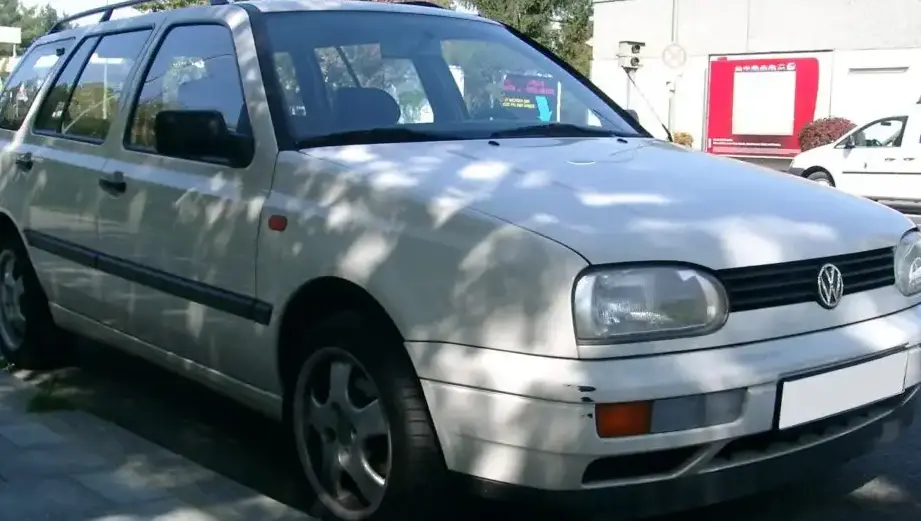
The Volkswagen Golf III Variant 1.4, producing 60 horsepower, was a mainstay of the Golf III range in Europe from 1993 to 1999. Positioned as the entry-level engine option in the Variant (estate) body style, it offered a practical and affordable family vehicle. Built on the Volkswagen Group’s A3 platform (internally designated 1HX0 for the Variant), this model aimed to provide economical transportation with the added versatility of a wagon. It represented a significant step forward in Golf practicality, offering increased cargo space compared to the hatchback while retaining the Golf’s core values of build quality and usability.
Technical Specifications
| Brand | Volkswagen |
| Model | Golf |
| Generation | Golf III Variant |
| Type (Engine) | 1.4 (60 Hp) |
| Start of production | 1993 |
| End of production | 1999 |
| Powertrain Architecture | Internal Combustion engine |
| Body type | Station wagon (estate) |
| Seats | 5 |
| Doors | 5 |
| Fuel consumption (combined) | 6.5 l/100 km (36.2 US mpg, 43.5 UK mpg, 15.4 km/l) |
| Fuel Type | Petrol (Gasoline) |
| Acceleration 0 – 100 km/h | 14.9 sec |
| Acceleration 0 – 62 mph | 14.9 sec |
| Acceleration 0 – 60 mph | 14.2 sec |
| Maximum speed | 165 km/h (102.53 mph) |
| Weight-to-power ratio | 19.8 kg/Hp, 50.4 Hp/tonne |
| Weight-to-torque ratio | 10.3 kg/Nm, 97.5 Nm/tonne |
| Power | 60 Hp @ 5200 rpm |
| Power per litre | 43.1 Hp/l |
| Torque | 116 Nm @ 2800 rpm (85.56 lb.-ft. @ 2800 rpm) |
| Engine layout | Front, Transverse |
| Engine Model/Code | AEX, ABD |
| Engine displacement | 1391 cm3 (84.88 cu. in.) |
| Number of cylinders | 4 |
| Engine configuration | Inline |
| Cylinder Bore | 76.5 mm (3.01 in.) |
| Piston Stroke | 75.6 mm (2.98 in.) |
| Number of valves per cylinder | 2 |
| Fuel injection system | Single-point injection |
| Engine aspiration | Naturally aspirated engine |
| Valvetrain | OHC |
| Engine oil capacity | 3.4 l (3.59 US qt | 2.99 UK qt) |
| Coolant | 5.6 l (5.92 US qt | 4.93 UK qt) |
| Kerb Weight | 1190 kg (2623.5 lbs.) |
| Max. weight | 1615 kg (3560.47 lbs.) |
| Max load | 425 kg (936.96 lbs.) |
| Trunk (boot) space – minimum | 466 l (16.46 cu. ft.) |
| Trunk (boot) space – maximum | 1425 l (50.32 cu. ft.) |
| Fuel tank capacity | 60 l (15.85 US gal | 13.2 UK gal) |
| Length | 4340 mm (170.87 in.) |
| Width | 1695 mm (66.73 in.) |
| Height | 1430 mm (56.3 in.) |
| Wheelbase | 2475 mm (97.44 in.) |
| Front track | 1478 mm (58.19 in.) |
| Rear (Back) track | 1465 mm (57.68 in.) |
| Drivetrain Architecture | The Internal combustion engine (ICE) drives the front wheels of the vehicle. |
| Drive wheel | Front wheel drive |
| Number of gears and type of gearbox | 5 gears, manual transmission |
| Front suspension | Wishbone |
| Rear suspension | Suspension with traction connecting levers |
| Front brakes | Disc |
| Rear brakes | Drum |
| Assisting systems | ABS (Anti-lock braking system) |
| Steering type | Steering rack and pinion |
| Tires size | 175/70 R13 |
| Wheel rims size | 13 |
Powertrain & Engine Architecture
The Golf III Variant 1.4 utilized either the AEX or ABD engine code, both representing 1.4-liter, inline four-cylinder gasoline engines. These engines were characterized by their simplicity and durability, though they lacked the sophistication of later Volkswagen powerplants. The engines employed a single-point fuel injection system (SPI), where fuel was injected into the intake manifold rather than directly into the cylinders. This system, while cost-effective, resulted in less precise fuel delivery and lower overall efficiency compared to multi-point injection. The overhead camshaft (OHC) valvetrain operated two valves per cylinder. The 5-speed manual transmission was the standard offering, designed to maximize fuel economy and provide adequate, if not exhilarating, performance. The engine’s relatively low compression ratio and modest power output prioritized reliability and longevity over outright speed.
Driving Characteristics
The 1.4-liter engine in the Golf III Variant delivered a driving experience best described as practical and unhurried. With 60 horsepower, acceleration was leisurely, taking nearly 15 seconds to reach 62 mph. The engine needed to be revved to extract its maximum potential, and overtaking maneuvers required careful planning. The 5-speed manual transmission helped to keep the engine in its optimal power band, but the lack of torque meant frequent gear changes were necessary, especially when carrying a load. Compared to the more powerful 1.8-liter and VR6 variants, the 1.4 felt significantly underpowered. However, it offered a smoother and more forgiving driving experience than the diesel options, and its lighter weight contributed to better handling in everyday driving situations. The gear ratios were tuned for economy, prioritizing fuel efficiency over spirited performance.
Equipment & Trim Levels
The 1.4-liter Variant typically represented the base trim level. Standard equipment included central locking, power steering, and a basic stereo system. Interior upholstery was typically cloth, and the dashboard featured a simple, functional design. Optional extras included power windows, air conditioning, and alloy wheels. The focus was on providing essential features at an affordable price point. Higher trim levels, such as the GL, added features like electric windows, upgraded upholstery, and more sophisticated audio systems. The 1.4 Variant was often seen as a blank canvas for buyers who prioritized practicality and affordability over luxury.
Chassis & Braking
The Golf III Variant 1.4 utilized a MacPherson strut front suspension and a torsion beam rear suspension. This setup provided a comfortable ride, although it wasn’t particularly sporty. The front brakes were ventilated discs, while the rear brakes were drums. This configuration was typical for vehicles in this weight class and price range during the 1990s. ABS (Anti-lock Braking System) was often included as standard equipment, enhancing safety. Stabilizer bars were present, but their thickness was relatively modest, reflecting the car’s focus on comfort and economy rather than performance handling.
Market Reception & Comparison
The Golf III Variant 1.4 was generally well-received as an affordable and practical family car. Critics acknowledged its spacious interior and good build quality, but often criticized its lack of power. Compared to the 1.8-liter and VR6 variants, the 1.4 offered significantly lower performance but also better fuel economy. The 1.9 TDI diesel version provided similar fuel economy with more torque, but at the expense of refinement. The 1.4 appealed to buyers who prioritized economy and practicality over performance, such as families and those who primarily used the car for commuting.
Legacy
The Golf III Variant 1.4, while not the most exciting version of the Golf III, proved to be a reliable and durable vehicle. The engine, though simple, was known for its longevity, and many examples remain on the road today. In the used car market, these models are often sought after by those looking for an affordable and practical classic. Maintenance costs are relatively low, and parts availability is generally good. While it may not offer the performance of its more powerful siblings, the 1.4-liter Golf III Variant remains a testament to Volkswagen’s commitment to building well-engineered and dependable vehicles.