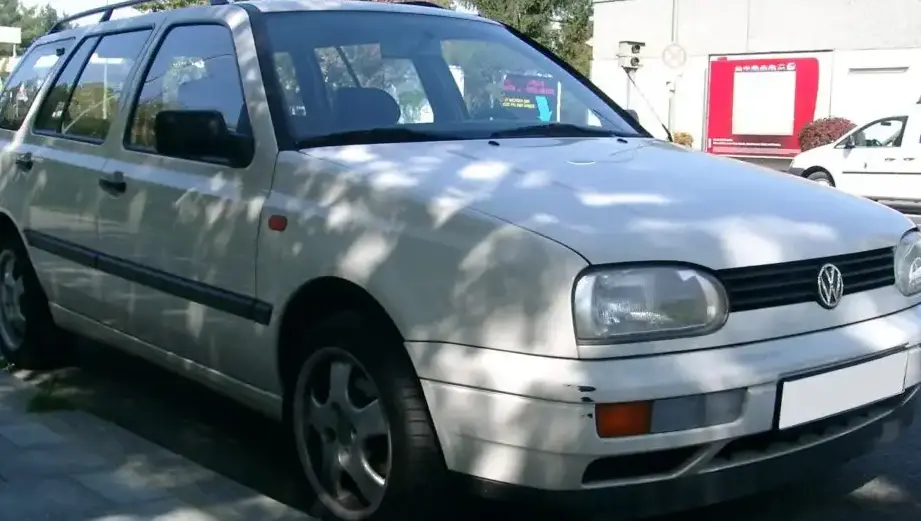
The Volkswagen Golf III Variant 1.6, producing 75 horsepower, was a popular entry-level offering within the Golf Mk3 range, specifically the estate (station wagon) body style. Produced from 1993 to 1999, it represented a practical and affordable option for families and those needing additional cargo space. This variant occupied the lower end of the Golf III lineup, positioned below the more powerful 1.8 and VR6 models, and also the diesel variants. It was primarily sold in Europe, where the estate body style was highly favored, offering a balance of fuel efficiency and utility. While not a performance model, the 1.6L engine provided adequate power for everyday driving, and the Variant’s spacious interior and large cargo area made it a versatile vehicle.
Technical Specifications
| Brand | Volkswagen |
| Model | Golf |
| Generation | Golf III Variant |
| Type (Engine) | 1.6 (75 Hp) |
| Start of production | 1993 |
| End of production | 1999 |
| Powertrain Architecture | Internal Combustion engine |
| Body type | Station wagon (estate) |
| Seats | 5 |
| Doors | 5 |
| Fuel consumption (economy) – extra urban | 6.5 l/100 km (36.2 US mpg, 43.5 UK mpg, 15.4 km/l) |
| Fuel consumption (economy) – combined | 8.8 l/100 km (26.7 US mpg, 32.1 UK mpg, 11.4 km/l) |
| Fuel Type | Petrol (Gasoline) |
| Acceleration 0 – 100 km/h | 14.9 sec |
| Acceleration 0 – 62 mph | 14.9 sec |
| Acceleration 0 – 60 mph | 14.2 sec |
| Maximum speed | 165 km/h (102.53 mph) |
| Weight-to-power ratio | 15.9 kg/Hp (63 Hp/tonne) |
| Weight-to-torque ratio | 8.8 kg/Nm (113.4 Nm/tonne) |
| Power | 75 Hp @ 5200 rpm |
| Power per litre | 46.9 Hp/l |
| Torque | 135 Nm @ 2800 rpm (99.57 lb.-ft. @ 2800 rpm) |
| Engine layout | Front, Transverse |
| Engine Model/Code | ABU, AEA, AEE |
| Engine displacement | 1598 cm3 (97.52 cu. in.) |
| Number of cylinders | 4 |
| Engine configuration | Inline |
| Cylinder Bore | 76.5 mm (3.01 in.) |
| Piston Stroke | 86.9 mm (3.42 in.) |
| Compression ratio | 9.3:1 |
| Number of valves per cylinder | 2 |
| Fuel injection system | Multi-port manifold injection |
| Engine aspiration | Naturally aspirated engine |
| Valvetrain | OHC |
| Engine oil capacity | 3.4 l (3.59 US qt | 2.99 UK qt) |
| Coolant | 5.6 l (5.92 US qt | 4.93 UK qt) |
| Kerb Weight | 1190 kg (2623.5 lbs.) |
| Max. weight | 1615 kg (3560.47 lbs.) |
| Max load | 425 kg (936.96 lbs.) |
| Trunk (boot) space – minimum | 466 l (16.46 cu. ft.) |
| Trunk (boot) space – maximum | 1425 l (50.32 cu. ft.) |
| Fuel tank capacity | 60 l (15.85 US gal | 13.2 UK gal) |
| Length | 4340 mm (170.87 in.) |
| Width | 1695 mm (66.73 in.) |
| Height | 1430 mm (56.3 in.) |
| Wheelbase | 2475 mm (97.44 in.) |
| Front track | 1478 mm (58.19 in.) |
| Rear (Back) track | 1465 mm (57.68 in.) |
| Drivetrain Architecture | The Internal combustion engine (ICE) drives the front wheels of the vehicle. |
| Drive wheel | Front wheel drive |
| Number of gears and type of gearbox | 5 gears, manual transmission |
| Front suspension | Wishbone |
| Rear suspension | Suspension with traction connecting levers |
| Front brakes | Disc |
| Rear brakes | Drum |
| Steering type | Steering rack and pinion |
| Tires size | 175/70 R13 |
| Wheel rims size | 13 |
Powertrain & Engine Architecture
The Golf III Variant 1.6 utilized various iterations of the Volkswagen EA827 engine family, most commonly the ABU, AEA, and AEE engine codes. These were 1.6-liter, inline-four cylinder engines featuring a single overhead camshaft (OHC) and two valves per cylinder. The engine employed multi-port fuel injection, a significant improvement over earlier carbureted designs, contributing to better fuel efficiency and smoother operation. The 75 horsepower output was achieved at 5200 rpm, with a torque figure of 135 Nm (99.57 lb-ft) available at 2800 rpm. The engine’s relatively low compression ratio of 9.3:1 was typical for the era and allowed it to run on readily available gasoline grades. The engine was transversely mounted, driving the front wheels. The standard transmission was a five-speed manual, although a four-speed automatic transmission was also available, albeit less common. The automatic transmission, while offering convenience, did impact acceleration and fuel economy.
Driving Characteristics
The 1.6-liter engine in the Golf III Variant, particularly when paired with the five-speed manual transmission, provided adequate performance for everyday driving. Acceleration was modest, with a 0-60 mph time of around 14.2 seconds. The engine felt somewhat strained at higher speeds, and overtaking required careful planning. The automatic transmission further reduced acceleration times. The gear ratios were geared towards fuel efficiency rather than outright performance. The suspension, while comfortable, wasn’t particularly sporty, prioritizing ride quality over handling precision. The steering was light and easy to use, making it well-suited for urban driving. Compared to the more powerful 1.8 and VR6 variants, the 1.6 felt noticeably slower, but it offered a more economical and relaxed driving experience.
Equipment & Trim Levels
The Golf III Variant 1.6 typically came with a relatively basic level of equipment, reflecting its position as an entry-level model. Standard features generally included power steering, central locking, and a basic stereo system. Interior upholstery was typically cloth, and the dashboard featured a simple, functional design. Optional extras included air conditioning, electric windows, and upgraded stereo systems. Higher trim levels, such as the ‘GL’ specification, added features like alloy wheels, upgraded interior trim, and additional comfort items. The Variant’s spacious interior and large boot (trunk) were key selling points, offering ample room for passengers and luggage. The rear seats could be folded down to further increase cargo capacity.
Chassis & Braking
The Golf III Variant 1.6 utilized a MacPherson strut front suspension and a torsion beam rear suspension. This setup provided a good balance of comfort and handling. The front brakes were disc brakes, while the rear brakes were typically drum brakes, a cost-saving measure for the base models. Stabilizer bars were fitted to both the front and rear axles to reduce body roll. The chassis was relatively lightweight, contributing to the car’s fuel efficiency. The steering was a rack and pinion system, providing precise and responsive steering feel. The standard tire size was 175/70 R13, mounted on 13-inch steel wheels.
Market Reception & Comparison
The Golf III Variant 1.6 was generally well-received by critics as a practical and affordable family car. It was praised for its spacious interior, fuel efficiency, and comfortable ride. However, it was also criticized for its lack of performance and relatively basic equipment level. Compared to the 1.8 and VR6 variants, the 1.6 offered significantly less power and refinement. However, it was also more affordable to purchase and operate. The 1.6L engine was known for its reliability, making it a popular choice for budget-conscious buyers. Fuel economy was a strong point, averaging around 26.7 US mpg in combined driving conditions.
Legacy
The Golf III Variant 1.6 has proven to be a durable and reliable vehicle, with many examples still on the road today. The EA827 engine is known for its longevity, provided it is properly maintained. Parts availability is generally good, and maintenance costs are relatively low. In the used car market, the 1.6L Variant is often seen as a sensible and affordable option for those seeking a practical and reliable estate car. While it may not offer the performance or prestige of higher-spec models, its simplicity and durability have ensured its continued popularity among enthusiasts and everyday drivers alike. It represents a significant era in Volkswagen’s history, showcasing the brand’s commitment to building practical and well-engineered vehicles.