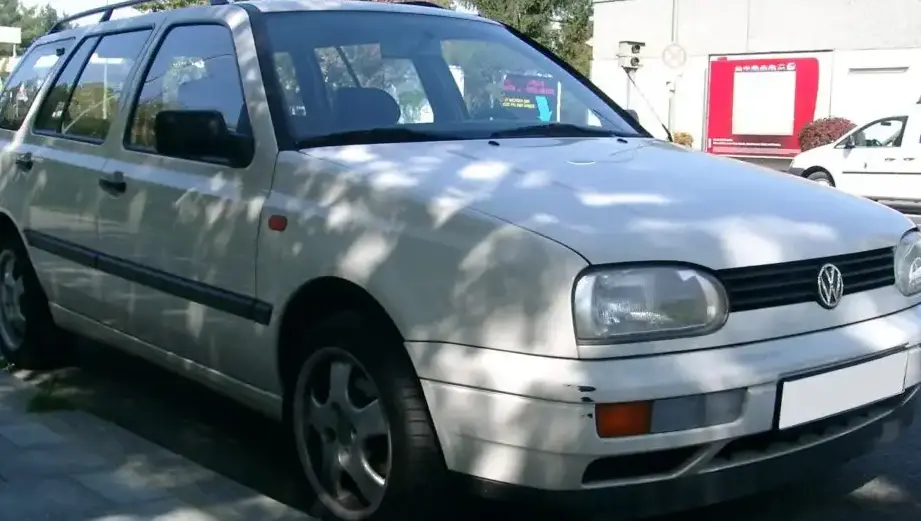
The Volkswagen Golf III Variant 1.9 SDI, produced between 1997 and 1999, represents a practical and fuel-efficient offering within the broader Golf Mk3 range. Positioned as an entry-level variant of the Golf estate (wagon) body style, it catered to buyers prioritizing economy and load-carrying capacity over outright performance. This model occupied a specific niche, offering a diesel-powered wagon alternative in a market increasingly focused on gasoline engines and emerging petrol direct injection technologies. It was built on the Volkswagen Group’s A3 platform, shared with models like the SEAT Ibiza, SEAT Cordoba, and the first-generation Audi A3.
Technical Specifications
| Brand | Volkswagen |
| Model | Golf |
| Generation | Golf III Variant |
| Type (Engine) | 1.9 SDI (64 Hp) |
| Start of production | 1997 |
| End of production | 1999 |
| Powertrain Architecture | Internal Combustion engine |
| Body type | Station wagon (estate) |
| Seats | 5 |
| Doors | 5 |
| Fuel consumption (combined) | 5.2 l/100 km (45.2 US mpg, 54.3 UK mpg, 19.2 km/l) |
| Fuel Type | Diesel |
| Acceleration 0 – 100 km/h | 18.6 sec |
| Acceleration 0 – 62 mph | 18.6 sec |
| Acceleration 0 – 60 mph | 17.7 sec |
| Maximum speed | 154 km/h (95.69 mph) |
| Weight-to-power ratio | 19.3 kg/Hp, 51.8 Hp/tonne |
| Weight-to-torque ratio | 9.9 kg/Nm, 101.2 Nm/tonne |
| Power | 64 Hp @ 4200 rpm |
| Power per litre | 33.8 Hp/l |
| Torque | 125 Nm @ 2200 rpm (92.2 lb.-ft. @ 2200 rpm) |
| Engine layout | Front, Transverse |
| Engine Model/Code | AEY |
| Engine displacement | 1896 cm3 (115.7 cu. in.) |
| Number of cylinders | 4 |
| Engine configuration | Inline |
| Cylinder Bore | 79.5 mm (3.13 in.) |
| Piston Stroke | 95.5 mm (3.76 in.) |
| Compression ratio | 19.5:1 |
| Number of valves per cylinder | 2 |
| Fuel injection system | Direct injection |
| Engine aspiration | Naturally aspirated engine |
| Valvetrain | OHC |
| Engine oil capacity | 4.3 l (4.54 US qt | 3.78 UK qt) |
| Coolant | 6.5 l (6.87 US qt | 5.72 UK qt) |
| Kerb Weight | 1235 kg (2722.71 lbs.) |
| Max. weight | 1660 kg (3659.67 lbs.) |
| Max load | 425 kg (936.96 lbs.) |
| Trunk (boot) space – minimum | 466 l (16.46 cu. ft.) |
| Trunk (boot) space – maximum | 1425 l (50.32 cu. ft.) |
| Fuel tank capacity | 60 l (15.85 US gal | 13.2 UK gal) |
| Length | 4340 mm (170.87 in.) |
| Width | 1695 mm (66.73 in.) |
| Height | 1430 mm (56.3 in.) |
| Wheelbase | 2475 mm (97.44 in.) |
| Front track | 1478 mm (58.19 in.) |
| Rear (Back) track | 1462 mm (57.56 in.) |
| Drivetrain Architecture | The Internal combustion engine (ICE) drives the front wheels of the vehicle. |
| Drive wheel | Front wheel drive |
| Number of gears and type of gearbox | 5 gears, manual transmission |
| Front suspension | Wishbone |
| Rear suspension | Suspension with traction connecting levers |
| Front brakes | Disc |
| Rear brakes | Drum |
| Assisting systems | ABS (Anti-lock braking system) |
| Steering type | Steering rack and pinion |
| Power steering | Hydraulic Steering |
| Tires size | 185/60 R14 |
| Wheel rims size | 14 |
Powertrain & Engine Architecture
The heart of the Golf III Variant 1.9 SDI is the AEY engine code, a 1.9-liter, inline-four cylinder diesel engine. This engine utilizes a direct injection (DI) system, a relatively advanced technology for its time, which injected fuel directly into the combustion chamber under high pressure. This improved combustion efficiency and reduced emissions compared to indirect injection systems. The engine features a single overhead camshaft (OHC) valvetrain operating two valves per cylinder. The SDI (Silent Diesel Injection) system aimed to reduce the characteristic diesel clatter, though it wasn’t as refined as later common rail diesel engines. The 5-speed manual transmission was the standard offering, chosen for its simplicity and contribution to fuel economy. The transmission’s gear ratios were geared towards maximizing fuel efficiency rather than providing sporty acceleration.
Driving Characteristics
The 1.9 SDI engine, producing 64 horsepower, delivered modest performance. Acceleration was leisurely, with a 0-60 mph time of around 17.7 seconds. The focus was on providing adequate power for everyday driving and hauling loads, rather than spirited performance. The engine’s torque peak of 125 Nm (92.2 lb-ft) at 2200 rpm provided reasonable pulling power at lower engine speeds, making it suitable for carrying passengers and cargo. Compared to the more powerful 1.9 TDI (Turbocharged Direct Injection) variants, the SDI lacked the responsiveness and outright speed of its turbocharged sibling. However, it offered a smoother, more linear power delivery. The manual transmission, while not particularly sporty, allowed for precise control and contributed to the car’s fuel efficiency.
Equipment & Trim Levels
The Golf III Variant 1.9 SDI typically came with a fairly basic level of equipment. Standard features generally included power steering, central locking, and an anti-lock braking system (ABS). Interior upholstery was typically cloth, and the dashboard featured a functional, if somewhat spartan, design. Optional extras included power windows, a sunroof, and upgraded audio systems. The trim level was generally considered entry-level within the Golf III Variant range, appealing to buyers seeking a practical and affordable wagon.
Chassis & Braking
The Golf III Variant 1.9 SDI utilized a front independent suspension with wishbones and a rear suspension with traction connecting levers. This setup provided a comfortable ride, although it wasn’t particularly sporty. The front brakes were discs, while the rear brakes were drums, a cost-saving measure common in this class of vehicle. The suspension was tuned for comfort and stability, prioritizing ride quality over handling precision. A stabilizer bar was included to reduce body roll during cornering.
Market Reception & Comparison
The Golf III Variant 1.9 SDI was generally well-received as a practical and economical wagon. Critics praised its fuel efficiency and spacious interior, but noted its lack of performance. Compared to the more popular 1.8 gasoline and 1.9 TDI diesel variants, the SDI offered a lower price point but sacrificed performance. The 1.9 TDI, with its turbocharging, provided significantly more power and torque, making it a more appealing option for drivers who prioritized performance. However, the SDI’s simplicity and reliability made it a popular choice for those seeking a dependable and affordable vehicle.
Legacy
The 1.9 SDI engine, while not known for its high performance, proved to be remarkably durable and reliable. Many examples of the Golf III Variant 1.9 SDI remain on the road today, a testament to the engine’s robust construction. In the used car market, these models are often sought after by buyers looking for a simple, affordable, and fuel-efficient vehicle. Maintenance costs are generally low, and parts availability is good. While not a collector’s item, the Golf III Variant 1.9 SDI represents a practical and enduring example of 1990s automotive engineering.