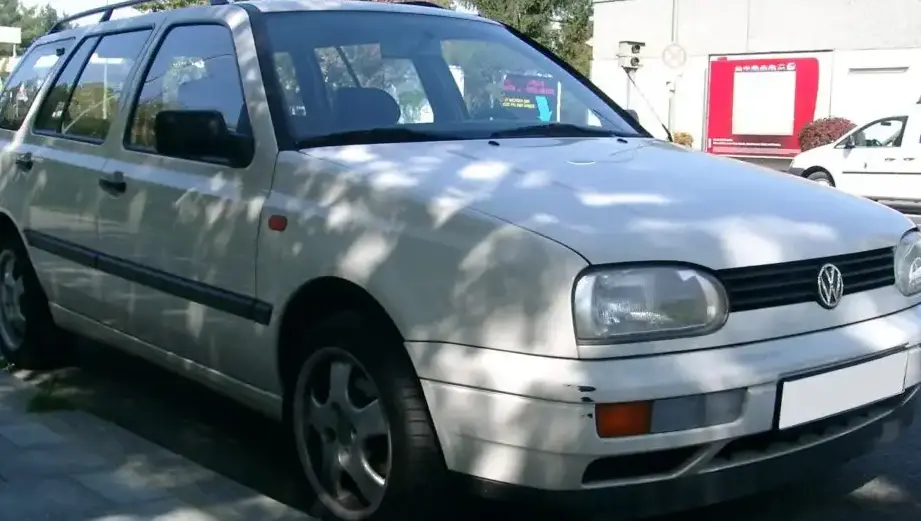
The Volkswagen Golf III Variant 1.9 TDI (110 hp) was a popular station wagon produced between 1996 and 1999, representing a practical and fuel-efficient option within the Golf III lineup. Built on the Golf III platform (1HX0/A3), the Variant – Volkswagen’s designation for its estate/wagon body style – offered increased cargo capacity compared to the hatchback while retaining the Golf’s renowned handling and build quality. This particular variant, powered by the 1.9-liter turbocharged diesel engine, aimed to balance economy with reasonable performance, appealing to families and drivers prioritizing practicality. It occupied a mid-range position in the Golf III Variant lineup, slotting below the more powerful petrol engines and above the base-level diesel options.
Technical Specifications
| Brand | Volkswagen |
| Model | Golf |
| Generation | Golf III Variant |
| Type (Engine) | 1.9 TDI (110 Hp) |
| Start of production | 1996 |
| End of production | 1999 |
| Powertrain Architecture | Internal Combustion engine |
| Body type | Station wagon (estate) |
| Seats | 5 |
| Doors | 5 |
| Fuel consumption (combined) | 5.2 l/100 km |
| Fuel consumption (US mpg) | 45.2 |
| Fuel consumption (UK mpg) | 54.3 |
| Fuel consumption (km/l) | 19.2 |
| Fuel Type | Diesel |
| Acceleration 0 – 100 km/h | 11.4 sec |
| Acceleration 0 – 62 mph | 11.4 sec |
| Acceleration 0 – 60 mph | 10.8 sec |
| Maximum speed | 190 km/h (118.06 mph) |
| Weight-to-power ratio | 11.5 kg/Hp |
| Weight-to-torque ratio | 5.4 kg/Nm |
| Power | 110 Hp @ 4150 rpm |
| Power per litre | 58 Hp/l |
| Torque | 235 Nm @ 1900 rpm (173.33 lb.-ft. @ 1900 rpm) |
| Engine layout | Front, Longitudinal |
| Engine Model/Code | AFN |
| Engine displacement | 1896 cm3 (115.7 cu. in.) |
| Number of cylinders | 4 |
| Engine configuration | Inline |
| Cylinder Bore | 79.5 mm (3.13 in.) |
| Piston Stroke | 95.5 mm (3.76 in.) |
| Compression ratio | 19.5:1 |
| Number of valves per cylinder | 2 |
| Fuel injection system | Direct injection |
| Engine aspiration | Turbocharger, Intercooler |
| Valvetrain | OHC |
| Engine oil capacity | 4.3 l (4.54 US qt | 3.78 UK qt) |
| Coolant capacity | 6.5 l (6.87 US qt | 5.72 UK qt) |
| Kerb Weight | 1270 kg (2799.87 lbs.) |
| Max. weight | 1695 kg (3736.84 lbs.) |
| Max load | 425 kg (936.96 lbs.) |
| Trunk (boot) space – minimum | 466 l (16.46 cu. ft.) |
| Trunk (boot) space – maximum | 1425 l (50.32 cu. ft.) |
| Fuel tank capacity | 60 l (15.85 US gal | 13.2 UK gal) |
| Length | 4340 mm (170.87 in.) |
| Width | 1695 mm (66.73 in.) |
| Height | 1430 mm (56.3 in.) |
| Wheelbase | 2475 mm (97.44 in.) |
| Front track | 1478 mm (58.19 in.) |
| Rear track | 1462 mm (57.56 in.) |
| Drivetrain Architecture | Front wheel drive |
| Number of gears | 5 |
| Gearbox type | Manual transmission |
| Front suspension | Wishbone |
| Rear suspension | Suspension with traction connecting levers |
| Front brakes | Ventilated discs |
| Rear brakes | Drum |
| Assisting systems | ABS (Anti-lock braking system) |
| Steering type | Steering rack and pinion |
| Power steering | Hydraulic |
| Tires size | 195/60 R14 |
| Wheel rims size | 14 |
Powertrain & Engine Architecture
The heart of the Golf III Variant 1.9 TDI was the AFN engine code, a 1.9-liter inline-four cylinder diesel engine. This engine utilized direct fuel injection, a technology that significantly improved fuel efficiency and reduced emissions compared to older indirect injection systems. The AFN featured a turbocharger with an intercooler, boosting power output to 110 horsepower and 235 Nm (173 lb-ft) of torque. The engine employed an overhead camshaft (OHC) valvetrain with two valves per cylinder. The five-speed manual transmission was the standard offering, providing a balance between fuel economy and drivability. The engine’s longitudinal mounting within the front-wheel-drive chassis was a characteristic of the Volkswagen Group’s engineering approach at the time. The direct injection system, coupled with the turbocharger, allowed for a relatively high compression ratio of 19.5:1, contributing to the engine’s efficiency and torque output.
Driving Characteristics
The 1.9 TDI engine, paired with the five-speed manual transmission, delivered a practical and efficient driving experience. While not a performance-oriented setup, the engine provided ample torque from low RPMs, making it well-suited for everyday driving and hauling loads. Acceleration to 60 mph took around 10.8 seconds, and the top speed was approximately 118 mph. The gear ratios were tuned for fuel economy, with a relatively long fifth gear for highway cruising. Compared to the more powerful petrol versions of the Golf III Variant, the TDI offered significantly better fuel economy but lacked the same level of outright acceleration. Compared to the non-turbocharged diesel options, the 1.9 TDI provided a noticeable increase in power and responsiveness. The engine’s torque curve was relatively flat, providing consistent power delivery throughout the rev range. This made it easy to drive in various conditions, from city traffic to highway cruising.
Equipment & Trim Levels
The Golf III Variant 1.9 TDI typically came with a reasonable level of standard equipment. This included power steering, central locking, electric front windows, and an adjustable steering column. Interior upholstery was typically cloth, with a functional and durable design. Optional extras included air conditioning, a sunroof, alloy wheels, and upgraded audio systems. Trim levels varied depending on the market, but generally, the 1.9 TDI sat in a mid-range position, offering a good balance of features and affordability. Higher trim levels added more luxurious appointments and convenience features, such as upgraded seat fabrics and additional sound insulation. The Variant’s interior was designed with practicality in mind, offering ample storage space and comfortable seating for five passengers.
Chassis & Braking
The Golf III Variant featured independent suspension at the front, utilizing a wishbone setup, and a semi-independent suspension with traction connecting levers at the rear. This configuration provided a comfortable ride and predictable handling. Braking duties were handled by ventilated discs at the front and drum brakes at the rear. Anti-lock Braking System (ABS) was standard, enhancing safety. The chassis was reinforced to accommodate the increased weight and load-carrying capacity of the station wagon body style. Stabilizer bars were fitted to both the front and rear axles to reduce body roll during cornering. The suspension was tuned to provide a balance between comfort and handling, making it suitable for both everyday driving and longer journeys. The drum brakes on the rear were a cost-saving measure, but provided adequate stopping power for most driving situations.
Market Reception & Comparison
The Golf III Variant 1.9 TDI was well-received in European markets as a practical and economical family car. Critics praised its fuel efficiency, spacious interior, and comfortable ride. The 1.9 TDI engine was considered a reliable and durable unit. Compared to the petrol-powered Golf III Variants, the TDI offered significantly better fuel economy, making it a popular choice for high-mileage drivers. However, some critics noted that the diesel engine was noisier and produced more vibrations than the petrol alternatives. The manual transmission was generally preferred over the optional automatic transmission, as it offered better fuel economy and a more engaging driving experience. The 1.9 TDI offered a compelling alternative to other station wagons in its class, such as the Ford Mondeo Estate and the Opel/Vauxhall Astra Estate.
Legacy
The 1.9 TDI engine, particularly the AFN code, has earned a reputation for its robustness and longevity. Many examples are still on the road today, testament to its durability. The Golf III Variant 1.9 TDI remains a popular choice in the used car market, particularly among those seeking an affordable and reliable estate car. While maintenance costs can increase with age, the engine’s simplicity and readily available parts contribute to its continued appeal. The Golf III Variant 1.9 TDI represents a significant milestone in the development of affordable and efficient diesel station wagons, and its legacy continues to influence the automotive landscape today. The engine’s design proved to be so successful that it was used in various other Volkswagen Group vehicles for many years, solidifying its place in automotive history.