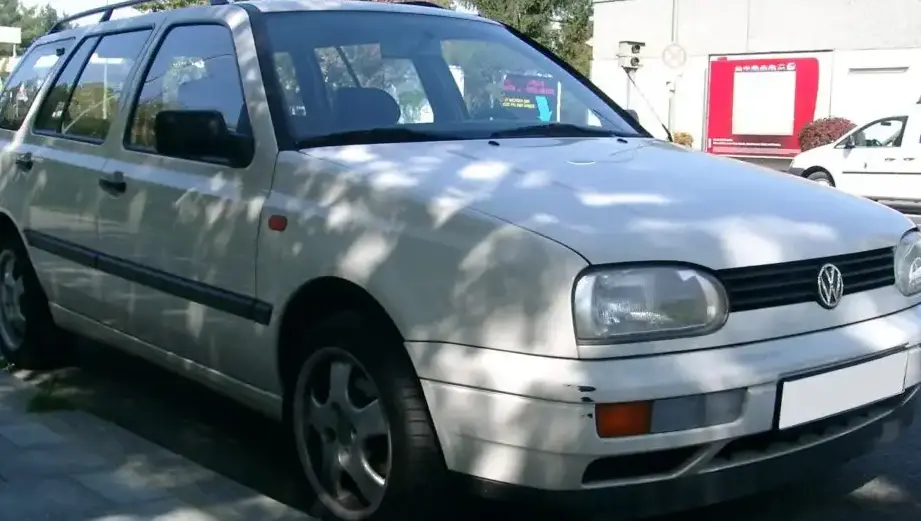
The Volkswagen Golf III Variant 1.9 TDI Automatic, produced between 1994 and 1999, represents a practical and fuel-efficient offering within the broader Golf Mk3 range. Positioned as a mid-range trim, it catered to buyers seeking the versatility of a station wagon (estate) body style combined with the economy of a diesel engine and the convenience of an automatic transmission. This variant was primarily sold in Europe, where station wagons held a significant market share, offering a compelling alternative to sedan models for families and those needing increased cargo capacity. It was built on the Volkswagen Group’s A3 platform, shared with models like the SEAT Ibiza, Skoda Octavia, and Audi A3.
Technical Specifications
| Brand | Volkswagen |
| Model | Golf |
| Generation | Golf III Variant |
| Type (Engine) | 1.9 TDI (90 Hp) Automatic |
| Start of production | 1994 |
| End of production | 1999 |
| Powertrain Architecture | Internal Combustion engine |
| Body type | Station wagon (estate) |
| Seats | 5 |
| Doors | 5 |
| Fuel consumption (urban) | 8.9 l/100 km (26.4 US mpg, 31.7 UK mpg, 11.2 km/l) |
| Fuel consumption (extra urban) | 4.8 l/100 km (49 US mpg, 58.9 UK mpg, 20.8 km/l) |
| Fuel consumption (combined) | 6.3 l/100 km (37.3 US mpg, 44.8 UK mpg, 15.9 km/l) |
| Fuel Type | Diesel |
| Acceleration 0 – 100 km/h | 13.1 sec |
| Acceleration 0 – 62 mph | 13.1 sec |
| Acceleration 0 – 60 mph | 12.4 sec |
| Maximum speed | 176 km/h (109.36 mph) |
| Weight-to-power ratio | 14.1 kg/Hp, 70.9 Hp/tonne |
| Weight-to-torque ratio | 6.3 kg/Nm, 159.1 Nm/tonne |
| Power | 90 Hp @ 4000 rpm |
| Power per litre | 47.5 Hp/l |
| Torque | 202 Nm @ 1900 rpm (148.99 lb.-ft. @ 1900 rpm) |
| Engine layout | Front, Longitudinal |
| Engine Model/Code | 1Z |
| Engine displacement | 1896 cm3 (115.7 cu. in.) |
| Number of cylinders | 4 |
| Engine configuration | Inline |
| Cylinder Bore | 79.5 mm (3.13 in.) |
| Piston Stroke | 95.5 mm (3.76 in.) |
| Compression ratio | 19.5:1 |
| Number of valves per cylinder | 2 |
| Fuel injection system | Direct injection |
| Engine aspiration | Turbocharger, Intercooler |
| Valvetrain | OHC |
| Engine oil capacity | 4.3 l (4.54 US qt | 3.78 UK qt) |
| Coolant capacity | 6.5 l (6.87 US qt | 5.72 UK qt) |
| Kerb Weight | 1270 kg (2799.87 lbs.) |
| Max. weight | 1695 kg (3736.84 lbs.) |
| Max load | 425 kg (936.96 lbs.) |
| Trunk (boot) space – minimum | 466 l (16.46 cu. ft.) |
| Trunk (boot) space – maximum | 1426 l (50.36 cu. ft.) |
| Fuel tank capacity | 60 l (15.85 US gal | 13.2 UK gal) |
| Length | 4340 mm (170.87 in.) |
| Width | 1695 mm (66.73 in.) |
| Height | 1430 mm (56.3 in.) |
| Wheelbase | 2475 mm (97.44 in.) |
| Front track | 1478 mm (58.19 in.) |
| Rear track | 1462 mm (57.56 in.) |
| Drivetrain Architecture | Front wheel drive |
| Number of gears | 4 |
| Gearbox type | Automatic transmission |
| Front suspension | Wishbone |
| Rear suspension | Suspension with traction connecting levers |
| Front brakes | Ventilated discs |
| Rear brakes | Drum |
| Assisting systems | ABS (Anti-lock braking system) |
| Steering type | Steering rack and pinion |
| Power steering | Hydraulic |
| Tires size | 195/60 R14 |
| Wheel rims size | 14 |
Powertrain & Engine Architecture
The heart of the Golf III Variant 1.9 TDI Automatic is the 1Z engine, a 1.9-liter, four-cylinder diesel engine. This engine utilizes direct injection technology, a key feature for improving fuel efficiency and reducing emissions. The 1Z engine is a longitudinal inline-four, meaning it’s mounted lengthwise in the engine bay. It features an overhead camshaft (OHC) valvetrain with two valves per cylinder. A turbocharger with an intercooler is employed to boost power output, delivering 90 horsepower at 4000 rpm and 202 Nm (148.99 lb-ft) of torque at a relatively low 1900 rpm. The automatic transmission is a four-speed unit, designed to provide smooth shifts and ease of driving, particularly in urban environments. This transmission, while offering convenience, does impact acceleration compared to the available five-speed manual gearbox.
Driving Characteristics
The 1.9 TDI Automatic variant delivers a driving experience focused on practicality and fuel economy rather than outright performance. Acceleration from 0-60 mph takes around 12.4 seconds, and top speed is approximately 109 mph. The automatic transmission, while convenient, results in some power loss compared to the manual version. Gear ratios are optimized for fuel efficiency, meaning the engine often operates at lower rpm during cruising. This contributes to excellent fuel economy – around 37.3 US mpg combined – but can feel somewhat sluggish when needing to accelerate quickly. The turbocharger does provide a noticeable boost in power once spooled up, but there’s a degree of turbo lag present. The overall driving experience is comfortable and predictable, making it well-suited for long journeys and everyday commuting.
Equipment & Trim Levels
The Golf III Variant 1.9 TDI Automatic typically came equipped with a reasonable level of standard features. Interior upholstery was usually cloth, with a functional, if somewhat basic, dashboard layout. Power windows and central locking were common, as was a radio/cassette player. Optional extras included air conditioning, alloy wheels, a sunroof, and upgraded audio systems. The Variant trim level itself signified the station wagon body style, offering increased cargo space compared to the hatchback. Safety features included ABS (Anti-lock Braking System) as standard, a significant advancement for the time.
Chassis & Braking
The Golf III Variant’s chassis features a wishbone front suspension and a torsion beam rear suspension with traction connecting levers. This setup provides a good balance between ride comfort and handling. Braking duties are handled by ventilated discs at the front and drum brakes at the rear. While adequate for the vehicle’s weight and performance, the rear drum brakes are a point of differentiation from higher-spec Golf models which often featured rear discs. The hydraulic power steering provides light and easy steering, making it maneuverable in tight spaces.
Market Reception & Comparison
The Golf III Variant 1.9 TDI Automatic was generally well-received by automotive critics as a practical and economical choice. Its fuel efficiency was a major selling point, particularly in Europe where diesel fuel was often cheaper than gasoline. Compared to the higher-performance Golf variants, such as the VR6, it lacked the same level of excitement, but it offered a significantly lower cost of ownership. Against other 1.9 TDI models, the automatic transmission was seen as a compromise – offering convenience at the expense of some performance and fuel economy. The 1.9 TDI manual was often preferred by driving enthusiasts.
Legacy
The 1Z engine, found in the Golf III Variant 1.9 TDI Automatic, is known for its durability and reliability. With proper maintenance, these engines can accumulate high mileage. Today, these cars are increasingly sought after by classic car enthusiasts and those looking for a reliable and economical used vehicle. Parts availability is generally good, although some trim-specific components may be harder to find. The Golf III Variant 1.9 TDI Automatic remains a testament to Volkswagen’s engineering prowess and its commitment to building practical and long-lasting vehicles.