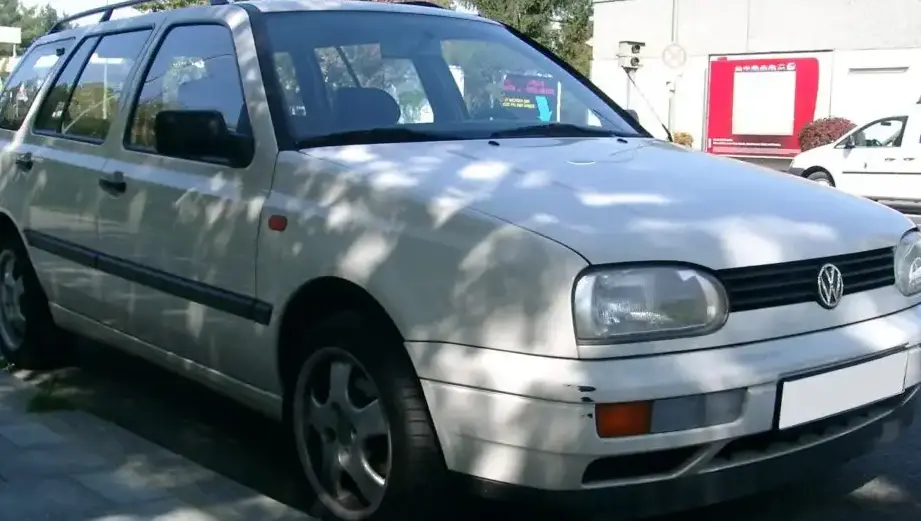
The Volkswagen Golf III Variant 2.9 VR6 Syncro, produced between 1994 and 1999, represents a unique and potent offering within the third-generation Golf lineup. Positioned as the performance and all-weather variant of the Golf estate (wagon), it combined the distinctive VR6 engine with Volkswagen’s Syncro all-wheel-drive system. This model catered to drivers seeking a practical, spacious vehicle with significantly enhanced performance compared to the standard Golf variants. It was built on the 1HX0/A3 platform, shared with other Volkswagen Group vehicles like the SEAT Ibiza, Cordoba, and the Skoda Octavia.
Technical Specifications
| Brand | Volkswagen |
| Model | Golf |
| Generation | Golf III Variant |
| Type (Engine) | 2.9 VR6 Syncro (190 Hp) |
| Start of production | 1994 |
| End of production | 1999 |
| Powertrain Architecture | Internal Combustion engine |
| Body type | Station wagon (estate) |
| Seats | 5 |
| Doors | 5 |
| Fuel consumption (economy) – urban | 16.1 l/100 km (14.6 US mpg, 17.5 UK mpg, 6.2 km/l) |
| Fuel consumption (economy) – extra urban | 8.2 l/100 km (28.7 US mpg, 34.4 UK mpg, 12.2 km/l) |
| Fuel consumption (economy) – combined | 10.6 l/100 km (22.2 US mpg, 26.6 UK mpg, 9.4 km/l) |
| Fuel Type | Petrol (Gasoline) |
| Acceleration 0 – 100 km/h | 8.1 sec |
| Acceleration 0 – 62 mph | 8.1 sec |
| Acceleration 0 – 60 mph | 7.7 sec |
| Maximum speed | 222 km/h (137.94 mph) |
| Weight-to-power ratio | 7.3 kg/Hp, 137.7 Hp/tonne |
| Weight-to-torque ratio | 5.6 kg/Nm, 177.5 Nm/tonne |
| Power | 190 Hp @ 5800 rpm |
| Power per litre | 66.4 Hp/l |
| Torque | 245 Nm @ 4200 rpm (180.7 lb.-ft. @ 4200 rpm) |
| Engine layout | Front, Transverse |
| Engine Model/Code | ABV |
| Engine displacement | 2861 cm3 (174.59 cu. in.) |
| Number of cylinders | 6 |
| Engine configuration | V-engine |
| Cylinder Bore | 82 mm (3.23 in.) |
| Piston Stroke | 90.3 mm (3.56 in.) |
| Compression ratio | 10:1 |
| Number of valves per cylinder | 2 |
| Fuel injection system | Multi-port manifold injection |
| Engine aspiration | Naturally aspirated engine |
| Valvetrain | DOHC |
| Engine oil capacity | 5.5 l (5.81 US qt | 4.84 UK qt) |
| Coolant | 10 l (10.57 US qt | 8.8 UK qt) |
| Kerb Weight | 1380 kg (3042.38 lbs.) |
| Max. weight | 1860 kg (4100.6 lbs.) |
| Max load | 480 kg (1058.22 lbs.) |
| Trunk (boot) space – minimum | 466 l (16.46 cu. ft.) |
| Trunk (boot) space – maximum | 1425 l (50.32 cu. ft.) |
| Fuel tank capacity | 65 l (17.17 US gal | 14.3 UK gal) |
| Length | 4340 mm (170.87 in.) |
| Width | 1695 mm (66.73 in.) |
| Height | 1430 mm (56.3 in.) |
| Wheelbase | 2475 mm (97.44 in.) |
| Front track | 1478 mm (58.19 in.) |
| Rear (Back) track | 1465 mm (57.68 in.) |
| Drive wheel | All wheel drive (4×4) |
| Number of gears and type of gearbox | 5 gears, manual transmission |
| Front suspension | Wishbone |
| Rear suspension | Suspension with traction connecting levers |
| Front brakes | Ventilated discs |
| Rear brakes | Disc |
| Assisting systems | ABS (Anti-lock braking system) |
| Steering type | Steering rack and pinion |
| Power steering | Hydraulic Steering |
| Tires size | 205/50 R15 |
| Wheel rims size | 6.5J x 15 |
Powertrain & Engine Architecture
The heart of the Golf III Variant 2.9 VR6 Syncro is the ABV engine code, a 2.9-liter naturally aspirated V6. This engine is a narrow-angle V6, meaning the cylinder banks are relatively close together, allowing it to be packaged more compactly than a traditional V6. It features dual overhead camshafts (DOHC) and multi-port fuel injection. The ABV produced 190 horsepower at 5800 rpm and 245 Nm (180.7 lb-ft) of torque at 4200 rpm. The engine’s unique firing order contributes to its distinctive exhaust note. The five-speed manual transmission was the only gearbox option available with this engine and drivetrain combination, prioritizing driver engagement and performance.
Driving Characteristics
The 2.9 VR6 Syncro offered a significantly different driving experience compared to the more common Golf variants. The engine’s power delivery was smooth and linear, providing strong acceleration throughout the rev range. The Syncro all-wheel-drive system enhanced traction, particularly in adverse weather conditions, making it a capable year-round vehicle. While not a dedicated sports car, the VR6 Syncro provided a responsive and engaging driving experience. The five-speed manual transmission allowed for precise control, and the relatively short gear ratios helped maximize the engine’s performance. Compared to the 1.8L or diesel Golfs, the VR6 offered a substantial performance upgrade, but at the cost of increased fuel consumption.
Equipment & Trim Levels
The Golf III Variant 2.9 VR6 Syncro typically came well-equipped, reflecting its position as a premium trim level. Standard features often included power windows, central locking, power steering, and an anti-lock braking system (ABS). Interior upholstery was typically cloth, although leather options were available. Dashboard configuration was consistent with other Golf III variants, featuring a functional and straightforward design. Optional extras included a sunroof, air conditioning, and upgraded audio systems. The Syncro models also featured a distinctive instrument cluster with gauges for monitoring the all-wheel-drive system.
Chassis & Braking
The Golf III Variant 2.9 VR6 Syncro utilized a robust chassis designed to handle the increased power and all-wheel-drive system. The front suspension featured independent wishbones, while the rear suspension employed a torsion beam setup with traction connecting levers. Braking duties were handled by ventilated discs at the front and solid discs at the rear. The ABS system provided enhanced braking control, particularly on slippery surfaces. The Syncro system added weight, necessitating slightly stiffer suspension components compared to front-wheel-drive Golfs.
Market Reception & Comparison
The Golf III Variant 2.9 VR6 Syncro was generally well-received by automotive critics. It was praised for its strong performance, all-weather capability, and spacious interior. However, its relatively high price and increased fuel consumption were noted as drawbacks. Compared to the standard Golf variants, the VR6 Syncro offered a significant performance upgrade but came at a premium. Against competitors like the Audi A4 Avant or BMW Touring, it offered a more affordable alternative with a unique character. Fuel economy was considerably lower than the 1.8L or TDI models, averaging around 22.2 US mpg combined.
Legacy
The Golf III Variant 2.9 VR6 Syncro has become a sought-after classic among Volkswagen enthusiasts. The ABV engine is known for its durability and relatively straightforward maintenance, although parts availability can be a concern. The Syncro all-wheel-drive system adds to its collectibility, as it represents a rare and capable variant. Today, well-maintained examples command a premium in the used car market. The combination of performance, practicality, and all-weather capability has cemented its place as a memorable and desirable vehicle from the 1990s.