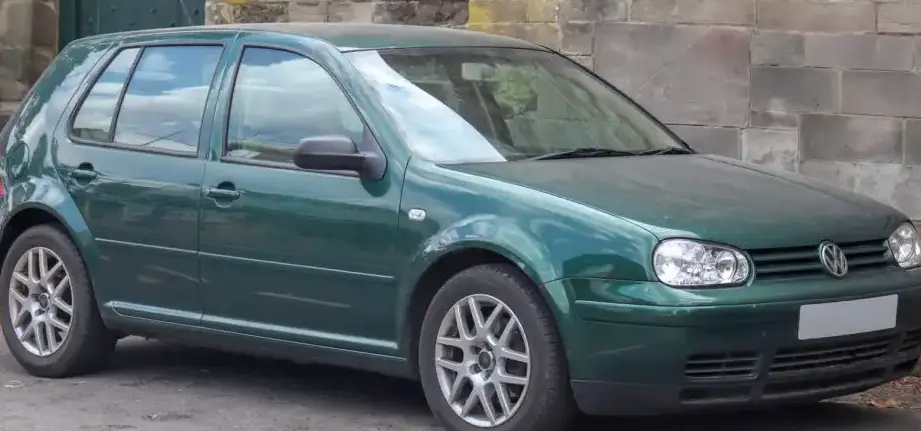
The Volkswagen Golf IV 1.6 i 16V FSI, produced from 2002 to 2003, represents a significant iteration within the fourth generation (Mk IV) Golf lineup, known internally as the 1HX0/A3 platform. This variant occupied a middle-ground position in the Golf IV range, offering a balance between affordability, fuel efficiency, and acceptable performance. It was primarily marketed in Europe as a practical and economical choice for everyday commuting and family transport. The introduction of Fuel Stratified Injection (FSI) technology marked a step forward in engine efficiency for Volkswagen at the time.
Technical Specifications
| Brand | Volkswagen |
| Model | Golf |
| Generation | Golf IV |
| Type (Engine) | 1.6 i 16V FSI (110 Hp) |
| Start of production | 2002 |
| End of production | 2003 |
| Powertrain Architecture | Internal Combustion engine |
| Body type | Hatchback |
| Seats | 5 |
| Doors | 3-5 |
| Fuel consumption (urban) | 7.9 l/100 km (29.8 US mpg, 35.8 UK mpg, 12.7 km/l) |
| Fuel consumption (extra urban) | 5.2 l/100 km (45.2 US mpg, 54.3 UK mpg, 19.2 km/l) |
| Fuel consumption (combined) | 6.2 l/100 km (37.9 US mpg, 45.6 UK mpg, 16.1 km/l) |
| Fuel Type | Petrol (Gasoline) |
| Acceleration 0 – 100 km/h | 10.6 sec |
| Acceleration 0 – 62 mph | 10.6 sec |
| Acceleration 0 – 60 mph | 10.1 sec |
| Maximum speed | 194 km/h (120.55 mph) |
| Weight-to-power ratio | 10.2 kg/Hp, 97.8 Hp/tonne |
| Weight-to-torque ratio | 7.3 kg/Nm, 137.8 Nm/tonne |
| Power | 110 Hp @ 5800 rpm |
| Power per litre | 68.8 Hp/l |
| Torque | 155 Nm @ 4500 rpm (114.32 lb.-ft. @ 4500 rpm) |
| Engine layout | Front, Transverse |
| Engine Model/Code | BAD |
| Engine displacement | 1598 cm3 (97.52 cu. in.) |
| Number of cylinders | 4 |
| Engine configuration | Inline |
| Cylinder Bore | 76.5 mm (3.01 in.) |
| Piston Stroke | 86.9 mm (3.42 in.) |
| Compression ratio | 12:1 |
| Number of valves per cylinder | 4 |
| Fuel injection system | Direct injection |
| Engine aspiration | Naturally aspirated engine |
| Engine oil capacity | 3.5 l (3.7 US qt | 3.08 UK qt) |
| Coolant | 6 l (6.34 US qt | 5.28 UK qt) |
| Kerb Weight | 1125 kg (2480.2 lbs.) |
| Trunk (boot) space – minimum | 175 l (6.18 cu. ft.) |
| Trunk (boot) space – maximum | 1184 l (41.81 cu. ft.) |
| Fuel tank capacity | 55 l (14.53 US gal | 12.1 UK gal) |
| Length | 4149 mm (163.35 in.) |
| Width | 1735 mm (68.31 in.) |
| Height | 1439 mm (56.65 in.) |
| Wheelbase | 2511 mm (98.86 in.) |
| Front track | 1513 mm (59.57 in.) |
| Rear (Back) track | 1494 mm (58.82 in.) |
| Drivetrain Architecture | The Internal combustion engine (ICE) drives the front wheels of the vehicle. |
| Drive wheel | Front wheel drive |
| Number of gears and type of gearbox | 5 gears, manual transmission |
| Front suspension | Wishbone |
| Rear suspension | Coil spring |
| Front brakes | Ventilated discs |
| Rear brakes | Disc |
| Assisting systems | ABS (Anti-lock braking system) |
| Steering type | Steering rack and pinion |
| Power steering | Hydraulic Steering |
| Tires size | 195/65 R15 |
| Wheel rims size | 6J x 15 |
INTRODUCTION
The Golf IV 1.6 i 16V FSI was introduced as Volkswagen sought to refine the already successful Mk IV Golf. The Mk IV, launched in 1997, had established a reputation for build quality and a comfortable ride. The 1.6 FSI engine was a key component of this update, offering improved fuel economy and a slightly increased power output compared to the older 1.6-liter non-FSI engines. This variant was typically offered in both 3-door and 5-door hatchback configurations, catering to a broad range of buyers. It aimed to provide a more sophisticated and efficient option than the base-level Golf models, while remaining more accessible than the higher-performance GTI or diesel variants.
Powertrain & Engine Architecture
The heart of this Golf variant is the 1.6-liter inline-four cylinder engine, designated BAD. This engine utilizes Volkswagen’s FSI (Fuel Stratified Injection) direct injection technology. Unlike traditional port fuel injection, FSI injects fuel directly into the combustion chamber, allowing for more precise fuel control, higher compression ratios, and improved thermal efficiency. The engine features a 12:1 compression ratio and four valves per cylinder (16V), contributing to its relatively high specific output. The engine’s output of 110 horsepower at 5800 rpm and 155 Nm (114 lb-ft) of torque at 4500 rpm was respectable for its displacement. The engine is transversely mounted, driving the front wheels. The transmission is a 5-speed manual gearbox, providing a balance between fuel economy and driver engagement. While an automatic transmission was available on other Golf IV models, it was less common with the 1.6 FSI engine.
Driving Characteristics
The Golf IV 1.6 i 16V FSI with a manual transmission offered a reasonably engaging driving experience. Acceleration from 0-60 mph took around 10.1 seconds, and top speed was approximately 120.55 mph. While not particularly quick, the engine provided adequate power for everyday driving and highway cruising. The FSI engine delivered a smooth and linear power delivery, making it easy to modulate throttle response. The 5-speed gearbox was well-matched to the engine’s characteristics, allowing drivers to keep the engine in its optimal power band. Compared to the more powerful Golf GTI or the torquey TDI diesel models, the 1.6 FSI felt less responsive, particularly during overtaking maneuvers. However, it offered a noticeable improvement in fuel economy and refinement over the base 1.6-liter engine.
Equipment & Trim Levels
The Golf IV 1.6 i 16V FSI typically came equipped with a reasonable level of standard features. These included central locking, power windows, power steering, and an anti-lock braking system (ABS). Interior upholstery was typically cloth, with a relatively simple dashboard layout. Optional extras included alloy wheels, air conditioning, a sunroof, and a CD stereo system. Higher trim levels, such as the ‘Trendline’ or ‘Comfortline’, added additional features like upgraded upholstery, climate control, and more sophisticated audio systems. The overall interior ambiance was functional and well-built, reflecting Volkswagen’s reputation for quality.
Chassis & Braking
The Golf IV utilized a MacPherson strut front suspension and a multi-link rear suspension, providing a comfortable and controlled ride. The chassis was well-tuned, offering good handling characteristics and stability. The front brakes were ventilated discs, providing ample stopping power, while the rear brakes were solid discs. The steering was a hydraulic power-assisted rack and pinion system, offering precise and responsive steering feel. The standard tire size was 195/65 R15, providing a good balance between comfort and grip.
Market Reception & Comparison
The Golf IV 1.6 i 16V FSI was generally well-received by automotive critics. It was praised for its fuel efficiency, refined engine, and comfortable ride. However, some critics noted that its performance was somewhat underwhelming compared to other Golf IV variants. Compared to the 1.8-liter petrol engine, the 1.6 FSI offered slightly better fuel economy but less power. The diesel TDI models provided significantly more torque and even better fuel economy, but at a higher initial cost. The 1.6 FSI appealed to buyers who prioritized fuel efficiency and affordability over outright performance.
Legacy
The Golf IV 1.6 i 16V FSI has proven to be a relatively reliable vehicle, with many examples still on the road today. The FSI engine, while more complex than older designs, has generally proven durable with regular maintenance. Common issues include occasional problems with the fuel injectors and the ignition coils. In the used car market, these Golfs are often sought after as affordable and practical transportation. Their relatively simple mechanical design and readily available parts make them relatively easy to maintain. While not a particularly collectible variant, the 1.6 FSI represents a significant step in Volkswagen’s engine technology and remains a popular choice for budget-conscious buyers.