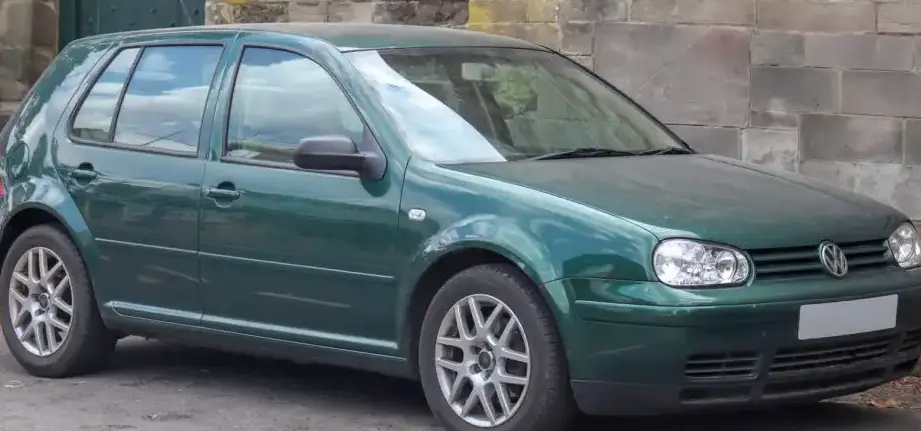
The Volkswagen Golf IV 1.8T 20V, produced from 1997 to 2003, represents a significant evolution in the Golf lineage. Positioned as a mid-range offering within the fourth-generation Golf (Mk IV) lineup – chassis codes 1HX0 for the hatchback and 1J5 for the wagon – this variant combined a turbocharged 1.8-liter engine with a five-speed automatic transmission. It aimed to provide a balance of performance and convenience, appealing to buyers who desired the benefits of forced induction without the complexity of a manual gearbox. The Golf IV itself was a pivotal model for Volkswagen, solidifying its reputation for build quality, refinement, and a relatively sporty driving experience in the compact class.
Technical Specifications
| Brand | Volkswagen |
| Model | Golf |
| Generation | Golf IV |
| Type (Engine) | 1.8 T 20V (150 Hp) |
| Start of production | 1997 |
| End of production | 2003 |
| Powertrain Architecture | Internal Combustion engine |
| Body type | Hatchback |
| Seats | 5 |
| Doors | 3-5 |
| Fuel consumption (urban) | 10.8 l/100 km (21.8 US mpg) |
| Fuel consumption (extra urban) | 6.1 l/100 km (38.6 US mpg) |
| Fuel Type | Petrol (Gasoline) |
| Acceleration 0 – 100 km/h | 8.5 sec |
| Acceleration 0 – 62 mph | 8.5 sec |
| Acceleration 0 – 60 mph | 8.1 sec |
| Maximum speed | 216 km/h (134.22 mph) |
| Weight-to-power ratio | 8.3 kg/Hp |
| Weight-to-torque ratio | 5.9 kg/Nm |
| Power | 150 Hp @ 5700 rpm |
| Torque | 210 Nm @ 1750 rpm (154.89 lb.-ft. @ 1750 rpm) |
| Engine layout | Front, Longitudinal |
| Engine Model/Code | AGU, AQA, ARZ, AUM, AWD, AWW |
| Engine displacement | 1781 cm3 (108.68 cu. in.) |
| Number of cylinders | 4 |
| Engine configuration | Inline |
| Cylinder Bore | 81 mm (3.19 in.) |
| Piston Stroke | 86.4 mm (3.4 in.) |
| Compression ratio | 9.5:1 |
| Number of valves per cylinder | 5 |
| Fuel injection system | Multi-port manifold injection |
| Engine aspiration | Turbocharger |
| Valvetrain | DOHC |
| Engine oil capacity | 4.5 l (4.76 US qt | 3.96 UK qt) |
| Coolant capacity | 5 l (5.28 US qt | 4.4 UK qt) |
| Kerb Weight | 1240 kg (2733.73 lbs.) |
| Max. weight | 1740 kg (3836.04 lbs.) |
| Max load | 500 kg (1102.31 lbs.) |
| Trunk (boot) space – minimum | 330 l (11.65 cu. ft.) |
| Trunk (boot) space – maximum | 1184 l (41.81 cu. ft.) |
| Fuel tank capacity | 55 l (14.53 US gal | 12.1 UK gal) |
| Length | 4149 mm (163.35 in.) |
| Width | 1735 mm (68.31 in.) |
| Height | 1439 mm (56.65 in.) |
| Wheelbase | 2511 mm (98.86 in.) |
| Front track | 1513 mm (59.57 in.) |
| Rear track | 1494 mm (58.82 in.) |
| Drivetrain Architecture | Front wheel drive |
| Number of gears | 5 |
| Gearbox type | Automatic transmission |
Powertrain & Engine Architecture
At the heart of the Golf IV 1.8T 20V lies the Volkswagen EA827 engine family. Specifically, this variant utilized engine codes such as AGU, AQA, ARZ, AUM, AWW, and others depending on the production year and market. The engine is a 1.8-liter, inline-four cylinder powerplant featuring a cast iron block and an aluminum cylinder head. The “20V” designation refers to the five valves per cylinder (three intake, two exhaust) configuration, contributing to improved breathing and higher-RPM performance. A single turbocharger, typically a Garrett or BorgWarner unit, provides forced induction, boosting power output significantly compared to naturally aspirated versions. Fuel delivery is managed by a Bosch Motronic electronic fuel injection system, utilizing multi-port fuel injection. The automatic transmission used was typically a 5-speed unit, offering smooth shifts but sacrificing some of the responsiveness found in the manual transmission versions.
Driving Characteristics
The 1.8T automatic Golf IV offered a comfortable and refined driving experience. While not as overtly sporty as the GTI or the manual transmission versions, the turbocharger provided a noticeable surge of power during acceleration. The automatic transmission, while smooth, did introduce some power loss compared to the manual. Gear ratios were tuned for a balance of fuel economy and usability, with a focus on providing adequate torque for everyday driving situations. 0-60 mph times were typically around 8.1-8.5 seconds, respectable for a family hatchback of that era. The automatic transmission did tend to hunt for gears on inclines or during aggressive driving, a common characteristic of older automatic transmissions.
Equipment & Trim Levels
The 1.8T automatic typically fell into the mid-range of the Golf IV trim levels. Standard equipment often included power windows, power locks, air conditioning, an AM/FM radio with cassette player, and alloy wheels. Higher trim levels, such as the GL, added features like a sunroof, upgraded upholstery, and a more sophisticated audio system. Optional extras included leather seats, heated front seats, automatic climate control, and a CD changer. Interior upholstery was typically cloth, with leather available as an upgrade. The dashboard layout was functional and well-designed, with clear instrumentation and logically placed controls.
Chassis & Braking
The Golf IV utilized an independent front suspension with wishbones and a multi-link rear suspension, providing a comfortable ride and good handling characteristics. The 1.8T automatic models typically featured disc brakes on all four wheels, although some base models may have had drum brakes on the rear. Anti-lock Braking System (ABS) was standard equipment. Stabilizer bars were fitted to both the front and rear axles to reduce body roll during cornering. The suspension tuning was geared towards comfort and everyday usability, rather than outright sportiness.
Market Reception & Comparison
The Golf IV 1.8T automatic was generally well-received by automotive critics. It was praised for its refined engine, comfortable ride, and practical interior. However, some critics noted that the automatic transmission dulled the driving experience compared to the manual version. Fuel economy was considered reasonable for a turbocharged engine, averaging around 22-28 mpg in mixed driving. Compared to the higher-performance GTI, the 1.8T automatic offered less outright speed but greater fuel efficiency and a more relaxed driving experience. Compared to the diesel variants (like the 1.9 TDI), the 1.8T offered quicker acceleration but higher fuel consumption.
Legacy
The Golf IV 1.8T 20V, particularly with the automatic transmission, has proven to be a relatively reliable powertrain. While age and mileage inevitably lead to wear and tear, the engine is generally robust and capable of high mileage with proper maintenance. Common issues include turbocharger failure, oil leaks, and problems with the automatic transmission. In the used car market today, these Golfs are often sought after as affordable and practical transportation. They represent a sweet spot in the Golf lineage, offering a blend of modern features, reasonable performance, and a relatively affordable price point. The 1.8T engine, in particular, remains a popular choice for enthusiasts due to its tuning potential and readily available aftermarket support.