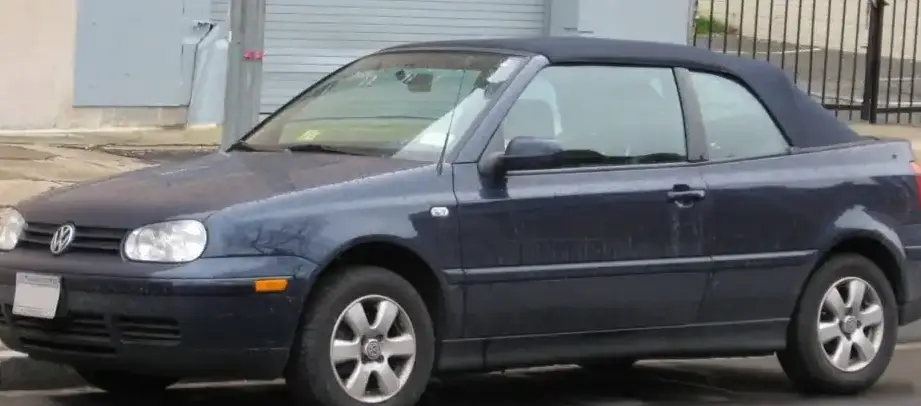
The Volkswagen Golf IV Cabrio 1.6i, produced between April 1998 and October 2000, represented the final iteration of the Mk4 Golf Cabriolet before its discontinuation. Positioned as the entry-level offering in the Golf IV Cabrio range, it provided an accessible open-top motoring experience within the popular Golf family. Built on the Golf IV platform (1HX0/A3), this variant aimed to balance affordability with the Golf’s renowned practicality and build quality. It was primarily marketed in Europe, where the convertible Golf held a significant appeal, offering a stylish and relatively affordable alternative to more premium drop-tops.
Technical Specifications
| Brand | Volkswagen |
| Model | Golf |
| Generation | Golf IV Cabrio |
| Type (Engine) | 1.6i (101 Hp) |
| Start of production | April, 1998 |
| End of production | October, 2000 |
| Powertrain Architecture | Internal Combustion engine |
| Body type | Cabriolet |
| Seats | 4 |
| Doors | 2 |
| Fuel consumption (urban) | 11.1 l/100 km (21.2 US mpg) |
| Fuel consumption (extra urban) | 6.5 l/100 km (36.2 US mpg) |
| Fuel Type | Petrol (Gasoline) |
| Acceleration 0 – 100 km/h | 11.9 sec |
| Acceleration 0 – 62 mph | 11.9 sec |
| Acceleration 0 – 60 mph | 11.3 sec |
| Maximum speed | 182 km/h (113.09 mph) |
| Weight-to-power ratio | 11.7 kg/Hp |
| Weight-to-torque ratio | 8.2 kg/Nm |
| Power | 101 Hp @ 5600 rpm |
| Torque | 145 Nm @ 3800 rpm (106.95 lb.-ft. @ 3800 rpm) |
| Engine layout | Front, Longitudinal |
| Engine Model/Code | AFT, AKS |
| Engine displacement | 1595 cm3 (97.33 cu. in.) |
| Number of cylinders | 4 |
| Engine configuration | Inline |
| Cylinder Bore | 81 mm (3.19 in.) |
| Piston Stroke | 77.4 mm (3.05 in.) |
| Compression ratio | 10.3:1 |
| Number of valves per cylinder | 2 |
| Fuel injection system | Multi-port manifold injection |
| Engine aspiration | Naturally aspirated engine |
| Valvetrain | OHC |
| Engine oil capacity | 4 l (4.23 US qt | 3.52 UK qt) |
| Coolant | 5.5 l (5.81 US qt | 4.84 UK qt) |
| Kerb Weight | 1185 kg (2612.48 lbs.) |
| Max. weight | 1580 kg (3483.3 lbs.) |
| Max load | 395 kg (870.83 lbs.) |
| Trunk (boot) space – minimum | 270 l (9.53 cu. ft.) |
| Trunk (boot) space – maximum | 448 l (15.82 cu. ft.) |
| Fuel tank capacity | 55 l (14.53 US gal | 12.1 UK gal) |
| Length | 4081 mm (160.67 in.) |
| Width | 1695 mm (66.73 in.) |
| Height | 1425 mm (56.1 in.) |
| Wheelbase | 2472 mm (97.32 in.) |
| Front track | 1464 mm (57.64 in.) |
| Rear (Back) track | 1428 mm (56.22 in.) |
| Drivetrain Architecture | The Internal combustion engine (ICE) drives the front wheels of the vehicle. |
| Drive wheel | Front wheel drive |
| Number of gears and type of gearbox | 5 gears, manual transmission |
| Front suspension | Spring Strut |
| Rear suspension | Coil spring |
| Front brakes | Ventilated discs |
| Rear brakes | Disc |
| Assisting systems | ABS (Anti-lock braking system) |
| Steering type | Steering rack and pinion |
| Power steering | Hydraulic Steering |
| Tires size | 185/60 R14 |
| Wheel rims size | 14 |
Powertrain & Engine Architecture
The Golf IV Cabrio 1.6i was powered by the Volkswagen AFT or AKS engine, a 1.6-liter inline-four cylinder gasoline engine. This engine was a mainstay in the Volkswagen Group’s lineup during the late 1990s and early 2000s, known for its relative simplicity and durability. The engine featured a single overhead camshaft (OHC) design with two valves per cylinder. Fuel delivery was handled by a multi-port fuel injection system, providing adequate, though not exceptional, performance. The 1.6L engine produced 101 horsepower at 5600 rpm and 145 Nm (107 lb-ft) of torque at 3800 rpm. The engine was mounted longitudinally in the front of the vehicle, driving the front wheels. The standard transmission was a five-speed manual, though a four-speed automatic transmission was also available, albeit less common. The automatic transmission, while offering convenience, noticeably impacted acceleration and fuel economy.
Driving Characteristics
The 1.6i Golf Cabriolet offered a comfortable, but not particularly sporty, driving experience. With 101 horsepower propelling approximately 2600 pounds, acceleration was adequate for everyday driving, but overtaking maneuvers required planning. The 0-60 mph time was around 11.3 seconds, and top speed was approximately 113 mph. The five-speed manual transmission allowed drivers to keep the engine in its optimal power band, while the optional four-speed automatic resulted in a more relaxed, but less engaging, driving experience. The automatic transmission’s gear ratios were spaced to prioritize fuel efficiency over performance. Steering was light and precise, typical of Volkswagen’s steering systems of the era. The suspension provided a comfortable ride, absorbing most road imperfections, but body roll was noticeable during cornering.
Equipment & Trim Levels
The 1.6i Cabriolet typically came with a modest level of standard equipment. Interior features included cloth upholstery, a basic stereo system, and manual windows and door locks. Power steering was standard. Optional extras included alloy wheels, upgraded stereo systems, air conditioning, and a leather-wrapped steering wheel. The trim level was generally considered the base model, focusing on providing an affordable entry point into Golf Cabriolet ownership. The interior dashboard layout was typical of the Mk4 Golf, with a functional, if somewhat dated, design. Safety features included driver and passenger airbags and ABS brakes.
Chassis & Braking
The Golf IV Cabriolet utilized a MacPherson strut front suspension and a coil spring rear suspension. This setup provided a good balance between ride comfort and handling. The front brakes were ventilated discs, offering good stopping power, while the rear brakes were solid discs. ABS (Anti-lock Braking System) was standard, enhancing safety during emergency braking situations. The chassis was reinforced to compensate for the lack of a fixed roof, providing adequate torsional rigidity. Stabilizer bars were fitted to both the front and rear axles to reduce body roll.
Market Reception & Comparison
The Golf IV Cabrio 1.6i was generally well-received as an affordable and practical open-top car. Critics noted its comfortable ride, decent fuel economy, and the inherent practicality of the Golf platform. However, the 1.6-liter engine was often criticized for being underpowered, particularly when compared to the more potent 1.8-liter and VR6 variants. The 1.8-liter offered a noticeable performance boost, while the VR6 provided significantly more power and a more refined driving experience. The 1.9 TDI diesel version offered superior fuel economy and torque, but at the expense of refinement. The 1.6i appealed to buyers prioritizing affordability and fuel efficiency over outright performance.
Legacy
The Golf IV Cabrio 1.6i remains a relatively common sight on the used car market, particularly in Europe. The AFT/AKS engine is known for its reliability, provided it has been properly maintained. Common issues include oil leaks and occasional sensor failures. The automatic transmission, while convenient, is generally considered less durable than the manual gearbox. Today, these cars are often sought after by enthusiasts looking for a classic, affordable convertible. Parts availability is generally good, thanks to the Golf IV’s widespread popularity. While not a performance icon, the 1.6i Golf Cabriolet represents a practical and enjoyable entry point into the world of classic Volkswagen motoring.