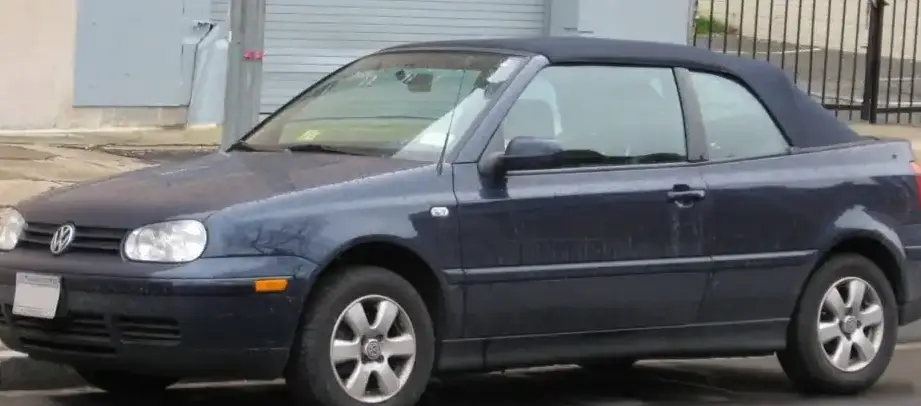
The Volkswagen Golf IV Cabrio 1.6i Automatic, produced between April 1998 and October 2000, represented an accessible entry point into the fourth-generation Golf Cabriolet range. Positioned as the base model, it offered open-air motoring with a focus on affordability and ease of use. This variant utilized the AFT or AKS engine code, falling within the broader 1HX0/A3 platform shared with other Volkswagen Group vehicles like the Bora, New Beetle, and Audi A3. It was primarily marketed in Europe, where the Golf Cabriolet maintained a strong following as a stylish and practical convertible.
Technical Specifications
| Brand | Volkswagen |
| Model | Golf |
| Generation | Golf IV Cabrio |
| Type (Engine) | 1.6i (101 Hp) Automatic |
| Start of production | April, 1998 |
| End of production | October, 2000 |
| Powertrain Architecture | Internal Combustion engine |
| Body type | Cabriolet |
| Seats | 4 |
| Doors | 2 |
| Fuel consumption (urban) | 13.4 l/100 km (17.6 US mpg, 21.1 UK mpg, 7.5 km/l) |
| Fuel consumption (extra urban) | 7 l/100 km (33.6 US mpg, 40.4 UK mpg, 14.3 km/l) |
| Fuel Type | Petrol (Gasoline) |
| Acceleration 0 – 100 km/h | 13.8 sec |
| Acceleration 0 – 62 mph | 13.8 sec |
| Acceleration 0 – 60 mph | 13.1 sec |
| Maximum speed | 179 km/h (111.23 mph) |
| Weight-to-power ratio | 11.7 kg/Hp, 85.2 Hp/tonne |
| Weight-to-torque ratio | 8.2 kg/Nm, 122.4 Nm/tonne |
| Power | 101 Hp @ 5600 rpm |
| Power per litre | 63.3 Hp/l |
| Torque | 145 Nm @ 3800 rpm (106.95 lb.-ft. @ 3800 rpm) |
| Engine layout | Front, Longitudinal |
| Engine Model/Code | AFT, AKS |
| Engine displacement | 1595 cm3 (97.33 cu. in.) |
| Number of cylinders | 4 |
| Engine configuration | Inline |
| Cylinder Bore | 81 mm (3.19 in.) |
| Piston Stroke | 77.4 mm (3.05 in.) |
| Compression ratio | 10.3:1 |
| Number of valves per cylinder | 2 |
| Fuel injection system | Multi-port manifold injection |
| Engine aspiration | Naturally aspirated engine |
| Valvetrain | OHC |
| Engine oil capacity | 4 l (4.23 US qt | 3.52 UK qt) |
| Coolant | 5.5 l (5.81 US qt | 4.84 UK qt) |
| Kerb Weight | 1185 kg (2612.48 lbs.) |
| Max. weight | 1580 kg (3483.3 lbs.) |
| Max load | 395 kg (870.83 lbs.) |
| Trunk (boot) space – minimum | 270 l (9.53 cu. ft.) |
| Trunk (boot) space – maximum | 448 l (15.82 cu. ft.) |
| Fuel tank capacity | 55 l (14.53 US gal | 12.1 UK gal) |
| Length | 4081 mm (160.67 in.) |
| Width | 1695 mm (66.73 in.) |
| Height | 1425 mm (56.1 in.) |
| Wheelbase | 2472 mm (97.32 in.) |
| Front track | 1464 mm (57.64 in.) |
| Rear (Back) track | 1428 mm (56.22 in.) |
| Drivetrain Architecture | The Internal combustion engine (ICE) drives the front wheels of the vehicle. |
| Drive wheel | Front wheel drive |
| Number of gears and type of gearbox | 4 gears, automatic transmission |
| Front suspension | Spring Strut |
| Rear suspension | Coil spring |
| Front brakes | Ventilated discs |
| Rear brakes | Disc |
| Assisting systems | ABS (Anti-lock braking system) |
| Steering type | Steering rack and pinion |
| Power steering | Hydraulic Steering |
| Tires size | 185/60 R14 |
| Wheel rims size | 6J x 14 |
Powertrain & Engine Architecture
The heart of the Golf IV Cabrio 1.6i Automatic was the 1.6-liter, inline four-cylinder engine, designated AFT or AKS depending on minor variations. This engine was a relatively simple, naturally aspirated unit featuring a single overhead camshaft (OHC) and multi-port fuel injection. The 1595cc displacement produced 101 horsepower at 5600 rpm and 145 Nm (107 lb-ft) of torque at 3800 rpm. The engine’s design prioritized fuel efficiency and smooth operation over outright performance. The automatic transmission was a conventional four-speed unit, chosen for its ease of use and suitability for urban driving. It wasn’t known for particularly quick shifts, but it provided a comfortable driving experience.
Driving Characteristics
The 1.6i Automatic Golf Cabriolet offered a relaxed driving experience. Acceleration was modest, taking around 13.8 seconds to reach 62 mph (100 km/h). The automatic transmission, while convenient, did detract from the engine’s available power, resulting in a noticeable difference in responsiveness compared to the five-speed manual versions. Gear ratios were optimized for fuel economy rather than spirited driving. The car felt best suited for cruising and city commutes, rather than aggressive cornering or highway passing. The power delivery was linear, but the engine lacked the punch of the more powerful 1.8-liter or VR6 variants.
Equipment & Trim Levels
The 1.6i Automatic typically came with a fairly basic level of equipment. Standard features generally included power steering, central locking, electric front windows, and an AM/FM radio. Interior upholstery was typically cloth, with a relatively simple dashboard layout. Optional extras included alloy wheels, air conditioning, a sunroof (in addition to the convertible top), and upgraded audio systems. The trim level was generally considered the entry-level offering, appealing to buyers prioritizing affordability and practicality.
Chassis & Braking
The Golf IV Cabriolet’s chassis was based on the Golf IV platform, offering a reasonable balance of comfort and handling. The front suspension utilized spring struts, while the rear employed a coil spring setup. Braking was provided by ventilated discs at the front and solid discs at the rear. ABS (Anti-lock Braking System) was standard, enhancing safety. The suspension tuning was geared towards comfort, resulting in a relatively soft ride. Stabilizer bars were present, but were typically smaller in diameter compared to those found on higher-performance models.
Market Reception & Comparison
The Golf IV Cabrio 1.6i Automatic was generally well-received as an affordable and accessible convertible. Critics acknowledged its practicality and ease of use, but often noted its lack of performance compared to other Golf Cabriolet variants, such as the 1.8 or VR6 models. The 1.8-liter engine offered a significant power boost, while the VR6 provided a more luxurious and sporty experience. The 1.9 TDI diesel offered superior fuel economy, but at the expense of refinement. The 1.6i Automatic appealed to buyers who prioritized affordability and a comfortable driving experience over outright performance.
Legacy
The AFT/AKS 1.6-liter engine and the four-speed automatic transmission pairing, while not known for being particularly exciting, proved to be relatively reliable. Properly maintained examples can still be found on the used car market today. Common issues are generally related to age and wear, such as oil leaks and corrosion. The Golf IV Cabriolet, in general, has become a popular choice for classic car enthusiasts, and the 1.6i Automatic represents an affordable entry point into Golf Cabriolet ownership. Its simplicity and ease of maintenance make it a relatively straightforward car to own and enjoy, even after two decades.