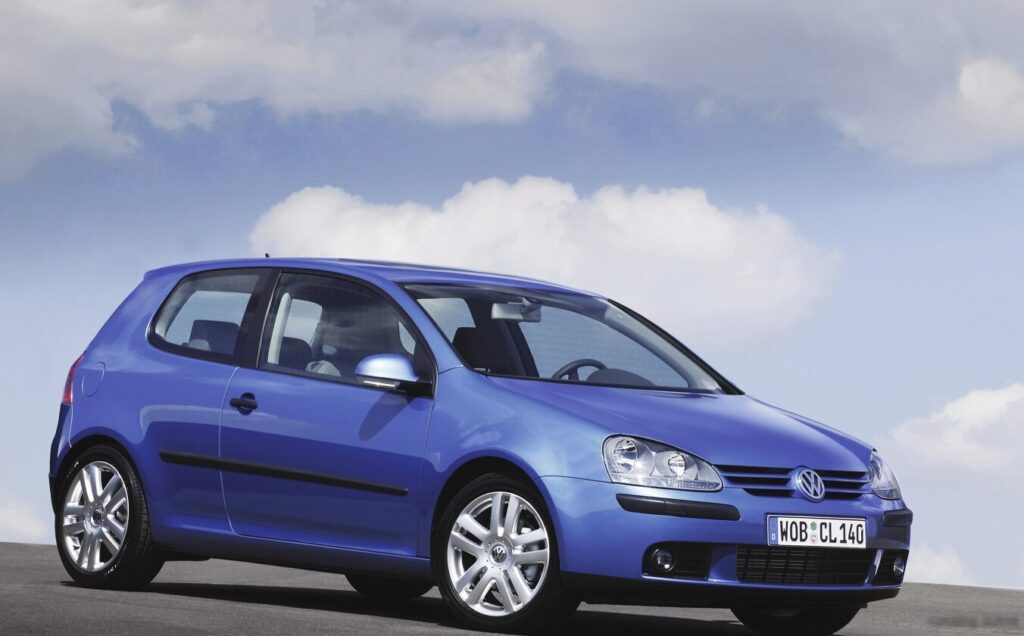
The Volkswagen Golf V, produced from 2003 to 2009, represented a significant evolution for Volkswagen’s iconic hatchback. The three-door variant, particularly the 1.4 16V model generating 75 horsepower, occupied an entry-level position within the Golf V range. This version was primarily aimed at the European market, where smaller displacement engines were favored due to tax regulations and fuel costs. It served as an accessible and economical option for buyers seeking the Golf’s practicality and build quality. Production of this specific configuration ran from 2003 to 2006, falling within the early years of the Golf V’s lifecycle (internally designated the 1HX0/A3 platform).
Technical Specifications
| Brand | Volkswagen |
| Model | Golf |
| Generation | Golf V (3-door) |
| Type (Engine) | 1.4 16V (75 Hp) |
| Start of production | 2003 |
| End of production | 2006 |
| Powertrain Architecture | Internal Combustion engine |
| Body type | Hatchback |
| Seats | 5 |
| Doors | 3 |
| Fuel consumption (economy) – urban (NEDC) | 9.4-9.6 l/100 km (25 – 24.5 US mpg, 30.1 – 29.4 UK mpg, 10.6 – 10.4 km/l) |
| Fuel consumption (economy) – extra urban (NEDC) | 5.5-5.7 l/100 km (42.8 – 41.3 US mpg, 51.4 – 49.6 UK mpg, 18.2 – 17.5 km/l) |
| Fuel consumption (economy) – combined (NEDC) | 6.9-7.1 l/100 km (34.1 – 33.1 US mpg, 40.9 – 39.8 UK mpg, 14.5 – 14.1 km/l) |
| CO2 emissions (NEDC) | 166-170 g/km |
| Fuel Type | Petrol (Gasoline) |
| Acceleration 0 – 100 km/h | 14.7 sec |
| Acceleration 0 – 62 mph | 14.7 sec |
| Acceleration 0 – 60 mph | 14 sec |
| Maximum speed | 164 km/h (101.9 mph) |
| Emission standard | Euro 4 |
| Weight-to-power ratio | 15.4 kg/Hp, 65 Hp/tonne |
| Weight-to-torque ratio | 9.2 kg/Nm, 109.2 Nm/tonne |
| Power | 75 Hp @ 5000 rpm |
| Power per litre | 54 Hp/l |
| Torque | 126 Nm @ 3800 rpm (92.93 lb.-ft. @ 3800 rpm) |
| Engine layout | Front, Transverse |
| Engine Model/Code | BCA |
| Engine displacement | 1390 cm3 (84.82 cu. in.) |
| Number of cylinders | 4 |
| Engine configuration | Inline |
| Cylinder Bore | 76.5 mm (3.01 in.) |
| Piston Stroke | 75.6 mm (2.98 in.) |
| Compression ratio | 10.5:1 |
| Number of valves per cylinder | 4 |
| Fuel injection system | Multi-port manifold injection |
| Engine aspiration | Naturally aspirated engine |
| Valvetrain | DOHC |
| Engine oil capacity | 3.2 l (3.38 US qt | 2.82 UK qt) |
| Coolant | 5.6 l (5.92 US qt | 4.93 UK qt) |
| Kerb Weight | 1154-1319 kg (2544.13 – 2907.9 lbs.) |
| Max. weight | 1740 kg (3836.04 lbs.) |
| Max load | 421-586 kg (928.15 – 1291.91 lbs.) |
| Trunk (boot) space – minimum | 350 l (12.36 cu. ft.) |
| Trunk (boot) space – maximum | 1305 l (46.09 cu. ft.) |
| Fuel tank capacity | 55 l (14.53 US gal | 12.1 UK gal) |
| Max. roof load | 75 kg (165.35 lbs.) |
| Permitted trailer load with brakes (8%) | 1200 kg (2645.55 lbs.) |
| Permitted trailer load with brakes (12%) | 1000 kg (2204.62 lbs.) |
| Permitted trailer load without brakes | 610 kg (1344.82 lbs.) |
| Permitted towbar download | 75 kg (165.35 lbs.) |
| Length | 4204 mm (165.51 in.) |
| Width | 1759 mm (69.25 in.) |
| Width including mirrors | 2010 mm (79.13 in.) |
| Height | 1485 mm (58.46 in.) |
| Wheelbase | 2578 mm (101.5 in.) |
| Front track | 1539 mm (60.59 in.) |
| Rear (Back) track | 1528 mm (60.16 in.) |
| Front overhang | 880 mm (34.65 in.) |
| Rear overhang | 746 mm (29.37 in.) |
| Minimum turning circle (turning diameter) | 10.9 m (35.76 ft.) |
| Drivetrain Architecture | The Internal combustion engine (ICE) drives the front wheels of the vehicle. |
| Drive wheel | Front wheel drive |
| Number of gears and type of gearbox | 5 gears, manual transmission |
| Front suspension | Independent, type McPherson with coil spring and anti-roll bar |
| Rear suspension | Independent multi-link spring suspension with stabilizer |
| Front brakes | Ventilated discs |
| Rear brakes | Disc |
| Assisting systems | ABS (Anti-lock braking system) |
| Steering type | Steering rack and pinion |
| Power steering | Electric Steering |
| Tires size | 195/65 R15; 205/55 R16; 225/45 R17 |
| Wheel rims size | 6J x 15; 6.5J x 15; 6.5J x 16; 7J x 17 |
Powertrain & Engine Architecture
The Golf V 1.4 16V utilized the BCA engine code, a 1390cc inline-four cylinder engine. This engine featured a dual overhead camshaft (DOHC) valvetrain with four valves per cylinder, contributing to its relatively efficient breathing. Fuel delivery was managed by a multi-port fuel injection system. The engine’s 10.5:1 compression ratio was typical for naturally aspirated gasoline engines of the era. The 75 horsepower output was modest, but the engine was known for its smoothness and willingness to rev. The engine was transversely mounted, driving the front wheels. The standard transmission was a five-speed manual, though a four-speed automatic was also available, albeit less common. The automatic transmission, while offering convenience, did impact acceleration and fuel economy.
Driving Characteristics
The 1.4 16V Golf V with the manual transmission offered adequate, though not exhilarating, performance. Acceleration to 60 mph took around 14 seconds, and top speed was approximately 102 mph. The engine felt best when kept in the upper reaches of its rev range. The automatic transmission version further diminished performance, with slightly slower acceleration and a less engaging driving experience. Gear ratios were optimized for fuel efficiency rather than outright speed. Compared to the more powerful 1.6 or 2.0-liter engines in the Golf V lineup, the 1.4 felt noticeably underpowered, especially when fully loaded or tackling steep inclines. However, its lighter weight and nimble handling made it enjoyable to drive in urban environments.
Equipment & Trim Levels
The 1.4 16V typically came with a base level of equipment. Standard features included central locking, power steering, electric front windows, and an ABS anti-lock braking system. Interior upholstery was typically cloth, and the dashboard featured a functional, if somewhat basic, design. Optional extras included air conditioning, alloy wheels, a CD stereo, and upgraded interior trim. Higher trim levels, such as the Trendline or Comfortline, added more features as standard, but the 1.4 16V was generally positioned as the entry point to the Golf V range.
Chassis & Braking
The Golf V utilized an independent McPherson strut suspension at the front and an independent multi-link suspension at the rear, providing a comfortable and controlled ride. Front brakes were ventilated discs, while rear brakes were solid discs. A stabilizer bar was fitted to both the front and rear axles to reduce body roll. The suspension setup was tuned for a balance between comfort and handling, making the Golf V a capable all-rounder. The relatively light weight of the 1.4 16V model contributed to its nimble handling characteristics.
Market Reception & Comparison
The Golf V 1.4 16V was generally well-received as an affordable and practical hatchback. Critics praised its build quality, comfortable ride, and fuel efficiency. However, the engine’s lack of power was a common criticism. Compared to the 1.6-liter and 2.0-liter versions, the 1.4 offered lower running costs but sacrificed performance. The 1.9 TDI diesel variant provided superior fuel economy and torque, but at a higher purchase price. The automatic transmission version was often criticized for its sluggishness and impact on fuel consumption.
Legacy
The BCA engine, found in the Golf V 1.4 16V, is generally considered a reliable unit, though it is not without its potential issues. Common problems include occasional oil leaks and failures of the ignition coils. The Golf V itself has proven to be a durable and long-lasting car, and well-maintained examples are still relatively common on the used car market. The 1.4 16V variant remains an affordable option for buyers seeking a practical and economical hatchback, though its limited power output may not appeal to those seeking a more engaging driving experience. Its simplicity and relatively low maintenance costs make it a popular choice for first-time car owners or those on a budget.