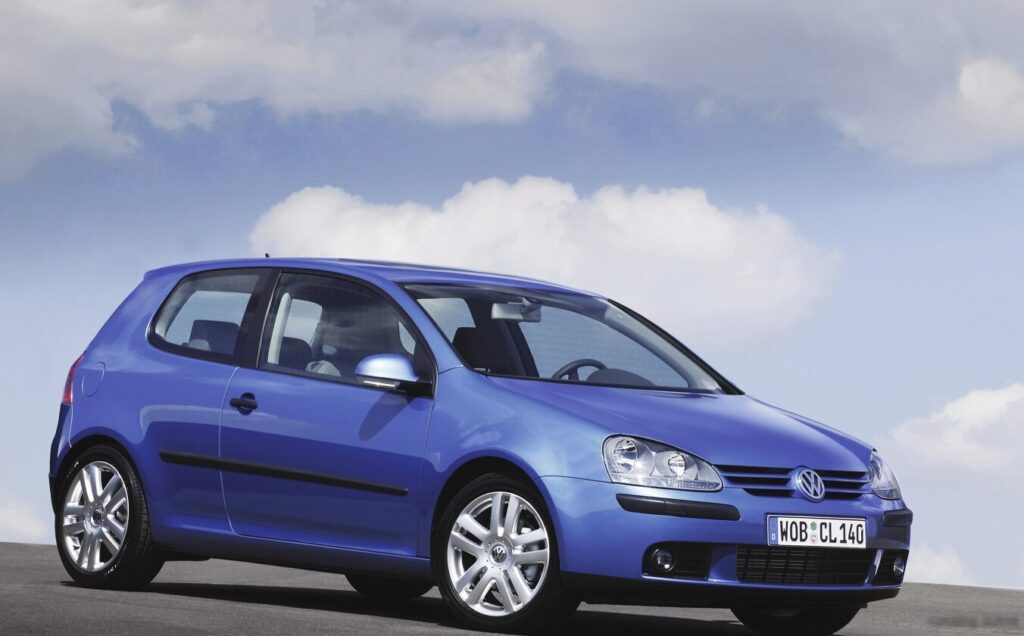
The Volkswagen Golf V, produced from 2003 to 2009, represented a significant evolution for Volkswagen’s iconic hatchback. The three-door variant, particularly the 1.4 FSI model generating 90 horsepower, occupied an important position in the lineup as an entry-level offering, aimed at buyers prioritizing fuel efficiency and affordability. This version was primarily sold in Europe, where smaller displacement engines were favored due to tax regulations and driving conditions. It served as a stepping stone into the Golf range, offering a more sophisticated package than the base models while remaining accessible to a wider customer base. Production of this specific configuration ran from 2003 to 2006.
Technical Specifications
| Brand | Volkswagen |
| Model | Golf |
| Generation | Golf V (3-door) |
| Type (Engine) | 1.4 FSI (90 Hp) |
| Start of production | 2003 |
| End of production | 2006 |
| Powertrain Architecture | Internal Combustion engine |
| Body type | Hatchback |
| Seats | 5 |
| Doors | 3 |
| Fuel consumption (urban) | 8.7 l/100 km (27 US mpg, 32.5 UK mpg, 11.5 km/l) |
| Fuel consumption (extra urban) | 5.3 l/100 km (44.4 US mpg, 53.3 UK mpg, 18.9 km/l) |
| Fuel consumption (combined) | 6.5 l/100 km (36.2 US mpg, 43.5 UK mpg, 15.4 km/l) |
| CO2 emissions | 156 g/km |
| Fuel Type | Petrol (Gasoline) |
| Acceleration 0 – 100 km/h | 12.9 sec |
| Acceleration 0 – 62 mph | 12.9 sec |
| Acceleration 0 – 60 mph | 12.3 sec |
| Maximum speed | 174 km/h (108.12 mph) |
| Emission standard | Euro 4 |
| Weight-to-power ratio | 13 kg/Hp, 77.1 Hp/tonne |
| Weight-to-torque ratio | 9 kg/Nm, 111.4 Nm/tonne |
| Power | 90 Hp @ 5200 rpm |
| Power per litre | 64.7 Hp/l |
| Torque | 130 Nm @ 3750 rpm (95.88 lb.-ft. @ 3750 rpm) |
| Engine layout | Front, Transverse |
| Engine Model/Code | BKG, BLN |
| Engine displacement | 1390 cm3 (84.82 cu. in.) |
| Number of cylinders | 4 |
| Engine configuration | Inline |
| Cylinder Bore | 76.5 mm (3.01 in.) |
| Piston Stroke | 75.6 mm (2.98 in.) |
| Compression ratio | 12:1 |
| Number of valves per cylinder | 4 |
| Fuel injection system | Direct injection |
| Engine aspiration | Naturally aspirated engine |
| Valvetrain | DOHC |
| Engine oil capacity | 3.5 l (3.7 US qt | 3.08 UK qt) |
| Coolant capacity | 5.6 l (5.92 US qt | 4.93 UK qt) |
| Kerb Weight | 1167 kg (2572.79 lbs.) |
| Max. weight | 1750 kg (3858.09 lbs.) |
| Max load | 583 kg (1285.29 lbs.) |
| Trunk (boot) space – minimum | 350 l (12.36 cu. ft.) |
| Trunk (boot) space – maximum | 1305 l (46.09 cu. ft.) |
| Fuel tank capacity | 55 l (14.53 US gal | 12.1 UK gal) |
| Max. roof load | 75 kg (165.35 lbs.) |
| Permitted trailer load with brakes (12%) | 1000 kg (2204.62 lbs.) |
| Permitted trailer load without brakes | 620 kg (1366.87 lbs.) |
| Permitted towbar download | 75 kg (165.35 lbs.) |
| Length | 4204 mm (165.51 in.) |
| Width | 1759 mm (69.25 in.) |
| Width including mirrors | 2010 mm (79.13 in.) |
| Height | 1485 mm (58.46 in.) |
| Wheelbase | 2578 mm (101.5 in.) |
| Front track | 1539 mm (60.59 in.) |
| Rear track | 1528 mm (60.16 in.) |
| Front overhang | 880 mm (34.65 in.) |
| Rear overhang | 746 mm (29.37 in.) |
| Minimum turning circle | 10.9 m (35.76 ft.) |
| Drivetrain | Front wheel drive |
| Number of gears | 5 |
| Gearbox type | Manual transmission |
| Front suspension | Independent, McPherson with coil spring and anti-roll bar |
| Rear suspension | Independent multi-link spring suspension with stabilizer |
| Front brakes | Ventilated discs |
| Rear brakes | Disc |
| Assisting systems | ABS (Anti-lock braking system) |
| Steering type | Steering rack and pinion |
| Power steering | Electric |
| Tires size | 195/65 R15; 205/55 R16; 225/45 R17 |
| Wheel rims size | 6J x 15; 6.5J x 15; 6.5J x 16; 7J x 17 |
INTRODUCTION
The Volkswagen Golf V 1.4 FSI (90 hp) three-door hatchback was a key component of the fifth-generation Golf lineup, launched in 2003. Built on the A5 (or 1HX0) platform, this model aimed to provide an affordable and economical entry point into the Golf range. It was particularly popular in European markets where fuel efficiency and lower vehicle taxation were significant purchasing factors. The 1.4 FSI engine, coupled with a five-speed manual transmission, offered a balance between reasonable performance and low running costs. This variant was positioned below the more powerful 1.6 FSI and 2.0 FSI models, as well as the diesel-powered TDI variants.
Powertrain & Engine Architecture
The heart of this Golf variant is the 1.4-liter inline-four cylinder engine, designated with engine codes BKG or BLN. This engine utilizes direct fuel injection (FSI – Fuel Stratified Injection), a technology that improves combustion efficiency and power output compared to traditional port fuel injection. The FSI system injects fuel directly into the combustion chamber, allowing for more precise control of the air-fuel mixture. The engine features a double overhead camshaft (DOHC) valvetrain with four valves per cylinder, contributing to its relatively high power output for its displacement. The five-speed manual transmission was the standard offering, providing a fairly conventional gear ratio spread. The transmission was chosen for its simplicity and contribution to fuel economy.
Driving Characteristics
The 1.4 FSI 90 hp Golf V offered adequate, but not exhilarating, performance. Acceleration from 0 to 60 mph took around 12.3 seconds, and top speed was limited to 108 mph. The engine’s torque peak of 130 Nm (95.88 lb-ft) at 3750 rpm meant that it required relatively high engine speeds to deliver strong acceleration. Compared to the more powerful 1.6 FSI or 2.0 FSI versions, the 1.4 FSI felt noticeably slower, particularly when fully loaded or tackling steep inclines. However, the direct injection system provided a responsive throttle feel and a willingness to rev. The manual transmission allowed for precise control, but the gear ratios were geared towards economy rather than outright performance.
Equipment & Trim Levels
The 1.4 FSI three-door Golf V typically came with a fairly basic level of equipment, reflecting its entry-level positioning. Standard features generally included power steering, ABS brakes, front airbags, and a basic audio system. Interior upholstery was typically cloth, and the dashboard featured a functional, if somewhat understated, design. Optional extras included air conditioning, alloy wheels, electric windows, and a more advanced audio system. Higher trim levels, such as Trendline or Comfortline, added more features as standard, but the 1.4 FSI was often purchased as a base model with minimal options.
Chassis & Braking
The Golf V utilized an independent suspension setup, with a McPherson strut arrangement at the front and a multi-link system at the rear. This provided a good balance between ride comfort and handling. The front brakes were ventilated discs, while the rear brakes were solid discs. The suspension was tuned for comfort, but the relatively light weight of the 1.4 FSI model helped to maintain reasonable body control. A stabilizer bar was fitted to both the front and rear axles to reduce body roll during cornering. The steering was rack and pinion with electric power assistance, providing a light and precise feel.
Market Reception & Comparison
The Golf V 1.4 FSI was generally well-received by automotive critics as a practical and economical hatchback. It was praised for its fuel efficiency, comfortable ride, and build quality. However, it was often criticized for its lack of outright performance. Compared to the 1.6 FSI, the 1.4 FSI offered slightly better fuel economy but noticeably less power. The TDI diesel models provided significantly more torque and better fuel economy, but at a higher purchase price. The 1.4 FSI appealed to buyers who prioritized affordability and running costs over performance.
Legacy
The 1.4 FSI engine, while not known for its longevity in some applications, proved to be reasonably reliable in the Golf V. Common issues included occasional problems with the coil packs and fuel injectors. However, with regular maintenance, these engines could provide many years of service. Today, the Golf V 1.4 FSI represents an affordable and practical used car option. Its fuel efficiency and relatively low maintenance costs make it an attractive choice for budget-conscious buyers. While it may not offer the performance of more powerful Golf variants, it remains a capable and well-rounded hatchback.