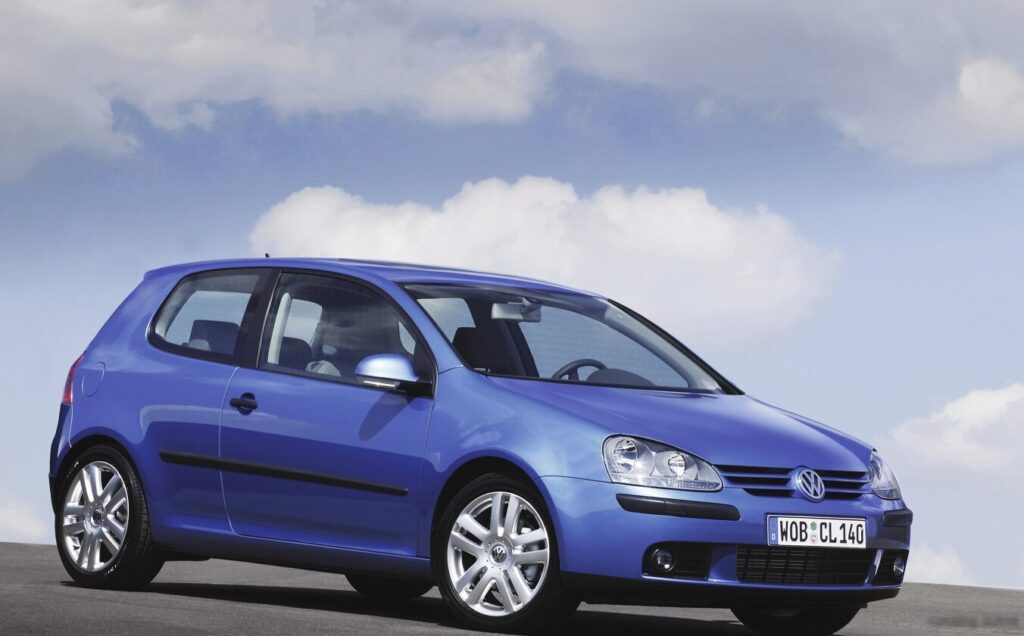
The Volkswagen Golf Mk5, produced from late 2003 through 2009, represented a significant leap forward for the iconic hatchback. The 3-door variant, particularly the 1.4 TSI (122 hp) model equipped with the Direct-Shift Gearbox (DSG), offered a compelling blend of efficiency, performance, and modern technology. Introduced in 2007 and continuing through 2008, this configuration occupied a mid-range position within the Mk5 Golf lineup, appealing to buyers seeking a more refined driving experience than the base models but without the higher price tag of the GTI or diesel variants.
Technical Specifications
| Brand | Volkswagen |
| Model | Golf |
| Generation | Golf V (3-door) |
| Type (Engine) | 1.4 TSI (122 Hp) DSG |
| Start of production | 2007 |
| End of production | 2008 |
| Powertrain Architecture | Internal Combustion engine |
| Body type | Hatchback |
| Seats | 5 |
| Doors | 3 |
| Fuel consumption (urban) | 7.7 l/100 km (30.5 US mpg, 36.7 UK mpg, 13 km/l) |
| Fuel consumption (extra urban) | 4.9 l/100 km (48 US mpg, 57.6 UK mpg, 20.4 km/l) |
| Fuel consumption (combined) | 5.9 l/100 km (39.9 US mpg, 47.9 UK mpg, 16.9 km/l) |
| CO2 emissions | 139 g/km |
| Fuel Type | Petrol (Gasoline) |
| Acceleration 0 – 100 km/h | 9.4 sec |
| Acceleration 0 – 62 mph | 9.4 sec |
| Acceleration 0 – 60 mph | 8.9 sec |
| Maximum speed | 197 km/h (122.41 mph) |
| Emission standard | Euro 4 |
| Weight-to-power ratio | 10 kg/Hp, 99.5 Hp/tonne |
| Weight-to-torque ratio | 6.1 kg/Nm, 163.1 Nm/tonne |
| Power | 122 Hp @ 5000 rpm |
| Power per litre | 87.8 Hp/l |
| Torque | 200 Nm @ 1500-4000 rpm (147.51 lb.-ft. @ 1500-4000 rpm) |
| Engine layout | Front, Transverse |
| Engine Model/Code | EA111 / CAXA |
| Engine displacement | 1390 cm3 (84.82 cu. in.) |
| Number of cylinders | 4 |
| Engine configuration | Inline |
| Cylinder Bore | 76.5 mm (3.01 in.) |
| Piston Stroke | 75.6 mm (2.98 in.) |
| Compression ratio | 9.7:1 |
| Number of valves per cylinder | 4 |
| Fuel injection system | Direct injection |
| Engine aspiration | Turbocharger, Intercooler |
| Valvetrain | DOHC |
| Engine oil capacity | 3.6 l (3.8 US qt | 3.17 UK qt) |
| Coolant | 5.6 l (5.92 US qt | 4.93 UK qt) |
| Kerb Weight | 1226 kg (2702.87 lbs.) |
| Max. weight | 1840 kg (4056.51 lbs.) |
| Max load | 614 kg (1353.64 lbs.) |
| Trunk (boot) space – minimum | 350 l (12.36 cu. ft.) |
| Trunk (boot) space – maximum | 1305 l (46.09 cu. ft.) |
| Fuel tank capacity | 55 l (14.53 US gal | 12.1 UK gal) |
| Max. roof load | 75 kg (165.35 lbs.) |
| Permitted trailer load with brakes (8%) | 1600 kg (3527.4 lbs.) |
| Permitted trailer load with brakes (12%) | 1300 kg (2866.01 lbs.) |
| Permitted trailer load without brakes | 650 kg (1433 lbs.) |
| Permitted towbar download | 75 kg (165.35 lbs.) |
| Length | 4204 mm (165.51 in.) |
| Width | 1759 mm (69.25 in.) |
| Width including mirrors | 2010 mm (79.13 in.) |
| Height | 1485 mm (58.46 in.) |
| Wheelbase | 2578 mm (101.5 in.) |
| Front track | 1539 mm (60.59 in.) |
| Rear (Back) track | 1528 mm (60.16 in.) |
| Front overhang | 880 mm (34.65 in.) |
| Rear overhang | 746 mm (29.37 in.) |
| Minimum turning circle | 10.9 m (35.76 ft.) |
| Drivetrain Architecture | Front wheel drive |
| Number of gears and type of gearbox | 7 gears, automatic transmission DSG |
| Front suspension | Independent, type McPherson with coil spring and anti-roll bar |
| Rear suspension | Independent multi-link spring suspension with stabilizer |
| Front brakes | Ventilated discs |
| Rear brakes | Disc |
INTRODUCTION
The Volkswagen Golf Mk5 1.4 TSI (122 hp) DSG, produced from 2007 to 2008, was a key component of Volkswagen’s strategy to offer a wider range of engine options within the popular Golf range. Built on the 1HX0/A3 platform, this variant aimed to bridge the gap between the more economical naturally aspirated engines and the performance-oriented GTI. The introduction of direct injection and turbocharging in this engine marked a significant advancement in Golf technology, providing a noticeable improvement in both power and fuel efficiency. The 3-door body style further emphasized a sportier aesthetic, appealing to a younger demographic.
Powertrain & Engine Architecture
At the heart of this Golf variant lies the EA111 engine family, specifically the CAXA code 1.4-liter turbocharged four-cylinder. This engine utilizes direct fuel injection (FSI) – a technology that injects fuel directly into the combustion chamber, improving combustion efficiency and power output. The CAXA engine boasts a single-scroll turbocharger with an intercooler, delivering 122 horsepower at 5000 rpm and 200 Nm (147.51 lb-ft) of torque between 1500 and 4000 rpm. The engine features a double overhead camshaft (DOHC) valvetrain with four valves per cylinder. Crucially, this model is paired with Volkswagen’s renowned 7-speed Direct-Shift Gearbox (DSG). The DSG is a dual-clutch transmission that offers the efficiency of a manual gearbox with the convenience of an automatic, providing quick and seamless gear changes.
Driving Characteristics
The 1.4 TSI with DSG offered a noticeably more engaging driving experience than the base Golf models. While not as overtly sporty as the GTI, the turbocharger provided a useful boost of power, making overtaking and highway cruising considerably easier. The DSG transmission contributed to this by allowing for precise and rapid gear changes, keeping the engine within its optimal power band. Compared to the 6-speed manual transmission available on other Golf models, the DSG offered smoother shifts and reduced driver fatigue. However, some drivers found the DSG’s automatic shifting logic to be occasionally hesitant or overly eager to upshift, particularly in lower gears. The gear ratios were tuned for a balance between acceleration and fuel economy, prioritizing everyday usability over outright performance.
Equipment & Trim Levels
The 1.4 TSI DSG typically came equipped with a reasonable level of standard features. Interior appointments generally included cloth upholstery, air conditioning, a CD stereo system, and power windows. Safety features such as ABS brakes, front airbags, and side airbags were standard. Optional extras included alloy wheels, a sunroof, parking sensors, and upgraded audio systems. Trim levels varied slightly depending on the market, but generally, this variant sat in the mid-range of the Golf Mk5 lineup, offering a step up in terms of equipment and refinement compared to the base models.
Chassis & Braking
The Golf Mk5 featured an independent suspension setup on both the front and rear axles. The front utilized a McPherson strut design with coil springs and an anti-roll bar, while the rear employed a more sophisticated multi-link suspension system, also with a stabilizer bar. This configuration provided a good balance between ride comfort and handling. Braking duties were handled by ventilated discs on the front wheels and solid discs on the rear. ABS (Anti-lock Braking System) was standard, enhancing braking performance and stability. The chassis was tuned to accommodate the increased power output of the 1.4 TSI engine, providing a stable and predictable driving experience.
Market Reception & Comparison
The Golf Mk5 1.4 TSI DSG was generally well-received by automotive critics. It was praised for its refined engine, efficient DSG transmission, and comfortable ride. Compared to the naturally aspirated 1.6-liter Golf, the 1.4 TSI offered a significant performance boost without a substantial increase in fuel consumption. Against the GTI, it offered a more affordable entry point, albeit with less power and a slightly less focused driving experience. The 1.6 FSI and 2.0 TDI models were the closest competitors within the Golf range, with the 1.4 TSI offering a compelling blend of performance and economy that appealed to a broad range of buyers. Fuel economy figures of around 39.9 US mpg combined were considered excellent for its time.
Legacy
The 1.4 TSI engine, and the DSG transmission, proved to be reliable powertrains when properly maintained. However, like any turbocharged engine, regular oil changes and diligent maintenance are crucial to prevent issues. The DSG transmission, while generally robust, can be susceptible to mechatronic unit failures if not serviced according to Volkswagen’s recommendations. Today, the Golf Mk5 1.4 TSI DSG remains a popular choice in the used car market, offering a good balance of practicality, affordability, and driving enjoyment. Its relatively modern technology and efficient engine make it a viable option for those seeking a well-rounded and reliable hatchback.