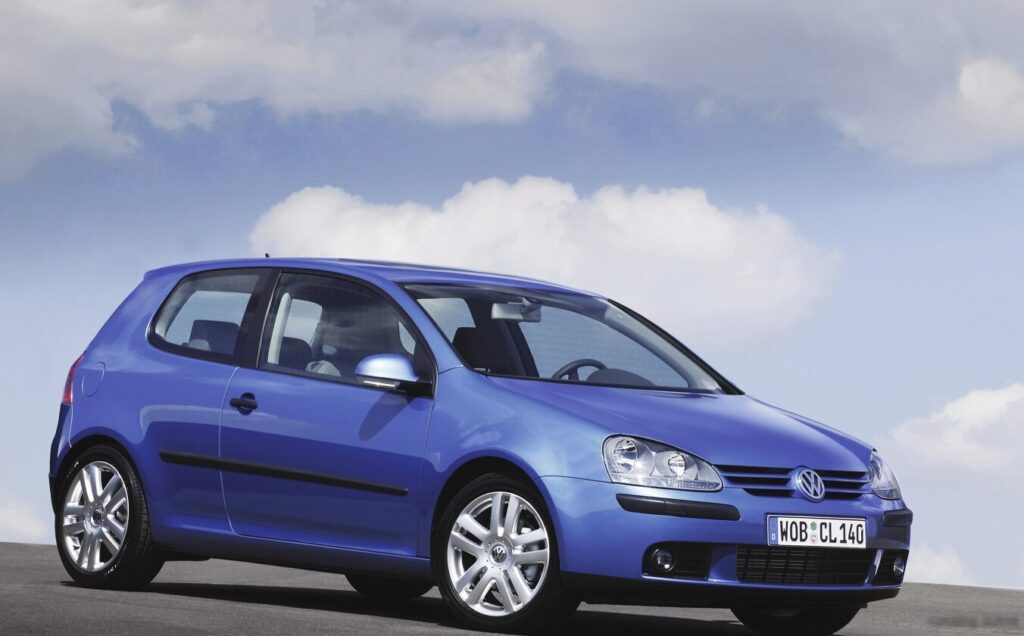
The Volkswagen Golf V 3-door 1.6 (102 hp) Automatic, produced between 2003 and 2008, represented an entry-level offering within the fifth generation (Mk V) Golf lineup. Built on the A5 platform – internally designated 1HX0 for the 3-door hatchback – this variant aimed to provide affordable access to the Golf’s renowned practicality and build quality, albeit with a focus on fuel economy rather than outright performance. It served as a stepping stone into the Golf range, positioned below the more powerful 1.9 TDI diesel and the sporty GTI models.
The heart of the Golf V 1.6 Automatic was the BGU, BSE, or BSF engine code 1.6-liter inline four-cylinder gasoline engine. This engine featured a naturally aspirated configuration with multi-port fuel injection and a single overhead camshaft (SOHC) valvetrain operating two valves per cylinder. The 1595 cc engine produced 102 horsepower at 5600 rpm and 148 Nm (109.16 lb-ft) of torque at 3800 rpm. The engine’s relatively modest output was paired exclusively with a six-speed automatic transmission, a significant feature for buyers prioritizing ease of driving over sporty engagement. This transmission was designed to provide smooth shifts and acceptable acceleration, though it wasn’t known for its particularly quick responsiveness.
In real-world driving, the 1.6-liter automatic Golf V offered adequate, but not exhilarating, performance. Acceleration from 0 to 100 km/h (0-62 mph) took approximately 12.5 seconds, and top speed was limited to 181 km/h (112.47 mph). Compared to the manual transmission versions of the same engine, the automatic resulted in a slight performance decrease due to the transmission’s inherent power loss. The higher-output engines, such as the 2.0 FSI or the 1.9 TDI, offered considerably more spirited acceleration and were favored by drivers seeking a more dynamic driving experience. The automatic transmission’s gear ratios were tuned for fuel efficiency and comfortable cruising, rather than aggressive acceleration.
The 1.6 Automatic trim level typically included standard features such as power windows, central locking, an air conditioning system, and a basic audio system. Interior upholstery was generally cloth, with a functional, if somewhat spartan, dashboard layout. Optional extras included alloy wheels, upgraded audio systems, and a sunroof. The 3-door configuration emphasized a slightly sportier aesthetic compared to the five-door model, appealing to buyers who didn’t regularly require rear passenger access.
The Golf V 1.6 Automatic utilized an independent McPherson strut front suspension with a coil spring and anti-roll bar, providing a comfortable ride. The rear suspension employed an independent multi-link setup, also with a stabilizer bar, contributing to improved handling and stability. Braking consisted of ventilated discs at the front and solid discs at the rear. ABS (Anti-lock Braking System) was standard equipment. The weight-to-power ratio of 11.9 kg/hp indicated the car’s modest performance capabilities, while the kerb weight ranged from 1211 to 1386 kg (2669.8 to 3055.61 lbs) depending on the specific equipment fitted.
Contemporary reviews of the Golf V 1.6 Automatic generally acknowledged its practicality and fuel efficiency, but often criticized its lack of outright performance. Fuel economy figures averaged around 8.2-8.3 l/100 km (28.7-28.3 US mpg) combined, which was competitive for its class. Reliability was generally good, although the automatic transmission could occasionally require servicing. Compared to the 1.9 TDI, the 1.6 offered lower running costs in terms of fuel, but the TDI provided significantly more torque and better fuel economy overall. The 1.6 was often seen as a sensible choice for urban commuters and drivers prioritizing affordability.
| Engine Model/Code | BGU, BSE, BSF |
| Engine Displacement | 1595 cm3 (97.33 cu. in.) |
| Number of Cylinders | 4, Inline |
| Power | 102 Hp @ 5600 rpm |
| Torque | 148 Nm @ 3800 rpm (109.16 lb.-ft.) |
| Fuel Type | Petrol (Gasoline) |
| Fuel Consumption (Combined) | 8.2-8.3 l/100 km (28.7 – 28.3 US mpg) |
| CO2 Emissions | 197-199 g/km |
| Acceleration 0-100 km/h | 12.5 sec |
| Maximum Speed | 181 km/h (112.47 mph) |
| Transmission | 6-speed Automatic |
| Kerb Weight | 1211-1386 kg (2669.8 – 3055.61 lbs.) |
| Fuel Tank Capacity | 55 l (14.53 US gal) |
| Trunk Space (Minimum) | 350 l (12.36 cu. ft.) |
| Trunk Space (Maximum) | 1305 l (46.09 cu. ft.) |
Today, the Golf V 1.6 Automatic is a relatively common sight on the used car market. The powertrain is generally considered reliable, although regular maintenance is crucial, particularly for the automatic transmission. Parts availability is good, and repair costs are typically reasonable. While it doesn’t offer the performance of other Golf V variants, its affordability, practicality, and relatively low running costs make it a viable option for budget-conscious buyers seeking a dependable and well-built hatchback. Its enduring popularity is a testament to the Golf’s overall reputation for quality and longevity.