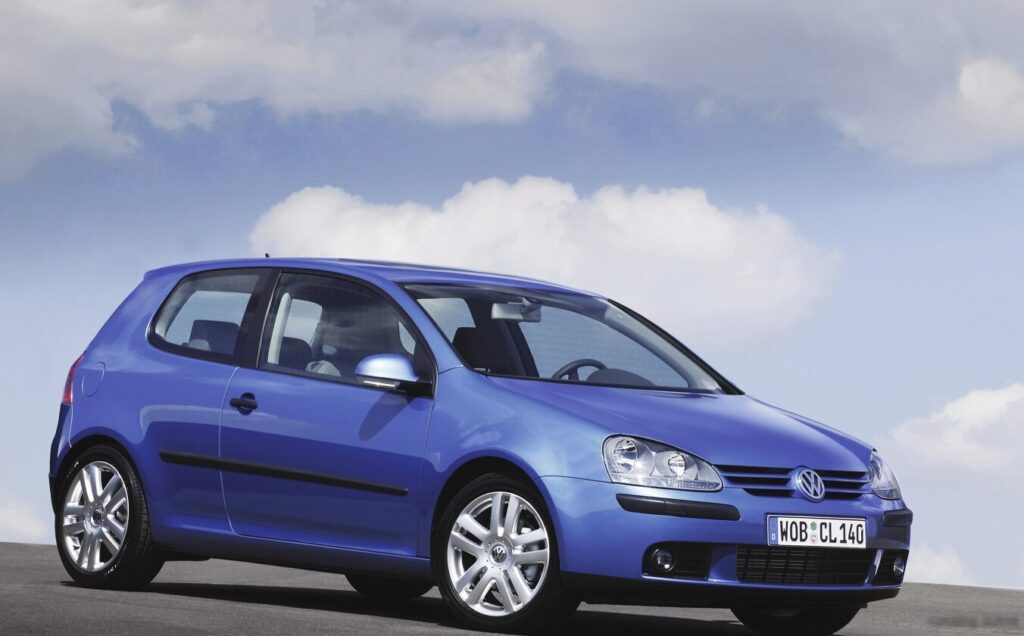
The Volkswagen Golf V, produced from 2003 to 2009, represented a significant evolution for Volkswagen’s iconic hatchback. The 3-door 1.9 TDI variant, specifically the 90 horsepower version, was available from 2004 to 2008 and occupied an important position in the Golf V lineup as an entry-level diesel option. It catered to buyers prioritizing fuel efficiency and practicality over outright performance. This model was built on the A5 (or 1HX0) platform, shared with other Volkswagen Group vehicles like the Audi A3 and Seat Leon.
The heart of the Golf V 1.9 TDI was the EA188 engine family, specifically utilizing the BRU or BXF engine codes. This 1.9-liter inline-four cylinder diesel engine featured a sophisticated pump-nozzle (unit injector) fuel injection system, a technology known for its precise fuel delivery and efficiency. The engine employed a single overhead camshaft (SOHC) valvetrain operating two valves per cylinder. A turbocharger with an intercooler was standard, boosting power output to 90 hp at 4000 rpm and 210 Nm (154.89 lb-ft) of torque at 1800 rpm. The engine’s transverse mounting and front-wheel drive configuration were typical for vehicles in this class. The 1.9 TDI was paired with a 5-speed manual transmission, offering a balance between fuel economy and usability. While an automatic transmission was offered in some Golf V models, it was less common with the 90 hp TDI engine.
In real-world driving, the 90 hp 1.9 TDI Golf V provided adequate, though not exhilarating, performance. Acceleration from 0 to 100 km/h (0-62 mph) took approximately 12.9 seconds, and top speed was rated at 176 km/h (109.36 mph). The engine’s strength lay in its strong low-end torque, making it suitable for everyday driving and overtaking maneuvers. Compared to the more powerful 1.9 TDI variants (typically 105 hp or higher) or the gasoline-powered Golfs, the 90 hp version felt noticeably slower. However, it offered significantly better fuel economy. The 5-speed manual transmission provided a reasonable spread of gear ratios, allowing the driver to keep the engine in its optimal torque band.
The 3-door 1.9 TDI Golf V typically came with a relatively basic trim level, focusing on practicality and affordability. Standard features often included power windows, central locking, and an audio system. Interior upholstery was typically cloth, and the dashboard featured a functional, if somewhat understated, design. Optional extras included alloy wheels, air conditioning, and upgraded audio systems. The 3-door configuration emphasized a sportier aesthetic and was popular with younger buyers or those who didn’t frequently carry rear passengers.
The Golf V 1.9 TDI utilized an independent McPherson strut front suspension with a coil spring and anti-roll bar, providing a comfortable ride and predictable handling. The rear suspension employed an independent multi-link setup, also with a stabilizer bar, further enhancing ride quality and stability. Braking duties were handled by ventilated discs at the front and discs at the rear. Anti-lock Braking System (ABS) was standard. The suspension setup was tuned to prioritize comfort and stability over outright sportiness, reflecting the car’s intended role as a practical and efficient everyday vehicle.
Contemporary reviews of the Golf V 1.9 TDI generally praised its fuel efficiency and practicality. Critics noted that the 90 hp engine, while adequate, lacked the punch of higher-output versions. However, the combination of fuel economy (ranging from 5.0-5.3 l/100 km combined) and low running costs made it an attractive option for budget-conscious buyers. Compared to the more expensive and powerful Golf variants, the 1.9 TDI offered a compelling value proposition. Reliability was generally good, although the pump-nozzle injection system could be prone to issues if not properly maintained.
| Brand | Volkswagen |
| Model | Golf |
| Generation | Golf V (3-door) |
| Type (Engine) | 1.9 TDI (90 Hp) |
| Start of production | 2004 |
| End of production | 2008 |
| Fuel consumption (urban) | 6.4-6.6 l/100 km (36.8 – 35.6 US mpg) |
| Fuel consumption (extra urban) | 4.3-4.7 l/100 km (54.7 – 50 US mpg) |
| Fuel consumption (combined) | 5-5.3 l/100 km (47 – 44.4 US mpg) |
| CO2 emissions | 135-143 g/km |
| Fuel Type | Diesel |
| Acceleration 0-100 km/h | 12.9 sec |
| Acceleration 0-62 mph | 12.9 sec |
| Maximum speed | 176 km/h (109.36 mph) |
| Engine Code | EA188 / BRU, BXF |
| Engine displacement | 1896 cm3 (115.7 cu. in.) |
| Number of cylinders | 4 |
| Power | 90 Hp @ 4000 rpm |
| Torque | 210 Nm @ 1800 rpm (154.89 lb.-ft. @ 1800 rpm) |
| Kerb Weight | 1251-1421 kg (2757.98 – 3132.77 lbs.) |
| Trunk space (min/max) | 350 l / 1305 l (12.36 cu. ft. / 46.09 cu. ft.) |
| Fuel tank capacity | 55 l (14.53 US gal) |
| Gears | 5, manual transmission |
Today, the Golf V 1.9 TDI remains a popular choice in the used car market, particularly for those seeking a reliable and fuel-efficient hatchback. The 1.9 TDI engine, while aging, is known for its durability when properly maintained. However, potential buyers should be aware of the potential for issues with the pump-nozzle injection system and the turbocharger. Overall, the Golf V 1.9 TDI 90 hp represents a solid and practical option for those seeking a dependable and economical vehicle.