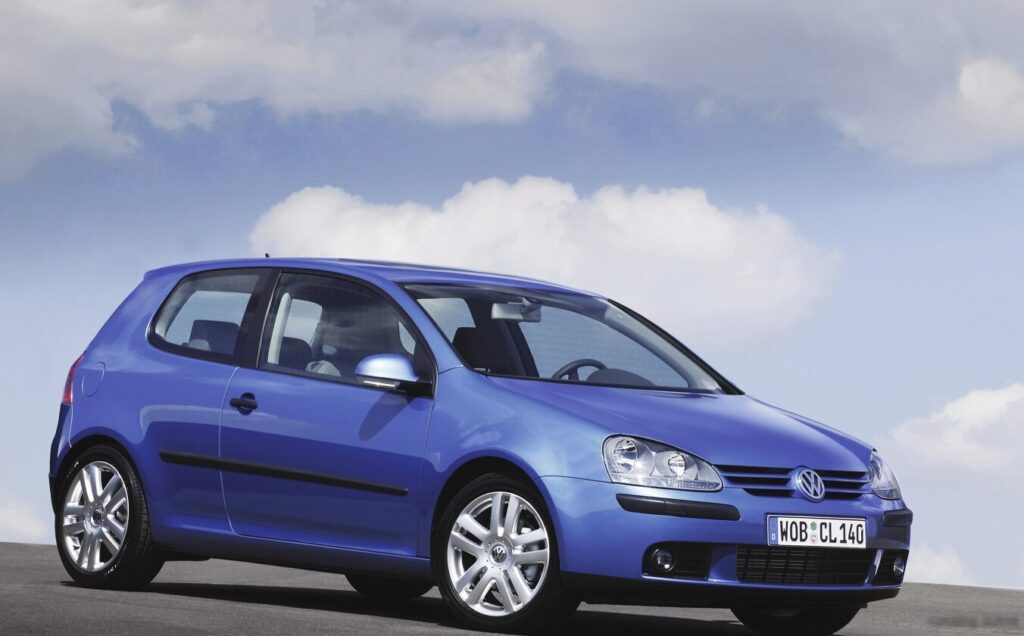
The Volkswagen Golf V, produced from 2003 to 2009, represented a significant evolution for the iconic hatchback. The 3-door 2.0 FSI (150 hp) 4MOTION variant, manufactured between 2004 and 2008, occupied a mid-range position within the Golf V lineup, offering a blend of performance and all-weather capability. It sat above the base 1.4 and 1.6 liter models, and below the more potent GTI and R32 versions. This model was built on the A5 (or 1HX0) platform, shared with other Volkswagen Group vehicles like the Audi A3 and Seat Leon.
The heart of the Golf V 2.0 FSI 4MOTION is the BLX or BVX engine code, a 1984cc inline-four cylinder gasoline engine. “FSI” stands for Fuel Stratified Injection, Volkswagen’s direct injection technology. This system injects fuel directly into the combustion chamber, allowing for more precise fuel control, increased power output, and improved fuel efficiency compared to traditional multi-point injection. The engine features a double overhead camshaft (DOHC) valvetrain with four valves per cylinder, contributing to its responsive nature. The 2.0 FSI engine produces 150 horsepower at 6000 rpm and 200 Nm (147.51 lb-ft) of torque at 3500 rpm. The 4MOTION system is a permanent all-wheel drive system utilizing a viscous coupling to distribute power between the front and rear axles as needed, enhancing traction in slippery conditions. The standard transmission for this variant was a 6-speed manual, though a 6-speed automatic transmission was also available.
In real-world driving, the 2.0 FSI 4MOTION offered a noticeable step up in performance compared to the lower-displacement Golf V models. Acceleration from 0 to 100 km/h (0-62 mph) took approximately 9.2 seconds, and 0-60 mph was achieved in around 8.7 seconds. While not as overtly sporty as the GTI, the 2.0 FSI provided ample power for everyday driving and confident overtaking. The 4MOTION system significantly improved handling and stability, particularly on wet or snowy roads. The 6-speed manual transmission offered precise shifts, while the optional automatic provided smooth and convenient gear changes. The gear ratios were tuned to balance acceleration and fuel economy, with a relatively tall sixth gear for efficient cruising.
The 2.0 FSI 4MOTION trim typically included features such as air conditioning, power windows, central locking, and an integrated stereo system. Interior upholstery was generally cloth, with optional leather available. Dashboard configurations were relatively straightforward, prioritizing functionality and ease of use. Common optional extras included alloy wheels, a sunroof, parking sensors, and upgraded audio systems. Safety features included ABS (Anti-lock Braking System) and front airbags, with side airbags often available as an option.
The Golf V 2.0 FSI 4MOTION utilized an independent suspension setup on both the front and rear axles. The front suspension employed a McPherson strut design with coil springs and an anti-roll bar, while the rear featured a multi-link setup, also with a stabilizer bar. This configuration provided a good balance between ride comfort and handling precision. Braking duties were handled by ventilated discs on the front wheels and discs on the rear. The weight distribution, combined with the all-wheel drive system, contributed to stable and predictable braking performance.
Contemporary reviews of the Golf V 2.0 FSI 4MOTION generally praised its refined engine, capable handling, and all-weather traction. Critics noted that while not the most exciting car to drive, it offered a comfortable and practical driving experience. Fuel economy was considered reasonable for its class, with combined fuel consumption figures ranging from 8.4 to 8.6 liters per 100 kilometers (28-27.4 US mpg). Reliability was generally good, although some owners reported issues with the FSI fuel injection system requiring occasional maintenance. Compared to the GTI, the 2.0 FSI 4MOTION offered a more subdued driving experience and lower running costs, appealing to a broader audience. Compared to the diesel variants, it provided a more responsive engine character, albeit with slightly higher fuel consumption.
| Brand | Volkswagen |
| Model | Golf |
| Generation | Golf V (3-door) |
| Type (Engine) | 2.0 FSI (150 Hp) 4MOTION |
| Start of production | 2004 |
| End of production | 2008 |
| Fuel consumption (urban) | 11.6-11.8 l/100 km (20.3 – 19.9 US mpg) |
| Fuel consumption (extra urban) | 6.6-6.8 l/100 km (35.6 – 34.6 US mpg) |
| Fuel consumption (combined) | 8.4-8.6 l/100 km (28 – 27.4 US mpg) |
| CO2 emissions | 202-206 g/km |
| Fuel Type | Petrol (Gasoline) |
| Acceleration 0 – 100 km/h | 9.2 sec |
| Acceleration 0 – 62 mph | 9.2 sec |
| Acceleration 0 – 60 mph | 8.7 sec |
| Maximum speed | 207 km/h (128.62 mph) |
| Emission standard | Euro 4 |
| Power | 150 Hp @ 6000 rpm |
| Torque | 200 Nm @ 3500 rpm (147.51 lb.-ft. @ 3500 rpm) |
| Engine displacement | 1984 cm3 (121.07 cu. in.) |
| Number of cylinders | 4 |
| Compression ratio | 11.5:1 |
| Kerb Weight | 1366-1506 kg (3011.51 – 3320.16 lbs.) |
| Max. weight | 1920 kg (4232.88 lbs.) |
| Trunk (boot) space (min) | 275 l (9.71 cu. ft.) |
| Trunk (boot) space (max) | 1230 l (43.44 cu. ft.) |
| Fuel tank capacity | 60 l (15.85 US gal) |
| Number of gears | 6 |
| Gearbox type | Manual |
Today, the Golf V 2.0 FSI 4MOTION remains a relatively common sight on used car markets. Its robust build quality and capable powertrain contribute to its longevity. While the FSI engine may require periodic maintenance, it generally proves reliable with proper care. The 4MOTION system continues to be a valuable asset in regions with inclement weather. These models represent a good value proposition for buyers seeking a practical, comfortable, and capable hatchback with all-wheel drive.