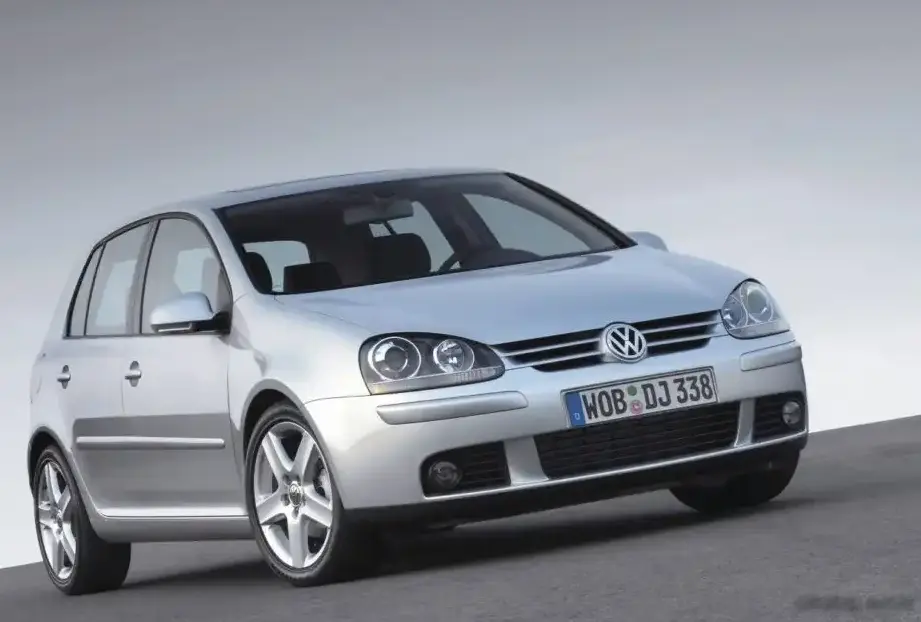
The Volkswagen Golf V, produced from 2003 to 2008, represented a significant evolution for Volkswagen’s iconic hatchback. Within the Golf V range, the 1.6 FSI (115 hp) variant, offered primarily in Europe, occupied a crucial position as an entry-level to mid-range option. This model aimed to provide a balance of fuel efficiency, reasonable performance, and affordability, appealing to a broad customer base seeking a practical and reliable family car. It was a key component of the Golf V’s success, built on the A5 (or 1HX) platform, and served as a stepping stone to more powerful and technologically advanced versions within the lineup.
Technical Specifications
| Brand | Volkswagen |
| Model | Golf |
| Generation | Golf V (5-door) |
| Type (Engine) | 1.6 FSI (115 Hp) |
| Start of production | 2003 |
| End of production | 2008 |
| Powertrain Architecture | Internal Combustion engine |
| Body type | Hatchback |
| Seats | 5 |
| Doors | 5 |
| Fuel consumption (urban) | 8.8-9.2 l/100 km (26.7 – 25.6 US mpg, 32.1 – 30.7 UK mpg, 11.4 – 10.9 km/l) |
| Fuel consumption (extra urban) | 5.5-5.7 l/100 km (42.8 – 41.3 US mpg, 51.4 – 49.6 UK mpg, 18.2 – 17.5 km/l) |
| Fuel consumption (combined) | 6.7-7 l/100 km (35.1 – 33.6 US mpg, 42.2 – 40.4 UK mpg, 14.9 – 14.3 km/l) |
| CO2 emissions | 161-168 g/km |
| Fuel Type | Petrol (Gasoline) |
| Acceleration 0 – 100 km/h | 10.8 sec |
| Acceleration 0 – 62 mph | 10.8 sec |
| Acceleration 0 – 60 mph | 10.3 sec |
| Maximum speed | 192 km/h (119.3 mph) |
| Emission standard | Euro 4 |
| Weight-to-power ratio | 10.6 kg/Hp, 94.3 Hp/tonne |
| Weight-to-torque ratio | 7.9 kg/Nm, 127.2 Nm/tonne |
| Power | 115 Hp @ 6000 rpm |
| Power per litre | 72 Hp/l |
| Torque | 155 Nm @ 4000 rpm (114.32 lb.-ft. @ 4000 rpm) |
| Engine layout | Front, Transverse |
| Engine Model/Code | BAG, BLF, BLP |
| Engine displacement | 1598 cm3 (97.52 cu. in.) |
| Number of cylinders | 4 |
| Engine configuration | Inline |
| Cylinder Bore | 76.5 mm (3.01 in.) |
| Piston Stroke | 86.9 mm (3.42 in.) |
| Compression ratio | 12:1 |
| Number of valves per cylinder | 4 |
| Fuel injection system | Direct injection |
| Engine aspiration | Naturally aspirated engine |
| Valvetrain | DOHC |
| Engine oil capacity | 3.5 l (3.7 US qt | 3.08 UK qt) |
| Coolant capacity | 5.6 l (5.92 US qt | 4.93 UK qt) |
| Kerb Weight | 1219 kg (2687.43 lbs.) |
| Max. weight | 1770 kg (3902.18 lbs.) |
| Max load | 551 kg (1214.75 lbs.) |
| Trunk (boot) space – minimum | 350 l (12.36 cu. ft.) |
| Trunk (boot) space – maximum | 1305 l (46.09 cu. ft.) |
| Fuel tank capacity | 55 l (14.53 US gal | 12.1 UK gal) |
| Max. roof load | 75 kg (165.35 lbs.) |
| Permitted trailer load with brakes (8%) | 1500 kg (3306.93 lbs.) |
| Permitted trailer load with brakes (12%) | 1200 kg (2645.55 lbs.) |
| Permitted trailer load without brakes | 620 kg (1366.87 lbs.) |
| Permitted towbar download | 75 kg (165.35 lbs.) |
| Length | 4204 mm (165.51 in.) |
| Width | 1759 mm (69.25 in.) |
| Width including mirrors | 2010 mm (79.13 in.) |
| Height | 1485 mm (58.46 in.) |
| Wheelbase | 2578 mm (101.5 in.) |
| Front track | 1539 mm (60.59 in.) |
| Rear track | 1528 mm (60.16 in.) |
| Front overhang | 880 mm (34.65 in.) |
| Rear overhang | 746 mm (29.37 in.) |
| Minimum turning circle | 10.9 m (35.76 ft.) |
| Drivetrain | Front wheel drive |
| Number of gears | 6 |
| Gearbox type | Manual transmission |
| Front suspension | Independent, type McPherson with coil spring and anti-roll bar |
| Rear suspension | Independent multi-link spring suspension with stabilizer |
| Front brakes | Ventilated discs |
| Rear brakes | Disc |
| Assisting systems | ABS (Anti-lock braking system) |
| Steering type | Steering rack and pinion |
| Power steering | Electric Steering |
| Tires size | 195/65 R15; 205/55 R16; 225/45 R17 |
| Wheel rims size | 6J x 15; 6.5J x 15; 6.5J x 16; 7J x 17 |
INTRODUCTION
The Volkswagen Golf V 1.6 FSI (115 hp) was a mainstay of the Golf Mk5 range, particularly in European markets. Introduced in 2003, it offered a more modern and refined experience compared to its predecessor, the Golf IV. The ‘FSI’ designation indicated the use of direct fuel injection, a technology aimed at improving fuel economy and power output. This variant typically sat in the lower-mid range of the Golf V lineup, positioned above the base 1.4-liter models but below the more potent 1.9 TDI diesel and the performance-oriented GTI. It was designed to appeal to buyers prioritizing practicality, efficiency, and a comfortable driving experience.
Powertrain & Engine Architecture
The heart of the Golf V 1.6 FSI was the BAG, BLF, or BLP engine code, a 1.6-liter inline-four cylinder engine. This engine utilized direct fuel injection (FSI – Fuel Stratified Injection), a system where fuel is injected directly into the combustion chamber, allowing for more precise control of the air-fuel mixture and improved combustion efficiency. The engine featured a double overhead camshaft (DOHC) valvetrain with four valves per cylinder, contributing to its relatively high power output for its displacement. The 1.6 FSI produced 115 horsepower at 6000 rpm and 155 Nm (114.32 lb-ft) of torque at 4000 rpm. The engine was transversely mounted in the front of the vehicle. The standard transmission was a 6-speed manual, though a 6-speed automatic transmission was also available, albeit less common. The automatic transmission was designed to provide smooth shifts and contribute to the car’s overall ease of driving.
Driving Characteristics
The Golf V 1.6 FSI, particularly with the manual transmission, offered a reasonably engaging driving experience. While not a performance car, the engine provided adequate power for everyday driving, with a noticeable improvement in responsiveness compared to older, non-FSI engines. The 6-speed gearbox allowed for efficient cruising on the highway, while still providing enough gearing for acceleration in urban environments. The automatic transmission, while convenient, did slightly diminish the car’s responsiveness. Gear ratios were tuned for fuel efficiency, meaning the engine needed to be revved to access its full potential. Compared to the 1.9 TDI, the 1.6 FSI lacked the low-end torque of the diesel, requiring more frequent downshifts. However, it offered a smoother and quieter driving experience. The suspension provided a comfortable ride, absorbing bumps and imperfections in the road well.
Equipment & Trim Levels
The Golf V 1.6 FSI typically came equipped with a respectable level of standard features. These included central locking, electric front windows, power steering, an ABS anti-lock braking system, and a basic audio system. Higher trim levels, such as ‘Trendline’ or ‘Comfortline’, added features like alloy wheels, air conditioning, a multi-function steering wheel, and upgraded upholstery. Optional extras included a sunroof, parking sensors, and a more advanced audio system with CD changer. Interior upholstery was typically cloth, with higher trims offering partial leather options. The dashboard layout was modern for its time, with a clear and functional design.
Chassis & Braking
The Golf V utilized an independent suspension system on both the front and rear axles. The front suspension employed a McPherson strut design with coil springs and an anti-roll bar, while the rear featured a multi-link setup, also with a stabilizer bar. This configuration provided a good balance of ride comfort and handling. Braking duties were handled by ventilated discs on the front wheels and solid discs on the rear. ABS was standard, providing enhanced braking performance in emergency situations. The chassis was designed to be rigid and provide a stable platform for the car’s components.
Market Reception & Comparison
The Golf V 1.6 FSI was generally well-received by automotive critics. It was praised for its fuel efficiency, comfortable ride, and refined engine. However, some critics noted that the engine lacked the punch of the more powerful options in the range. Compared to the 1.9 TDI, the 1.6 FSI offered lower running costs in terms of fuel, but the TDI provided significantly better fuel economy and more torque. The 1.6 FSI was also seen as a more affordable alternative to the GTI, offering a similar level of practicality but with a more modest performance profile. Reliability was generally good, although some early FSI engines were known to experience issues with carbon buildup on the intake valves.
Legacy
The Golf V 1.6 FSI remains a popular choice in the used car market, particularly for buyers seeking a reliable and affordable hatchback. While the FSI engine requires regular maintenance to prevent carbon buildup, it is generally a durable and long-lasting unit. The Golf V’s reputation for build quality and practicality has ensured its continued desirability. Today, these models represent a good value proposition, offering a comfortable and efficient driving experience at a relatively low price point. The 1.6 FSI variant, while not the most exciting Golf V, played a vital role in the model’s overall success and continues to be a practical and dependable choice for many drivers.