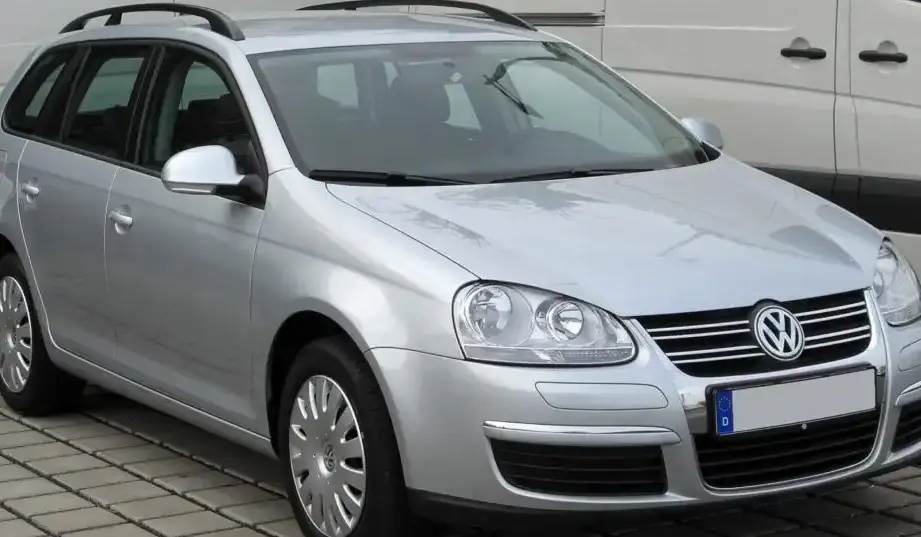
The Volkswagen Golf V Variant 1.9 TDI (105 hp) was a popular station wagon offered as part of the Golf Mk5 range, produced between March 2007 and May 2009. Positioned as a fuel-efficient and practical option within the Golf V Variant lineup, it catered to buyers seeking a versatile vehicle for family use or carrying larger loads. This variant occupied a middle ground in terms of performance and price, slotting below the more powerful petrol engines and the higher-output TDI models, but above the base-level trims. It was primarily sold in the European market, where station wagons (known as ‘estates’) held a significant share of the automotive landscape.
Technical Specifications
| Brand | Volkswagen |
| Model | Golf |
| Generation | Golf V Variant |
| Type (Engine) | 1.9 TDI (105 Hp) |
| Start of production | March, 2007 |
| End of production | May, 2009 |
| Powertrain Architecture | Internal Combustion engine |
| Body type | Station wagon (estate) |
| Seats | 5 |
| Doors | 5 |
| Fuel consumption (urban) | 6.6 l/100 km (35.6 US mpg, 42.8 UK mpg, 15.2 km/l) |
| Fuel consumption (extra urban) | 4.5 l/100 km (52.3 US mpg, 62.8 UK mpg, 22.2 km/l) |
| Fuel consumption (combined) | 5.2 l/100 km (45.2 US mpg, 54.3 UK mpg, 19.2 km/l) |
| Fuel Type | Diesel |
| Acceleration 0 – 100 km/h | 12.2 sec |
| Acceleration 0 – 62 mph | 12.2 sec |
| Acceleration 0 – 60 mph | 11.6 sec |
| Maximum speed | 187 km/h (116.2 mph) |
| Emission standard | Euro 4 |
| Weight-to-power ratio | 13 kg/Hp, 77.1 Hp/tonne |
| Weight-to-torque ratio | 5.4 kg/Nm, 183.7 Nm/tonne |
| Power | 105 Hp @ 4000 rpm |
| Power per litre | 55.4 Hp/l |
| Torque | 250 Nm @ 1900 rpm (184.39 lb.-ft. @ 1900 rpm) |
| Engine layout | Front, Transverse |
| Engine Model/Code | EA188 / BXE |
| Engine displacement | 1896 cm3 (115.7 cu. in.) |
| Number of cylinders | 4 |
| Engine configuration | Inline |
| Cylinder Bore | 79.5 mm (3.13 in.) |
| Piston Stroke | 95.5 mm (3.76 in.) |
| Compression ratio | 19:1 |
| Number of valves per cylinder | 2 |
| Fuel injection system | Pump-nozzle (Unit Injector) |
| Engine aspiration | Turbocharger, Intercooler |
| Engine oil capacity | 3.8 l (4.02 US qt | 3.34 UK qt) |
| Coolant | 8 l (8.45 US qt | 7.04 UK qt) |
| Kerb Weight | 1361 kg (3000.49 lbs.) |
| Max. weight | 1990 kg (4387.2 lbs.) |
| Max load | 629 kg (1386.71 lbs.) |
| Trunk (boot) space – minimum | 505 l (17.83 cu. ft.) |
| Trunk (boot) space – maximum | 1495 l (52.8 cu. ft.) |
| Fuel tank capacity | 55 l (14.53 US gal | 12.1 UK gal) |
| Length | 4556 mm (179.37 in.) |
| Width | 1781 mm (70.12 in.) |
| Height | 1504 mm (59.21 in.) |
| Wheelbase | 2578 mm (101.5 in.) |
| Front track | 1535 mm (60.43 in.) |
| Rear (Back) track | 1508 mm (59.37 in.) |
| Minimum turning circle | 10.9 m (35.76 ft.) |
| Drivetrain Architecture | Front wheel drive |
| Number of gears | 5 gears, manual transmission |
| Assisting systems | ABS (Anti-lock braking system) |
| Tires size | 205/55 R16 |
| Wheel rims size | 6.5J x 16 |
INTRODUCTION
The Golf V Variant, launched in 2007, represented Volkswagen’s fifth generation of the Golf, but in the more practical station wagon body style. The 1.9 TDI (105 hp) variant was a key offering, designed to appeal to buyers prioritizing fuel economy and everyday usability. It utilized the ‘BXE’ engine code, a common iteration of the EA188 engine family. This engine was a mainstay in the Volkswagen Group’s diesel lineup for several years, known for its robustness and relatively simple mechanical design. The Golf V Variant itself was built on the A5 platform (internally designated 1HX0), which also underpinned models like the Audi A3 and SEAT Leon.
Powertrain & Engine Architecture
The heart of this Golf Variant was the 1.9-liter, four-cylinder diesel engine, specifically the EA188 BXE code. This engine featured a cast iron block and an aluminum cylinder head, employing a single overhead camshaft (SOHC) design with two valves per cylinder. Fuel was delivered via a pump-nozzle (unit injector) system, a technology known for its precise fuel metering and contribution to efficient combustion. A turbocharger with an intercooler was standard, boosting power output and improving torque delivery. The 105 horsepower peak was achieved at 4000 rpm, while the 250 Nm (184 lb-ft) of torque was readily available from just 1900 rpm. This made the engine surprisingly flexible for everyday driving. The engine was paired with a five-speed manual transmission, which was the most common configuration. While an automatic transmission was available, it was less frequently chosen due to its impact on fuel economy and performance.
Driving Characteristics
The 1.9 TDI (105 hp) Golf V Variant offered a comfortable and economical driving experience. Acceleration was adequate for most situations, with a 0-60 mph time of around 11.6 seconds. However, it wasn’t a particularly sporty vehicle. The focus was on maximizing fuel efficiency and providing a relaxed driving experience. The five-speed manual transmission was well-matched to the engine’s characteristics, offering smooth gear changes and allowing the driver to keep the engine in its optimal torque band. Compared to the more powerful 2.0 TDI variants, the 1.9 TDI felt noticeably slower, especially when fully loaded or tackling steep inclines. However, it offered a significant advantage in fuel economy, making it a popular choice for long-distance drivers.
Equipment & Trim Levels
The 1.9 TDI (105 hp) Golf V Variant typically came equipped with a reasonable level of standard features. These included central locking, electric front windows, power steering, and an ABS anti-lock braking system. Interior upholstery was usually cloth, with a functional and durable design. Optional extras included alloy wheels, a CD stereo system, air conditioning, and parking sensors. Higher trim levels, such as ‘Trendline’ or ‘Comfortline’, added features like climate control, upgraded upholstery, and additional safety equipment. The dashboard layout was typical of the Golf V, with a clear and straightforward design.
Chassis & Braking
The Golf V Variant featured independent suspension at the front, utilizing MacPherson struts, and a multi-link rear suspension. This setup provided a good balance between ride comfort and handling. The 1.9 TDI variant typically came with front disc brakes and rear drum brakes. ABS was standard, enhancing braking performance and stability. Stabilizer bars were fitted to both the front and rear axles to reduce body roll during cornering. The suspension was tuned for comfort, prioritizing a smooth ride over sporty handling.
Market Reception & Comparison
The Golf V Variant 1.9 TDI (105 hp) was generally well-received by automotive critics. It was praised for its fuel efficiency, practicality, and comfortable ride. However, some reviewers noted that the engine lacked outright power, particularly when compared to the more potent petrol and TDI alternatives. Compared to the 2.0 TDI models, the 1.9 TDI offered significantly better fuel economy but at the cost of performance. The 1.9 TDI also proved to be more reliable than some of the more complex engine options in the Golf V range, making it a popular choice in the used car market.
Legacy
The 1.9 TDI engine, in its various iterations, has proven to be remarkably durable and reliable. The BXE code engine found in the Golf V Variant is no exception. While age and mileage inevitably take their toll, these engines are known to withstand high mileage with proper maintenance. Today, the Golf V Variant 1.9 TDI (105 hp) remains a relatively affordable and practical option in the used car market. Its fuel efficiency and spacious interior continue to appeal to buyers seeking a versatile and economical vehicle. However, potential buyers should be aware of the age-related issues common to older vehicles, such as wear and tear on suspension components and potential issues with the turbocharger.