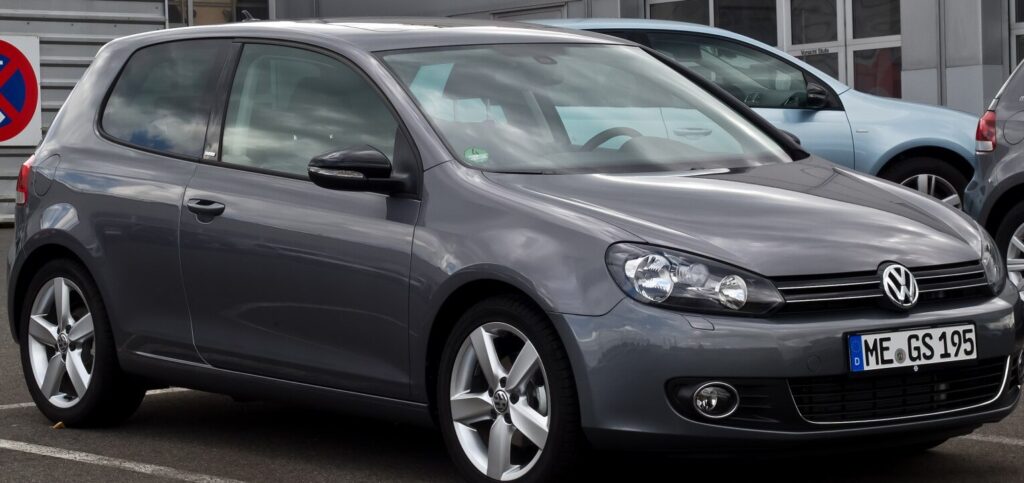
The Volkswagen Golf VI 1.6 (102 hp) DSG, a three-door hatchback, was produced from October 2008 to April 2013. This variant occupied the entry to mid-level position within the Golf VI range, offering a balance of affordability, fuel efficiency, and practicality. It was positioned below the more powerful 1.4 TSI and 2.0 TDI models, and above the base 1.4-liter naturally aspirated engine option. The Golf VI itself was built on the A5 platform (internally designated 1HX0 for the three-door hatchback), representing a significant evolution of the Golf lineage with improvements in build quality, technology, and refinement compared to its predecessor.
Powertrain & Engine Architecture
The Golf VI 1.6 DSG was powered by the BSE, BSF, or CCSA engine code, a 1.6-liter inline four-cylinder gasoline engine. This engine featured a naturally aspirated configuration and multi-port fuel injection. The engine produced 102 horsepower at 5600 rpm and 148 Nm (109.16 lb-ft) of torque at 3800 rpm, resulting in a power-to-liter ratio of 63.9 hp/l. The engine utilized an overhead camshaft (OHC) valvetrain with two valves per cylinder. Compression ratio was set at 10.5:1. Engine oil capacity was 4.5 liters (4.76 US quarts or 3.96 UK quarts).
Crucially, this variant was paired with a 7-speed dual-clutch transmission (DSG). The DSG, a sophisticated automated manual transmission, offered quicker and smoother gear changes compared to a traditional automatic transmission. The DSG’s operation involved two separate clutches, one for odd-numbered gears and one for even-numbered gears, allowing for pre-selection of the next gear and seamless shifts. This particular DSG unit was designed to handle the engine’s torque output efficiently, contributing to improved fuel economy and a more engaging driving experience than a conventional automatic.
Engine Codes & Variations
While the BSE, BSF, and CCSA codes are all 1.6-liter engines, subtle differences existed between them, primarily relating to emissions control systems and minor software calibrations. The CCSA engine, for example, was often found in vehicles meeting more stringent Euro 5 emission standards. These variations didn’t significantly alter the engine’s overall performance characteristics.
Driving Characteristics
The 1.6-liter engine with the 7-speed DSG provided adequate, though not exhilarating, performance. Acceleration from 0 to 100 km/h (0-62 mph) took approximately 12.5 seconds, and 0-60 mph was achieved in around 11.9 seconds. The maximum speed was 188 km/h (116.82 mph). The DSG transmission helped to maximize the available power, keeping the engine within its optimal operating range during acceleration. Compared to the manual transmission versions of the 1.6-liter Golf VI, the DSG offered slightly quicker acceleration due to the faster gear changes. However, it lacked the direct engagement and control offered by a manual gearbox.
The gear ratios in the 7-speed DSG were optimized for both fuel efficiency and performance. Lower gears provided brisk acceleration, while higher gears allowed for relaxed cruising at highway speeds. The transmission’s ability to skip gears during downshifts further enhanced its responsiveness. While not as sporty as the higher-output TSI engines, the 1.6 DSG offered a comfortable and refined driving experience suitable for everyday commuting and longer journeys.
Equipment & Trim Levels
The Golf VI 1.6 DSG typically came equipped with a reasonable level of standard features. These included power windows, power door locks, air conditioning, a basic audio system (usually with CD player and MP3 compatibility), and alloy wheels (typically 15 or 16 inch). Safety features such as ABS (Anti-lock Braking System), airbags (front, side, and curtain), and electronic stability control were also standard. Interior upholstery was typically cloth, with a relatively simple dashboard layout.
Optional extras included features like a more advanced audio system with touchscreen display, navigation system, parking sensors, automatic climate control, heated seats, and upgraded interior trim materials. Specific trim levels (Trendline, Comfortline, Highline) offered varying levels of standard equipment, with the Highline being the most well-equipped.
Chassis & Braking
The Golf VI 1.6 DSG featured an independent suspension system. The front suspension utilized a McPherson strut design with coil springs and an anti-roll bar, while the rear suspension employed a multi-link setup, also with a stabilizer bar. This suspension configuration provided a good balance of ride comfort and handling. The front brakes were ventilated discs, while the rear brakes were discs. Electric power steering was standard, offering a light and precise steering feel.
The weight of the 1.6 DSG model (approximately 1190 kg or 2623.5 lbs) was relatively low compared to the more powerful Golf VI variants, contributing to its nimble handling characteristics. Tire sizes typically ranged from 195/65 R15 to 205/55 R16, depending on the trim level and wheel size.
Market Reception & Comparison
The Golf VI 1.6 DSG was generally well-received by automotive critics as a practical and economical choice. It was praised for its comfortable ride, refined interior, and efficient DSG transmission. However, some critics noted that the engine lacked the punch of the more powerful TSI and TDI options. Fuel economy was a strong point, with combined fuel consumption figures of around 8.1 l/100 km (29 US mpg or 34.9 UK mpg).
Compared to the 1.4 TSI, the 1.6 DSG offered slightly lower performance but was generally more affordable. The 2.0 TDI, while offering superior fuel economy and torque, was more expensive to purchase and maintain due to the complexities of its diesel engine and emissions control systems. The 1.6 DSG appealed to buyers who prioritized affordability, fuel efficiency, and a comfortable driving experience over outright performance.
Technical Specifications
| Brand | Volkswagen |
| Model | Golf |
| Generation | Golf VI (3-door) |
| Type (Engine) | 1.6 (102 Hp) DSG |
| Start of production | October, 2008 |
| End of production | April, 2013 |
| Fuel consumption (urban) | 11.5 l/100 km (20.5 US mpg, 24.6 UK mpg) |
| Fuel consumption (extra urban) | 6.1 l/100 km (38.6 US mpg, 46.3 UK mpg) |
| Fuel consumption (combined) | 8.1 l/100 km (29 US mpg, 34.9 UK mpg) |
| Fuel Type | Petrol (Gasoline) |
| Acceleration 0 – 100 km/h | 12.5 sec |
| Acceleration 0 – 62 mph | 12.5 sec |
| Acceleration 0 – 60 mph | 11.9 sec |
| Maximum speed | 188 km/h (116.82 mph) |
| Emission standard | Euro 5 |
| Weight-to-power ratio | 11.7 kg/Hp |
| Power | 102 Hp @ 5600 rpm |
| Torque | 148 Nm @ 3800 rpm (109.16 lb.-ft. @ 3800 rpm) |
| Engine layout | Front, Transverse |
| Engine Model/Code | BSE, BSF, CCSA |
| Engine displacement | 1595 cm3 (97.33 cu. in.) |
| Number of cylinders | 4 |
| Engine configuration | Inline |
| Cylinder Bore | 81 mm (3.19 in.) |
| Piston Stroke | 77.4 mm (3.05 in.) |
| Compression ratio | 10.5:1 |
| Number of valves per cylinder | 2 |
| Fuel injection system | Multi-port manifold injection |
| Engine aspiration | Naturally aspirated |
| Valvetrain | OHC |
| Engine oil capacity | 4.5 l (4.76 US qt | 3.96 UK qt) |
| Kerb Weight | 1190 kg (2623.5 lbs.) |
| Max. weight | 1810 kg (3990.37 lbs.) |
| Trunk (boot) space – minimum | 350 l (12.36 cu. ft.) |
| Trunk (boot) space – maximum | 1305 l (46.09 cu. ft.) |
| Fuel tank capacity | 55 l (14.53 US gal | 12.1 UK gal) |
| Number of gears and type of gearbox | 7 gears, automatic transmission (DSG) |
Legacy
The 1.6-liter engine and 7-speed DSG combination in the Golf VI proved to be a relatively reliable powertrain. While the DSG transmission can require more frequent maintenance (fluid changes) than a traditional automatic, it is generally durable when properly serviced. The 1.6-liter engine is known for its simplicity and robustness. On the used car market, the Golf VI 1.6 DSG remains a popular choice for buyers seeking an affordable and practical hatchback. Its fuel efficiency and relatively low running costs make it an attractive option for those on a budget. However, potential buyers should ensure that the DSG transmission has been regularly maintained to avoid potential issues.