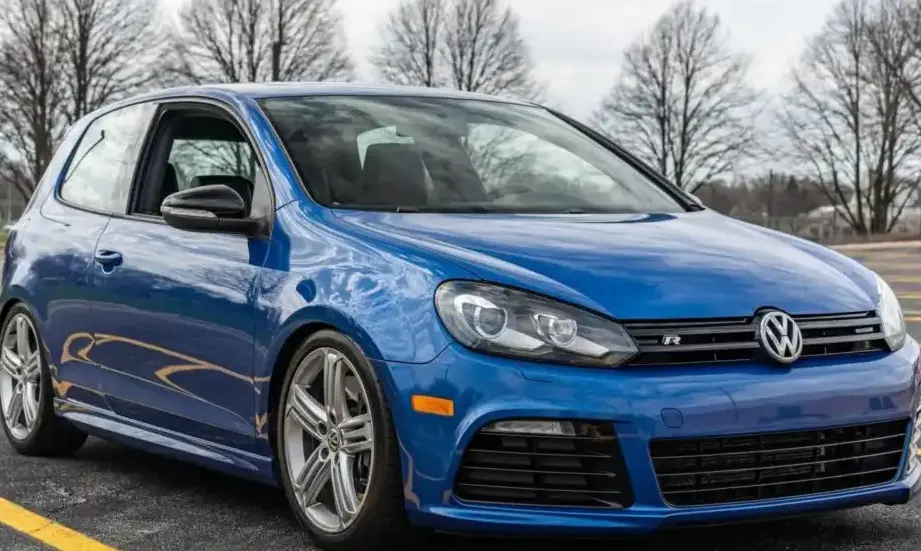
The Volkswagen Golf VI R, produced between December 2009 and October 2012, represented the high-performance variant of the sixth-generation Golf. Available in both 3-door and 5-door configurations, the “R” designation signified Volkswagen’s commitment to a more engaging driving experience. This particular iteration, the 2.0 TSI 270 Hp 4MOTION DSG, was positioned as the flagship model, offering a substantial increase in power and sophisticated all-wheel-drive technology compared to other Golf VI trims. It served as a direct competitor to hot hatches like the Ford Focus RS and the Renault Mégane RS, aiming to deliver a blend of everyday usability and track-day capability.
Technical Specifications
| Brand | Volkswagen |
| Model | Golf |
| Generation | Golf VI (3-door) |
| Type (Engine) | R 2.0 TSI (270 Hp) 4MOTION DSG |
| Start of production | December, 2009 |
| End of production | October, 2012 |
| Powertrain Architecture | Internal Combustion engine |
| Body type | Hatchback |
| Seats | 5 |
| Doors | 3 |
| Fuel consumption (economy) – urban (NEDC) | 11.2 l/100 km (21 US mpg, 25.2 UK mpg, 8.9 km/l) |
| Fuel consumption (economy) – extra urban (NEDC) | 6.8 l/100 km (34.6 US mpg, 41.5 UK mpg, 14.7 km/l) |
| Fuel consumption (economy) – combined (NEDC) | 8.4 l/100 km (28 US mpg, 33.6 UK mpg, 11.9 km/l) |
| CO2 emissions (NEDC) | 195 g/km |
| Fuel Type | Petrol (Gasoline) |
| Acceleration 0 – 100 km/h | 5.5 sec |
| Acceleration 0 – 62 mph | 5.5 sec |
| Acceleration 0 – 60 mph | 5.2 sec |
| Maximum speed | 250 km/h (155.34 mph), Electronically limited |
| Emission standard | Euro 5 |
| Weight-to-power ratio | 5.4 kg/Hp, 184.2 Hp/tonne |
| Weight-to-torque ratio | 4.2 kg/Nm, 238.7 Nm/tonne |
| Power | 270 Hp @ 6000 rpm |
| Power per litre | 136.1 Hp/l |
| Torque | 350 Nm @ 2500-5000 rpm (258.15 lb.-ft. @ 2500-5000 rpm) |
| Engine layout | Front, Transverse |
| Engine Model/Code | EA113 / CDLF |
| Engine displacement | 1984 cm3 (121.07 cu. in.) |
| Number of cylinders | 4 |
| Engine configuration | Inline |
| Cylinder Bore | 82.5 mm (3.25 in.) |
| Piston Stroke | 92.8 mm (3.65 in.) |
| Compression ratio | 9.8:1 |
| Number of valves per cylinder | 4 |
| Fuel injection system | Direct injection |
| Engine aspiration | Turbocharger, Intercooler |
| Valvetrain | DOHC |
| Engine oil capacity | 4.6 l (4.86 US qt | 4.05 UK qt) |
| Coolant | 8 l (8.45 US qt | 7.04 UK qt) |
| Kerb Weight | 1466 kg (3231.98 lbs.) |
| Max. weight | 2030 kg (4475.38 lbs.) |
| Max load | 564 kg (1243.41 lbs.) |
| Trunk (boot) space – minimum | 275 l (9.71 cu. ft.) |
| Trunk (boot) space – maximum | 1230 l (43.44 cu. ft.) |
| Fuel tank capacity | 60 l (15.85 US gal | 13.2 UK gal) |
| Max. roof load | 75 kg (165.35 lbs.) |
| Length | 4212 mm (165.83 in.) |
| Width | 1779 mm (70.04 in.) |
| Height | 1461 mm (57.52 in.) |
| Wheelbase | 2578 mm (101.5 in.) |
| Front track | 1533 mm (60.35 in.) |
| Rear (Back) track | 1515 mm (59.65 in.) |
| Ride height (ground clearance) | 132 mm (5.2 in.) |
| Minimum turning circle (turning diameter) | 10.9 m (35.76 ft.) |
| Drivetrain Architecture | All wheel drive (4×4). ICE drives front wheels, rear wheels driven via clutch. |
| Number of gears and type of gearbox | 6 gears, automatic transmission DSG |
| Front suspension | Independent, McPherson with coil spring and anti-roll bar |
| Rear suspension | Independent multi-link spring suspension with stabilizer |
| Front brakes | Ventilated discs |
| Rear brakes | Disc |
INTRODUCTION
The Golf VI R, launched in late 2009, built upon the success of previous “R” models, offering a significant performance upgrade over the standard Golf VI. It was built on the Volkswagen Group’s A5 platform (internally designated 1HX0 for the 3-door and 5HX0 for the 5-door), sharing its basic architecture with models like the Audi A3 and SEAT Leon. The 2.0 TSI 270 Hp 4MOTION DSG variant was the top-of-the-line offering, combining a potent turbocharged engine with a sophisticated all-wheel-drive system and a dual-clutch transmission. This combination aimed to deliver a thrilling driving experience with enhanced grip and control, making it a popular choice for enthusiasts.
Powertrain & Engine Architecture
At the heart of the Golf VI R lies the EA113 2.0-liter turbocharged inline-four cylinder engine, specifically coded CDLF. This engine featured direct fuel injection, a robust turbocharger, and an intercooler to maximize power output. The engine produced 270 horsepower at 6000 rpm and 350 Nm (258 lb-ft) of torque available from 2500 to 5000 rpm. The direct injection system allowed for precise fuel delivery, improving efficiency and reducing emissions. The engine utilized a dual overhead camshaft (DOHC) valvetrain with four valves per cylinder, optimizing airflow for increased performance. Paired with this engine was the Volkswagen Group’s renowned 6-speed DSG (Direct-Shift Gearbox) dual-clutch transmission. This transmission offered incredibly fast and smooth gear changes, contributing to the car’s impressive acceleration. The 4MOTION all-wheel-drive system utilized a Haldex multi-plate clutch to distribute torque between the front and rear axles, providing enhanced traction in various driving conditions.
Driving Characteristics
The Golf VI R 2.0 TSI 4MOTION DSG delivered a noticeably more engaging driving experience than lower-powered Golf VI variants. The 270 hp engine provided strong acceleration, with a 0-60 mph time of around 5.2 seconds. The DSG transmission ensured that power was delivered seamlessly, with minimal turbo lag. The 4MOTION system provided excellent grip, particularly in wet or slippery conditions, inspiring confidence during spirited driving. Compared to the manual transmission versions, the DSG offered quicker shifts and a more refined driving experience, although some purists preferred the greater control of a manual gearbox. The gear ratios were tuned for a balance between acceleration and fuel efficiency, making the car reasonably practical for everyday use. The suspension was firmer than standard Golf models, providing better body control and reducing roll in corners.
Equipment & Trim Levels
The Golf VI R came generously equipped as standard. Interior features included sport seats upholstered in a unique “R” fabric, a leather-wrapped steering wheel with “R” badging, and aluminum pedal caps. Standard exterior features included a unique front bumper with larger air intakes, side skirts, a rear diffuser, and a roof spoiler. Bi-Xenon headlights with LED daytime running lights were also standard. Optional extras included leather upholstery, a touchscreen navigation system, and a premium sound system. The overall interior design was sporty and functional, with a focus on providing a comfortable and engaging driving environment.
Chassis & Braking
The Golf VI R featured a sport-tuned suspension with stiffer springs and dampers compared to standard Golf models. The front suspension utilized a McPherson strut design, while the rear suspension employed a multi-link setup. This configuration provided a good balance between ride comfort and handling performance. The braking system consisted of ventilated disc brakes on all four wheels, providing ample stopping power. The R model also featured larger brake rotors and calipers compared to lower-spec Golfs. Anti-lock braking system (ABS) and electronic stability control (ESC) were standard safety features.
Market Reception & Comparison
The Golf VI R was generally well-received by automotive critics, who praised its performance, handling, and practicality. It was often lauded as one of the best hot hatches on the market. Compared to other Golf VI trims, the R offered a significant performance advantage, but it also came with a higher price tag. The 1.8L TSI and 2.0 TDI models offered better fuel economy, while the base models were more affordable. However, none of these trims could match the R’s overall performance and driving experience. The R’s 4MOTION system provided a distinct advantage over front-wheel-drive rivals, particularly in challenging weather conditions.
Legacy
The Golf VI R remains a popular choice among enthusiasts in the used car market. The EA113 engine, while known for its potential for modification, has proven to be relatively reliable when properly maintained. The DSG transmission, however, can require more frequent servicing than a traditional manual gearbox. Regular oil changes and adherence to the manufacturer’s maintenance schedule are crucial for ensuring the long-term reliability of this powertrain. Today, the Golf VI R is considered a modern classic, offering a compelling blend of performance, practicality, and style.