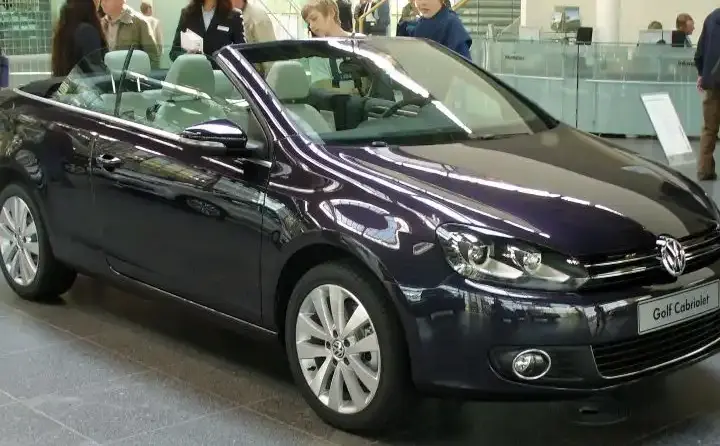
The Volkswagen Golf VI Cabriolet GTI 2.0 TSI (220 hp) BMT DSG, produced from 2015 to 2016, represents the performance-oriented variant of the sixth-generation Golf Cabriolet following its facelift. Positioned as the flagship trim, it combined the open-air enjoyment of a convertible with the spirited driving experience associated with the GTI badge. This model sat atop the Cabriolet range, offering a significant performance upgrade over the standard 1.2L and 1.4L TSI engine options. It was primarily marketed in Europe, where the Golf Cabriolet maintained a strong following, offering a more affordable and accessible alternative to premium convertible brands.
Technical Specifications
| Brand | Volkswagen |
| Model | Golf |
| Generation | Golf VI Cabriolet (facelift 2015) |
| Type (Engine) | GTI 2.0 TSI (220 Hp) BMT DSG |
| Start of production | 2015 |
| End of production | 2016 |
| Powertrain Architecture | Internal Combustion engine |
| Body type | Cabriolet |
| Seats | 4 |
| Doors | 2 |
| Fuel consumption (economy) – urban (NEDC) | 8.2 l/100 km (28.7 US mpg, 34.4 UK mpg, 12.2 km/l) |
| Fuel consumption (economy) – extra urban (NEDC) | 5.6 l/100 km (42 US mpg, 50.4 UK mpg, 17.9 km/l) |
| Fuel consumption (economy) – combined (NEDC) | 6.5 l/100 km (36.2 US mpg, 43.5 UK mpg, 15.4 km/l) |
| CO2 emissions (NEDC) | 152 g/km |
| Fuel Type | Petrol (Gasoline) |
| Acceleration 0 – 100 km/h | 6.9 sec |
| Acceleration 0 – 62 mph | 6.9 sec |
| Acceleration 0 – 60 mph | 6.6 sec |
| Maximum speed | 236 km/h (146.64 mph) |
| Emission standard | Euro 6 |
| Weight-to-power ratio | 6.5 kg/Hp, 153.8 Hp/tonne |
| Weight-to-torque ratio | 4.1 kg/Nm, 244.8 Nm/tonne |
| Power | 220 Hp @ 4500-6200 rpm |
| Power per litre | 110.9 Hp/l |
| Torque | 350 Nm @ 1500-4400 rpm (258.15 lb.-ft. @ 1500-4400 rpm) |
| Engine layout | Front, Transverse |
| Engine Model/Code | EA888 / CULC |
| Engine displacement | 1984 cm3 (121.07 cu. in.) |
| Number of cylinders | 4 |
| Engine configuration | Inline |
| Cylinder Bore | 82.5 mm (3.25 in.) |
| Piston Stroke | 92.8 mm (3.65 in.) |
| Compression ratio | 9.6:1 |
| Number of valves per cylinder | 4 |
| Fuel injection system | Direct injection and Multi-port manifold injection |
| Engine aspiration | Turbocharger, Intercooler |
| Valvetrain | DOHC |
| Engine oil capacity | 5.7 l (6.02 US qt | 5.02 UK qt) |
| Kerb Weight | 1430 kg (3152.61 lbs.) |
| Max. weight | 1950 kg (4299.01 lbs.) |
| Max load | 520 kg (1146.4 lbs.) |
| Trunk (boot) space – minimum | 250 l (8.83 cu. ft.) |
| Fuel tank capacity | 55 l (14.53 US gal | 12.1 UK gal) |
| Permitted trailer load with brakes (12%) | 1400 kg (3086.47 lbs.) |
| Permitted trailer load without brakes | 750 kg (1653.47 lbs.) |
| Permitted towbar download | 75 kg (165.35 lbs.) |
| Length | 4258 mm (167.64 in.) |
| Width | 1782 mm (70.16 in.) |
| Width including mirrors | 2044 mm (80.47 in.) |
| Height | 1414 mm (55.67 in.) |
| Wheelbase | 2578 mm (101.5 in.) |
| Front track | 1533 mm (60.35 in.) |
| Rear (Back) track | 1514 mm (59.61 in.) |
| Ride height (ground clearance) | 130 mm (5.12 in.) |
| Minimum turning circle (turning diameter) | 10.9 m (35.76 ft.) |
| Approach angle | 11.7° |
| Departure angle | 14.1° |
| Ramp-over (brakeover) angle | 9.7° |
| Drivetrain Architecture | The Internal combustion engine (ICE) drives the front wheels of the vehicle. |
| Drive wheel | Front wheel drive |
| Number of gears and type of gearbox | 6 gears, automatic transmission DSG |
| Front suspension | Independent, type McPherson with coil spring and anti-roll bar |
| Rear suspension | Independent multi-link spring suspension with stabilizer |
| Front brakes | Ventilated discs |
| Rear brakes | Disc |
| Assisting systems | ABS (Anti-lock braking system) |
| Steering type | Steering rack and pinion |
| Power steering | Electric Steering |
| Tires size | 225/40 R18 |
| Wheel rims size | 7.5J x 18 |
INTRODUCTION
The 2015-2016 Volkswagen Golf VI Cabriolet GTI 2.0 TSI (220 hp) BMT DSG represented the pinnacle of performance for the sixth-generation Golf Cabriolet. Following the facelift of the Golf VI range, this variant combined the open-top driving experience with the GTI’s renowned sporty character. Built on the A5 platform (internally designated 1HX0 for the Cabriolet), it offered a compelling alternative to hardtop GTI models, appealing to drivers seeking a more engaging and stylish driving experience. The “BMT” designation refers to the engine’s BlueMotion Technology features, aimed at improving fuel efficiency.
Powertrain & Engine Architecture
At the heart of the Golf VI Cabriolet GTI lies the EA888 CULC 2.0-liter turbocharged four-cylinder engine. This engine, a mainstay of the Volkswagen Group’s performance models, produces 220 horsepower at 4500-6200 rpm and 350 Nm (258 lb-ft) of torque between 1500 and 4400 rpm. The CULC code signifies a specific iteration of the EA888, featuring direct fuel injection combined with multi-point injection for optimized combustion. The engine utilizes a sophisticated turbocharger and intercooler system to deliver strong, consistent power throughout the rev range. Paired with this engine is the 6-speed DSG (Dual-Clutch Gearbox), offering rapid and smooth gear changes. The DSG transmission features paddle shifters for manual control, enhancing the driving experience. The BMT (BlueMotion Technology) package includes features like start/stop system and regenerative braking to improve fuel economy.
Driving Characteristics
The 220 hp GTI Cabriolet offered a noticeably more engaging driving experience than the lower-powered Golf Cabriolet variants. Acceleration from 0 to 62 mph (0-100 km/h) takes approximately 6.9 seconds, making it a genuinely quick convertible. The DSG transmission contributes to this performance, providing quick shifts and allowing the engine to remain in its optimal power band. While the Cabriolet body style adds weight compared to the Golf GTI hatchback, the engine’s ample torque compensates for this, providing strong acceleration in everyday driving situations. The suspension is tuned for a balance between comfort and handling, offering a firm but not overly harsh ride. Compared to the 1.4 TSI models, the GTI provides a significantly more responsive throttle and a more satisfying exhaust note.
Equipment & Trim Levels
The GTI Cabriolet came generously equipped as standard. Key features included sport seats upholstered in the classic GTI “Clark” plaid fabric, a leather-wrapped multi-function steering wheel, automatic climate control, and a touchscreen infotainment system. Exterior styling cues included GTI-specific front and rear bumpers, side skirts, and a rear spoiler. Optional extras included bi-xenon headlights, a premium sound system, and parking sensors. The interior trim was typically finished with red accents, further emphasizing the GTI’s sporty character.
Chassis & Braking
The Golf VI Cabriolet GTI utilized an independent suspension setup at all four wheels. The front suspension employed a McPherson strut design with coil springs and an anti-roll bar, while the rear featured a multi-link setup, also with coil springs and a stabilizer bar. This configuration provided a good balance of ride comfort and handling precision. Braking duties were handled by ventilated discs at the front and solid discs at the rear, equipped with ABS (Anti-lock Braking System). The steering system was a rack-and-pinion type with electric power assistance.
Market Reception & Comparison
The Golf VI Cabriolet GTI was generally well-received by automotive critics. It was praised for its strong performance, engaging handling, and stylish design. Compared to the standard Golf Cabriolet models, the GTI offered a significant performance upgrade, justifying its higher price tag. Fuel economy, while respectable for a performance convertible, was slightly lower than the more economical 1.2L and 1.4L TSI variants. However, the GTI’s superior driving experience and more powerful engine were considered worthwhile trade-offs by many buyers. It competed with other premium compact convertibles, such as the Audi A3 Cabriolet and the BMW 1 Series Convertible.
Legacy
The EA888 2.0 TSI engine, as found in the Golf VI Cabriolet GTI, has proven to be a robust and reliable unit when properly maintained. The DSG transmission, while requiring periodic servicing, is also generally considered durable. Today, the 2015-2016 Golf VI Cabriolet GTI represents a desirable used car option for those seeking a sporty and stylish convertible. Its combination of performance, practicality, and relatively affordable price point continues to appeal to enthusiasts. Common maintenance items include regular oil changes, DSG fluid changes, and inspection of the turbocharger system. Well-maintained examples command a premium in the used car market.