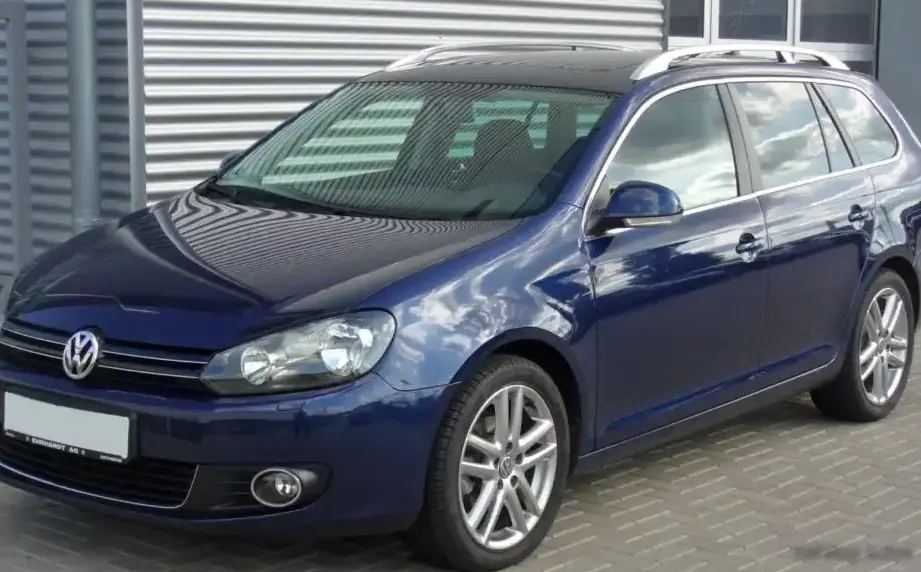
The Volkswagen Golf VI Variant 1.6 TDI BMT (105 hp) DSG, produced from May 2009 to April 2013, represents a fuel-efficient and practical offering within the sixth generation of the Golf Variant (estate) lineup. Positioned as an entry-to-mid-range trim, it catered to buyers prioritizing economy and usability over outright performance. This variant was primarily sold in the European market, where compact wagons held significant popularity, offering a balance between the Golf’s renowned practicality and the efficiency of a modern diesel engine paired with a dual-clutch transmission. It formed part of the broader Golf VI range, which utilized the Volkswagen Group’s A6 platform (also known as the PQ35 platform).
Technical Specifications
| Brand | Volkswagen |
| Model | Golf |
| Generation | Golf VI Variant |
| Type (Engine) | 1.6 TDI BMT (105 Hp) DSG |
| Start of production | May, 2009 |
| End of production | April, 2013 |
| Powertrain Architecture | Internal Combustion engine |
| Body type | Station wagon (estate) |
| Seats | 5 |
| Doors | 5 |
| Fuel consumption (economy) – urban (NEDC) | 4.9 l/100 km (48 US mpg, 57.6 UK mpg, 20.4 km/l) |
| Fuel consumption (economy) – extra urban (NEDC) | 4 l/100 km (58.8 US mpg, 70.6 UK mpg, 25 km/l) |
| Fuel consumption (economy) – combined (NEDC) | 4.3 l/100 km (54.7 US mpg, 65.7 UK mpg, 23.3 km/l) |
| CO2 emissions (NEDC) | 113 g/km |
| Fuel Type | Diesel |
| Acceleration 0 – 100 km/h | 11.9 sec |
| Acceleration 0 – 62 mph | 11.9 sec |
| Acceleration 0 – 60 mph | 11.3 sec |
| Maximum speed | 190 km/h (118.06 mph) |
| Emission standard | Euro 5 |
| Weight-to-power ratio | 13.3 kg/Hp, 75.1 Hp/tonne |
| Weight-to-torque ratio | 5.6 kg/Nm, 178.8 Nm/tonne |
| Power | 105 Hp @ 4400 rpm |
| Power per litre | 65.7 Hp/l |
| Torque | 250 Nm @ 1500-2500 rpm (184.39 lb.-ft. @ 1500-2500 rpm) |
| Engine layout | Front, Transverse |
| Engine Model/Code | CAYC |
| Engine displacement | 1598 cm3 (97.52 cu. in.) |
| Number of cylinders | 4 |
| Engine configuration | Inline |
| Cylinder Bore | 79.5 mm (3.13 in.) |
| Piston Stroke | 80.5 mm (3.17 in.) |
| Compression ratio | 16.5:1 |
| Number of valves per cylinder | 4 |
| Fuel injection system | Diesel Commonrail |
| Engine aspiration | Turbocharger, Intercooler |
| Valvetrain | DOHC |
| Engine oil capacity | 4.3 l (4.54 US qt | 3.78 UK qt) |
| Kerb Weight | 1398 kg (3082.06 lbs.) |
| Max. weight | 1980 kg (4365.15 lbs.) |
| Max load | 582 kg (1283.09 lbs.) |
| Trunk (boot) space – minimum | 505 l (17.83 cu. ft.) |
| Trunk (boot) space – maximum | 1495 l (52.8 cu. ft.) |
| Fuel tank capacity | 55 l (14.53 US gal | 12.1 UK gal) |
| Max. roof load | 75 kg (165.35 lbs.) |
| Permitted trailer load with brakes (8%) | 1700 kg (3747.86 lbs.) |
| Permitted trailer load with brakes (12%) | 1400 kg (3086.47 lbs.) |
| Permitted trailer load without brakes | 730 kg (1609.37 lbs.) |
| Permitted towbar download | 75 kg (165.35 lbs.) |
| Length | 4534 mm (178.5 in.) |
| Width | 1781 mm (70.12 in.) |
| Width including mirrors | 2003 mm (78.86 in.) |
| Height | 1504 mm (59.21 in.) |
| Wheelbase | 2578 mm (101.5 in.) |
| Front track | 1535 mm (60.43 in.) |
| Rear (Back) track | 1508 mm (59.37 in.) |
| Ride height (ground clearance) | 141 mm (5.55 in.) |
| Minimum turning circle (turning diameter) | 10.9 m (35.76 ft.) |
| Drivetrain Architecture | The Internal combustion engine (ICE) drives the front wheels of the vehicle. |
| Drive wheel | Front wheel drive |
| Number of gears and type of gearbox | 7 gears, automatic transmission DSG |
| Front suspension | Independent type McPherson, Transverse stabilizer |
| Rear suspension | Independent multi-link suspension, Transverse stabilizer |
| Front brakes | Ventilated discs |
| Rear brakes | Disc |
| Assisting systems | ABS (Anti-lock braking system) |
| Steering type | Steering rack and pinion |
| Power steering | Electric Steering |
| Tires size | 205/55 R16 |
| Wheel rims size | 6.5J x 16 |
Powertrain & Engine Architecture
The heart of this Golf Variant is the 1.6-liter (1598 cc) CAYC inline-four cylinder diesel engine. This engine belongs to Volkswagen’s EA188 family, known for its compact design and efficiency. The CAYC engine utilizes a common rail direct injection system, delivering fuel directly into the combustion chamber at extremely high pressure for optimized combustion. It’s turbocharged with an intercooler to increase air density and boost power output. The engine features a double overhead camshaft (DOHC) valvetrain with four valves per cylinder, enhancing breathing and contributing to its relatively high specific output for its displacement. The “BMT” designation stands for “BlueMotion Technology,” indicating the inclusion of fuel-saving features like start-stop functionality and regenerative braking. This engine is paired with the Volkswagen Group’s 7-speed dual-clutch transmission (DSG). The DSG provides quick, seamless shifts and contributes to improved fuel economy compared to a traditional automatic transmission.
Driving Characteristics
The 105 hp output and 250 Nm (184 lb-ft) of torque provide adequate, though not exhilarating, performance. Acceleration from 0-62 mph takes approximately 11.9 seconds, and the top speed is 190 km/h (118 mph). The DSG transmission is well-matched to the engine’s characteristics, offering smooth and responsive shifts. The gear ratios are tuned for fuel efficiency, meaning the engine can feel somewhat strained when accelerating hard or climbing hills. Compared to the more powerful 1.4 TSI or 2.0 TDI variants, this 1.6 TDI BMT feels noticeably slower. However, it excels in everyday driving situations, providing sufficient power for commuting and general transportation. The focus is on maximizing fuel economy, and the engine delivers on this front, achieving combined fuel consumption figures of around 4.3 l/100 km (54.7 US mpg).
Equipment & Trim Levels
The 1.6 TDI BMT DSG typically came equipped with a reasonable level of standard features. These included air conditioning, electric front windows, central locking, a basic audio system, and ABS brakes. Higher trim levels, such as Trendline or Comfortline, added features like alloy wheels, a multi-function steering wheel, cruise control, and upgraded interior trim. Optional extras included a sunroof, parking sensors, and a more advanced infotainment system. Interior upholstery was typically cloth, with a functional and durable design. The dashboard layout was typical of the Golf VI, with a clear and straightforward design.
Chassis & Braking
The Golf VI Variant’s chassis features independent suspension all around – McPherson struts at the front and a multi-link setup at the rear. This provides a comfortable ride and good handling characteristics. The front suspension incorporates a transverse stabilizer bar to reduce body roll. Braking duties are handled by ventilated discs at the front and solid discs at the rear. ABS (Anti-lock Braking System) is standard. The suspension setup is tuned for comfort and practicality, rather than outright sportiness, reflecting the car’s intended role as a family vehicle.
Market Reception & Comparison
The Golf VI Variant 1.6 TDI BMT DSG was generally well-received by critics for its fuel efficiency and practicality. It was seen as a sensible choice for buyers prioritizing economy and usability. However, some reviewers noted that the engine lacked outright power, particularly when fully loaded. Compared to the more powerful diesel variants, the 1.6 TDI BMT offered significantly better fuel economy but at the expense of performance. It also tended to be more affordable to purchase and maintain. Against competitors like the Ford Focus Estate and Opel Astra Sports Tourer, the Golf VI Variant offered a well-rounded package with a reputation for build quality and reliability.
Legacy
The 1.6 TDI CAYC engine, when properly maintained, has proven to be a relatively reliable unit. However, like all modern diesel engines, it’s susceptible to issues with the diesel particulate filter (DPF) if not driven on longer journeys regularly. The DSG transmission is generally robust, but requires regular fluid changes to ensure longevity. In the used car market, the Golf VI Variant 1.6 TDI BMT DSG represents a good value proposition for buyers seeking an economical and practical estate car. Its fuel efficiency and relatively low running costs make it an attractive option, but potential buyers should be aware of the potential DPF issues and ensure the DSG transmission has been serviced according to the manufacturer’s recommendations.