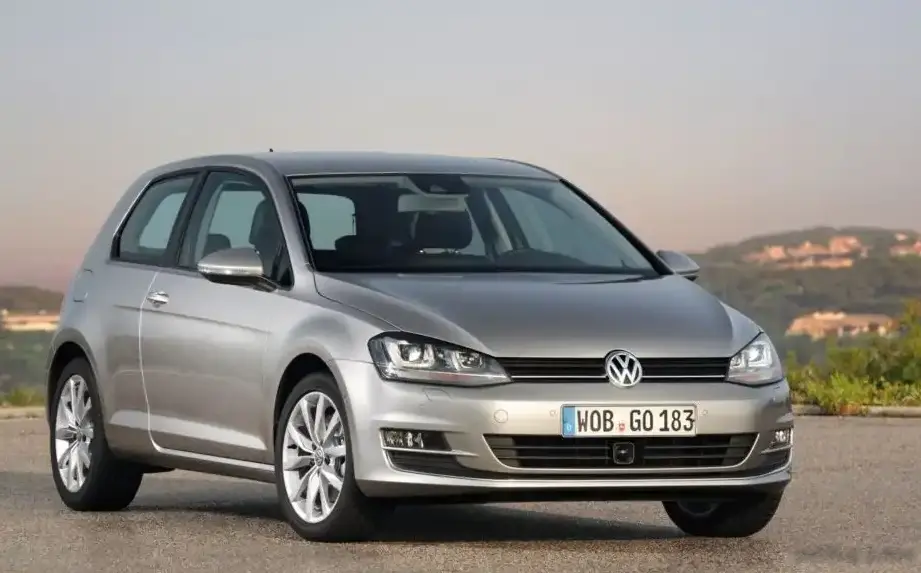
The Volkswagen Golf VII 1.4 TSI ACT, produced from 2012 to 2014, represents a significant iteration in the Golf lineage, specifically within the seventh generation (Mk7) of this iconic hatchback. This 3-door variant, powered by a 1.4-liter turbocharged direct-injection engine producing 140 horsepower, occupied a key position in the Golf lineup as a balance between fuel efficiency and respectable performance. It was a popular choice in European markets, offering a modern and technologically advanced package in a compact form. The “ACT” designation stands for Active Cylinder Technology, a fuel-saving feature that deactivates two cylinders under light load conditions.
Technical Specifications
| Brand | Volkswagen |
| Model | Golf |
| Generation | Golf VII (3-door) |
| Type (Engine) | 1.4 TSI ACT (140 Hp) |
| Start of production | 2012 |
| End of production | 2014 |
| Powertrain Architecture | Internal Combustion engine |
| Body type | Hatchback |
| Seats | 5 |
| Doors | 3 |
| Fuel consumption (urban) | 5.8 l/100 km (40.6 US mpg, 48.7 UK mpg, 17.2 km/l) |
| Fuel consumption (extra urban) | 4.2 l/100 km (56 US mpg, 67.3 UK mpg, 23.8 km/l) |
| Fuel consumption (combined) | 4.7 l/100 km (50 US mpg, 60.1 UK mpg, 21.3 km/l) |
| CO2 emissions | 109 g/km |
| Fuel Type | Petrol (Gasoline) |
| Acceleration 0 – 100 km/h | 8.4 sec |
| Acceleration 0 – 62 mph | 8.4 sec |
| Acceleration 0 – 60 mph | 8 sec |
| Maximum speed | 212 km/h (131.73 mph) |
| Emission standard | Euro 5 |
| Weight-to-power ratio | 8.5 kg/Hp, 117.2 Hp/tonne |
| Weight-to-torque ratio | 4.8 kg/Nm, 209.2 Nm/tonne |
| Power | 140 Hp @ 4500-6000 rpm |
| Power per litre | 100.4 Hp/l |
| Torque | 250 Nm @ 1500-3500 rpm (184.39 lb.-ft. @ 1500-3500 rpm) |
| Engine layout | Front, Transverse |
| Engine Model/Code | CPTA |
| Engine displacement | 1395 cm3 (85.13 cu. in.) |
| Number of cylinders | 4 |
| Engine configuration | Inline |
| Cylinder Bore | 74.5 mm (2.93 in.) |
| Piston Stroke | 80 mm (3.15 in.) |
| Compression ratio | 10:1 |
| Number of valves per cylinder | 4 |
| Fuel injection system | Direct injection |
| Engine aspiration | Turbocharger, Intercooler |
| Valvetrain | DOHC |
| Engine oil capacity | 4 l (4.23 US qt | 3.52 UK qt) |
| Kerb Weight | 1195 kg (2634.52 lbs.) |
| Max. weight | 1780 kg (3924.23 lbs.) |
| Max load | 585 kg (1289.7 lbs.) |
| Trunk (boot) space – minimum | 380 l (13.42 cu. ft.) |
| Trunk (boot) space – maximum | 1270 l (44.85 cu. ft.) |
| Fuel tank capacity | 50 l (13.21 US gal | 11 UK gal) |
| Max. roof load | 75 kg (165.35 lbs.) |
| Permitted trailer load with brakes (12%) | 1500 kg (3306.93 lbs.) |
| Permitted trailer load without brakes | 630 kg (1388.91 lbs.) |
| Permitted towbar download | 80 kg (176.37 lbs.) |
| Length | 4255 mm (167.52 in.) |
| Width | 1799 mm (70.83 in.) |
| Width including mirrors | 2027 mm (79.8 in.) |
| Height | 1452 mm (57.17 in.) |
| Wheelbase | 2637 mm (103.82 in.) |
| Front track | 1549 mm (60.98 in.) |
| Rear track | 1520 mm (59.84 in.) |
| Ride height (ground clearance) | 142 mm (5.59 in.) |
| Minimum turning circle | 10.9 m (35.76 ft.) |
| Front suspension | Independent, type McPherson with coil spring and anti-roll bar |
| Rear suspension | Independent multi-link spring suspension with stabilizer |
| Front brakes | Ventilated discs |
| Rear brakes | Disc |
| Assisting systems | ABS (Anti-lock braking system) |
| Steering type | Steering rack and pinion |
| Power steering | Electric Steering |
| Tires size | 205/55 R16 |
| Wheel rims size | 6.5J x 16 |
INTRODUCTION
The Golf VII 1.4 TSI ACT 3-door, launched in 2012, was a key component of Volkswagen’s strategy to offer a broad range of Golf models catering to diverse customer needs. Built on the modular transverse matrix (MQB) platform – designated 1HX0/A3 – this generation of Golf represented a leap forward in terms of technology, safety, and refinement. The 1.4 TSI ACT variant was positioned as an efficient and accessible entry point into the Mk7 Golf range, appealing to buyers prioritizing fuel economy and everyday usability. It offered a compelling alternative to diesel options, particularly in regions where gasoline fuel quality was high.
Powertrain & Engine Architecture
At the heart of the Golf VII 1.4 TSI ACT lies the CPTA engine code, a 1.4-liter inline-four cylinder engine featuring direct fuel injection and a turbocharger with an intercooler. This engine is notable for its Active Cylinder Technology (ACT), which shuts down cylinders 2 and 3 during low-load cruising conditions to reduce fuel consumption. The system utilizes a dedicated camshaft follower and valve lift adjustment to seamlessly switch between four-cylinder and two-cylinder operation. Fuel is delivered via a high-pressure direct injection system, optimizing combustion efficiency. The engine employs a dual overhead camshaft (DOHC) valvetrain with four valves per cylinder. The standard transmission for this variant was a 6-speed manual gearbox, although a 7-speed dual-clutch transmission (DSG) was available as an option. The DSG offered quicker shifts and improved fuel economy, but at an additional cost.
Driving Characteristics
The 140 horsepower and 184 lb-ft of torque produced by the 1.4 TSI engine provided adequate performance for everyday driving. Acceleration from 0 to 60 mph took approximately 8.4 seconds, and the car had a top speed of 131.73 mph. While not as sporty as the Golf GTI or models equipped with larger engines, the 1.4 TSI ACT offered a smooth and refined driving experience. The ACT system was largely imperceptible during normal driving, contributing to a quiet and comfortable ride. The 6-speed manual transmission had well-chosen gear ratios, allowing for efficient cruising and responsive acceleration. Compared to the more powerful 1.8 TSI or 2.0 TDI models, the 1.4 TSI felt less eager to rev, but its lighter weight and efficient engine contributed to better fuel economy.
Equipment & Trim Levels
The Golf VII 1.4 TSI ACT typically came equipped with a respectable level of standard features. These included air conditioning, power windows, power mirrors, a CD/MP3 stereo system, and alloy wheels. Safety features such as ABS, electronic stability control, and multiple airbags were also standard. Higher trim levels offered additional features such as a touchscreen infotainment system, automatic climate control, parking sensors, and upgraded upholstery. Optional extras included a panoramic sunroof, navigation system, and adaptive cruise control. Interior upholstery was typically cloth, with leather options available on higher trims.
Chassis & Braking
The Golf VII 1.4 TSI ACT utilized an independent suspension system, with a McPherson strut setup at the front and a multi-link setup at the rear. This provided a good balance between ride comfort and handling. The front brakes were ventilated discs, while the rear brakes were solid discs. The electric power steering offered precise and responsive steering feel. The car’s relatively light weight contributed to its agile handling characteristics. Stabilizer bars were fitted to both the front and rear axles to reduce body roll during cornering.
Market Reception & Comparison
The Golf VII 1.4 TSI ACT was generally well-received by automotive critics. It was praised for its fuel efficiency, comfortable ride, and refined engine. However, some reviewers noted that the engine could feel a bit underpowered when fully loaded or driving uphill. Compared to the 1.6-liter naturally aspirated engine offered in some markets, the 1.4 TSI ACT provided significantly more power and torque. Against the 2.0 TDI diesel, the 1.4 TSI offered a quieter and smoother driving experience, but with slightly lower fuel economy. The 1.8 TSI provided more performance but at a higher price point.
Legacy
The 1.4 TSI engine, including the CPTA variant found in the Golf VII, has proven to be a relatively reliable powertrain. However, like all turbocharged engines, it requires regular maintenance, including oil changes and spark plug replacements. The ACT system has been known to experience occasional issues, such as solenoid failures, but these are typically not major problems. Today, used Golf VII 1.4 TSI ACT models represent a good value for buyers seeking a fuel-efficient and well-equipped hatchback. Their relatively low running costs and comfortable driving experience make them a popular choice in the used car market.