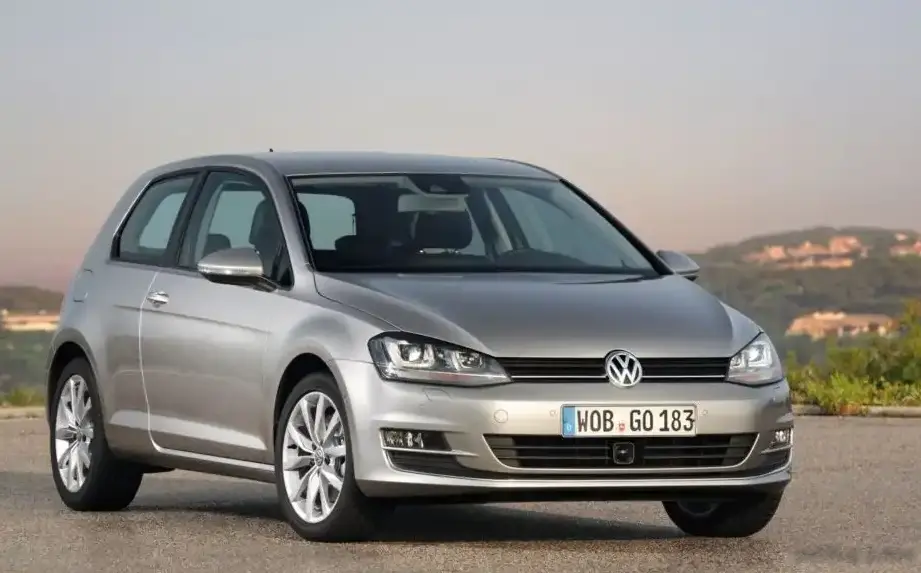
The Volkswagen Golf VII 1.4 TSI ACT (140 hp) DSG, a three-door hatchback, was produced from 2012 to 2014. This variant occupied a significant position within the seventh generation Golf (A7) lineup, representing a balance between fuel efficiency, performance, and modern technology. It was positioned as a mid-range offering, appealing to buyers seeking a more refined driving experience than the base models, but without the higher price tag of the GTI or diesel variants. The “ACT” designation stands for Active Cylinder Technology, a fuel-saving feature that deactivates two cylinders under light load conditions. This model was primarily marketed in Europe, where smaller displacement, turbocharged engines and efficient transmissions were highly valued.
Technical Specifications
| Brand | Volkswagen |
| Model | Golf |
| Generation | Golf VII (3-door) |
| Type (Engine) | 1.4 TSI ACT (140 Hp) DSG |
| Start of production | 2012 |
| End of production | 2014 |
| Powertrain Architecture | Internal Combustion engine |
| Body type | Hatchback |
| Seats | 5 |
| Doors | 3 |
| Fuel consumption (urban) | 5.8 l/100 km (40.6 US mpg, 48.7 UK mpg, 17.2 km/l) |
| Fuel consumption (extra urban) | 4.1 l/100 km (57.4 US mpg, 68.9 UK mpg, 24.4 km/l) |
| Fuel consumption (combined) | 4.7 l/100 km (50 US mpg, 60.1 UK mpg, 21.3 km/l) |
| CO2 emissions | 109 g/km |
| Fuel Type | Petrol (Gasoline) |
| Acceleration 0 – 100 km/h | 8.4 sec |
| Acceleration 0 – 62 mph | 8.4 sec |
| Acceleration 0 – 60 mph | 8 sec |
| Maximum speed | 212 km/h (131.73 mph) |
| Emission standard | Euro 5 |
| Weight-to-power ratio | 8.7 kg/Hp, 115.2 Hp/tonne |
| Weight-to-torque ratio | 4.9 kg/Nm, 205.8 Nm/tonne |
| Power | 140 Hp @ 4500-6000 rpm |
| Power per litre | 100.4 Hp/l |
| Torque | 250 Nm @ 1500-3500 rpm (184.39 lb.-ft. @ 1500-3500 rpm) |
| Engine layout | Front, Transverse |
| Engine Model/Code | CPTA |
| Engine displacement | 1395 cm3 (85.13 cu. in.) |
| Number of cylinders | 4 |
| Engine configuration | Inline |
| Cylinder Bore | 74.5 mm (2.93 in.) |
| Piston Stroke | 80 mm (3.15 in.) |
| Compression ratio | 10:1 |
| Number of valves per cylinder | 4 |
| Fuel injection system | Direct injection |
| Engine aspiration | Turbocharger, Intercooler |
| Valvetrain | DOHC |
| Engine oil capacity | 4 l (4.23 US qt | 3.52 UK qt) |
| Kerb Weight | 1215 kg (2678.62 lbs.) |
| Max. weight | 1800 kg (3968.32 lbs.) |
| Max load | 585 kg (1289.7 lbs.) |
| Trunk (boot) space – minimum | 380 l (13.42 cu. ft.) |
| Trunk (boot) space – maximum | 1270 l (44.85 cu. ft.) |
| Fuel tank capacity | 50 l (13.21 US gal | 11 UK gal) |
| Max. roof load | 75 kg (165.35 lbs.) |
| Permitted trailer load with brakes (12%) | 1500 kg (3306.93 lbs.) |
| Permitted trailer load without brakes | 640 kg (1410.96 lbs.) |
| Permitted towbar download | 80 kg (176.37 lbs.) |
| Length | 4255 mm (167.52 in.) |
| Width | 1799 mm (70.83 in.) |
| Width including mirrors | 2027 mm (79.8 in.) |
| Height | 1452 mm (57.17 in.) |
| Wheelbase | 2637 mm (103.82 in.) |
| Front track | 1549 mm (60.98 in.) |
| Rear track | 1520 mm (59.84 in.) |
| Ride height (ground clearance) | 142 mm (5.59 in.) |
| Minimum turning circle | 10.9 m (35.76 ft.) |
| Drivetrain Architecture | Front wheel drive |
| Number of gears and type of gearbox | 7 gears, automatic transmission DSG |
Powertrain & Engine Architecture
The heart of the Golf VII 1.4 TSI ACT is the CPTA engine code, a 1.4-liter inline-four cylinder gasoline engine. This engine utilizes direct fuel injection (FSI) and a turbocharger with an intercooler to deliver a balance of power and efficiency. The key innovation is the Active Cylinder Technology (ACT), which shuts down cylinders two and three during low-load cruising conditions. This reduces pumping losses and improves fuel economy. The engine employs a dual overhead camshaft (DOHC) valvetrain with four valves per cylinder, optimizing gas flow for enhanced performance. The seven-speed dual-clutch transmission (DSG) is integral to the driving experience, providing quick and seamless gear changes. The DSG’s programming is tuned for both fuel efficiency and responsive acceleration.
Driving Characteristics
The 140 hp output, coupled with the DSG transmission, provides adequate performance for everyday driving. Acceleration from 0 to 62 mph takes approximately 8.4 seconds, and the top speed is 131.73 mph. While not a sports car, the Golf VII 1.4 TSI ACT offers a comfortable and engaging driving experience. The DSG transmission contributes to smooth acceleration and allows for manual gear selection when desired. Compared to the more powerful Golf variants, such as the GTI, this version prioritizes fuel economy over outright speed. The ACT system is largely imperceptible during normal driving, contributing to a refined and quiet ride. The gear ratios in the DSG are optimized for both fuel efficiency and responsiveness, providing good pulling power in most situations.
Equipment & Trim Levels
The Golf VII 1.4 TSI ACT typically came equipped with a reasonable level of standard features. These included air conditioning, power windows, power mirrors, a multi-function steering wheel, and an infotainment system with a touchscreen display. Safety features such as ABS, ESP (Electronic Stability Program), and multiple airbags were standard. Optional extras included features like alloy wheels, a panoramic sunroof, parking sensors, and upgraded infotainment systems with navigation. Interior upholstery was typically cloth, with the option of leather upgrades. Trim levels varied slightly depending on the market, but generally offered a progression of features and comfort.
Chassis & Braking
The Golf VII utilizes an independent suspension system, with a McPherson strut setup at the front and a multi-link setup at the rear. This provides a good balance of ride comfort and handling. The front brakes are ventilated discs, while the rear brakes are typically solid discs. The steering is electric power-assisted, offering precise and responsive control. The chassis is designed to be lightweight yet rigid, contributing to the car’s overall handling characteristics. Stabilizer bars are fitted to both the front and rear axles to reduce body roll during cornering.
Market Reception & Comparison
The Golf VII 1.4 TSI ACT was generally well-received by automotive critics. It was praised for its fuel efficiency, comfortable ride, and refined driving experience. However, some critics noted that the 140 hp output could feel somewhat underpowered when fully loaded or driving uphill. Compared to the 1.6-liter gasoline and diesel variants, the 1.4 TSI ACT offered a noticeable performance upgrade. It also provided better fuel economy than the more powerful Golf models. The reliability of the 1.4 TSI engine has been generally good, although some owners have reported issues with the turbocharger and direct injection system.
Legacy
The Golf VII 1.4 TSI ACT represents a significant step forward in automotive technology, showcasing Volkswagen’s commitment to fuel efficiency and innovation. The ACT system, while not without its complexities, demonstrated the potential for reducing emissions and improving fuel economy in gasoline engines. In the used car market, these models remain popular due to their blend of practicality, efficiency, and reliability. While maintenance costs can be slightly higher than older Golf models due to the more complex engine technology, the overall ownership experience is generally positive. The Golf VII 1.4 TSI ACT continues to be a sought-after option for buyers looking for a well-rounded and efficient hatchback.