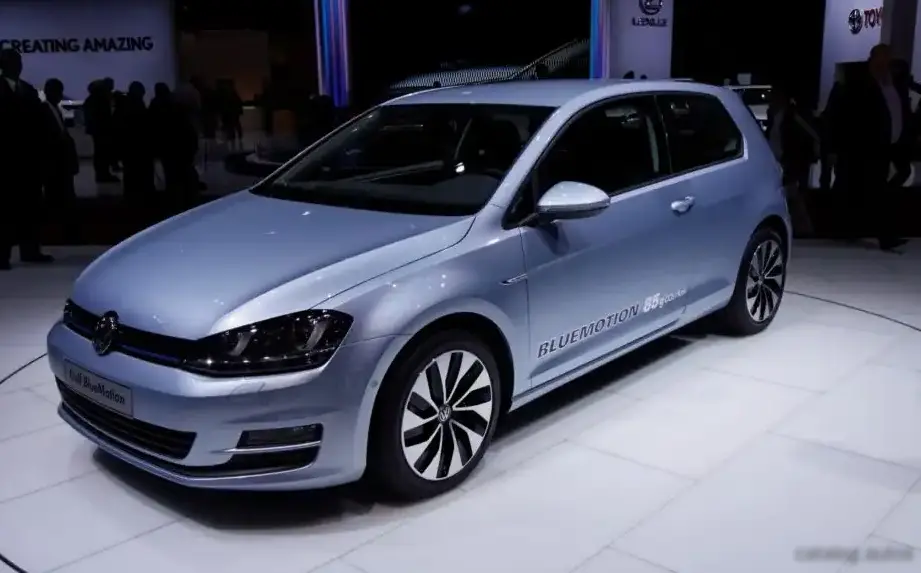
The Volkswagen Golf VII 1.6 TDI BlueMotion, produced from 2013 to 2016, represented a key variant within the seventh generation of Volkswagen’s iconic Golf hatchback. Offered primarily in Europe, this 3-door model focused on fuel efficiency and affordability, slotting into the lower-mid range of the Golf VII lineup. It aimed to provide a practical and economical option for buyers prioritizing low running costs over outright performance. The “BlueMotion” designation signified Volkswagen’s efforts to enhance fuel economy and reduce emissions through aerodynamic improvements and optimized engine management.
Technical Specifications
| Brand | Volkswagen |
| Model | Golf |
| Generation | Golf VII (3-door) |
| Type (Engine) | 1.6 TDI (110 Hp) BlueMotion |
| Start of production | 2013 |
| End of production | 2016 |
| Powertrain Architecture | Internal Combustion engine |
| Body type | Hatchback |
| Seats | 5 |
| Doors | 3 |
| Fuel consumption (economy) – urban (NEDC) | 3.8 l/100 km (61.9 US mpg, 74.3 UK mpg, 26.3 km/l) |
| Fuel consumption (economy) – extra urban (NEDC) | 3 l/100 km (78.4 US mpg, 94.2 UK mpg, 33.3 km/l) |
| Fuel consumption (economy) – combined (NEDC) | 3.2 l/100 km (73.5 US mpg, 88.3 UK mpg, 31.3 km/l) |
| CO2 emissions (NEDC) | 85 g/km |
| Fuel Type | Diesel |
| Acceleration 0 – 100 km/h | 10.5 sec |
| Acceleration 0 – 62 mph | 10.5 sec |
| Acceleration 0 – 60 mph | 10 sec |
| Maximum speed | 200 km/h (124.27 mph) |
| Emission standard | Euro 5 |
| Weight-to-power ratio | 11 kg/Hp, 91.3 Hp/tonne |
| Weight-to-torque ratio | 4.8 kg/Nm, 207.5 Nm/tonne |
| Power | 110 Hp @ 3200-4000 rpm |
| Power per litre | 68.8 Hp/l |
| Torque | 250 Nm @ 1500-3000 rpm (184.39 lb.-ft. @ 1500-3000 rpm) |
| Engine layout | Front, Transverse |
| Engine Model/Code | CRKB, CXXB |
| Engine displacement | 1598 cm3 (97.52 cu. in.) |
| Number of cylinders | 4 |
| Engine configuration | Inline |
| Cylinder Bore | 79.5 mm (3.13 in.) |
| Piston Stroke | 80.5 mm (3.17 in.) |
| Compression ratio | 16.2:1 |
| Number of valves per cylinder | 4 |
| Fuel injection system | Diesel Commonrail |
| Engine aspiration | Turbocharger, Intercooler |
| Valvetrain | DOHC |
| Engine oil capacity | 4.7 l (4.97 US qt | 4.14 UK qt) |
| Kerb Weight | 1205 kg (2656.57 lbs.) |
| Max. weight | 1740 kg (3836.04 lbs.) |
| Max load | 535 kg (1179.47 lbs.) |
| Trunk (boot) space – minimum | 380 l (13.42 cu. ft.) |
| Trunk (boot) space – maximum | 1270 l (44.85 cu. ft.) |
| Fuel tank capacity | 50 l (13.21 US gal | 11 UK gal) |
| Max. roof load | 75 kg (165.35 lbs.) |
| Permitted trailer load with brakes (12%) | 1000 kg (2204.62 lbs.) |
| Permitted trailer load without brakes | 630 kg (1388.91 lbs.) |
| Permitted towbar download | 80 kg (176.37 lbs.) |
| Length | 4255 mm (167.52 in.) |
| Width | 1799 mm (70.83 in.) |
| Width including mirrors | 2027 mm (79.8 in.) |
| Height | 1452 mm (57.17 in.) |
| Wheelbase | 2637 mm (103.82 in.) |
| Front track | 1549 mm (60.98 in.) |
| Rear (Back) track | 1520 mm (59.84 in.) |
| Ride height (ground clearance) | 142 mm (5.59 in.) |
| Minimum turning circle (turning diameter) | 10.9 m (35.76 ft.) |
| Front suspension | Independent, type McPherson with coil spring and anti-roll bar |
| Rear suspension | Coil spring, Torsion |
| Front brakes | Ventilated discs |
| Rear brakes | Disc |
| Assisting systems | ABS (Anti-lock braking system) |
| Steering type | Steering rack and pinion |
| Power steering | Electric Steering |
| Tires size | 195/65 R15 |
| Wheel rims size | 6J x 15 |
INTRODUCTION
The Golf VII 1.6 TDI BlueMotion, launched in 2013, was a significant offering in the European market, capitalizing on the growing demand for fuel-efficient diesel vehicles. Built on the Volkswagen Group’s MQB (Modular Transverse Matrix) platform – specifically the 1HX0/A3 variant – it shared its underpinnings with models like the Audi A3, SEAT Leon, and Skoda Octavia. This platform allowed for a flexible and cost-effective manufacturing process. The 1.6 TDI BlueMotion was positioned as an entry-level to mid-range option, appealing to buyers seeking practicality and low running costs without sacrificing the Golf’s inherent quality and refinement.
Powertrain & Engine Architecture
At the heart of the Golf VII 1.6 TDI BlueMotion lies the 1.6-liter four-cylinder diesel engine, identified by engine codes CRKB and CXXB. This engine is a common-rail direct injection diesel, utilizing piezo injectors for precise fuel delivery. The engine features a turbocharger with an intercooler to boost power and efficiency. The valvetrain employs a dual overhead camshaft (DOHC) configuration with four valves per cylinder, optimizing gas flow. The engine produces 110 horsepower at 3200-4000 rpm and 250 Nm (184 lb-ft) of torque between 1500-3000 rpm. This variant was almost exclusively paired with a 5-speed manual transmission, although a 7-speed dual-clutch DSG (Direct-Shift Gearbox) was available as an option. The BlueMotion package included modifications to reduce aerodynamic drag and optimize engine management for improved fuel economy.
Driving Characteristics
The 1.6 TDI BlueMotion, with its 110 hp and relatively modest torque output, offered adequate performance for everyday driving. Acceleration from 0-62 mph (0-100 km/h) took around 10.5 seconds, and top speed was limited to 124 mph (200 km/h). Compared to higher-output Golf VII variants like the 2.0 TDI or the GTI, the 1.6 TDI felt noticeably less powerful, particularly when fully loaded or tackling steep inclines. The 5-speed manual transmission, while providing a direct connection to the engine, had relatively widely spaced gear ratios, requiring frequent shifting to maintain optimal engine speed. The DSG option offered smoother and quicker gear changes, improving the overall driving experience. However, the focus of this variant was not on sporty performance but on maximizing fuel efficiency.
Equipment & Trim Levels
The Golf VII 1.6 TDI BlueMotion typically came equipped with a reasonable level of standard features. These included air conditioning, power windows, central locking, and an infotainment system with a touchscreen display. Safety features such as ABS, ESP (Electronic Stability Program), and multiple airbags were also standard. Interior upholstery was typically cloth, with options for upgraded materials available. Trim levels varied depending on the market, but common options included alloy wheels, parking sensors, and a multi-function steering wheel. The BlueMotion package itself added aerodynamic enhancements like a rear spoiler and lowered suspension.
Chassis & Braking
The Golf VII 1.6 TDI BlueMotion utilized a MacPherson strut front suspension and a torsion beam rear suspension. This setup provided a good balance between ride comfort and handling. The front brakes were ventilated discs, while the rear brakes were solid discs. The suspension was tuned for comfort, prioritizing a smooth ride over sporty handling. The steering was electrically assisted, providing light and precise control. The relatively low weight of the 1.6 TDI engine contributed to balanced handling characteristics.
Market Reception & Comparison
The Golf VII 1.6 TDI BlueMotion was generally well-received by critics for its fuel efficiency and practicality. It consistently achieved impressive fuel economy figures, making it an attractive option for drivers covering long distances. However, some reviewers criticized its lack of outright performance compared to other Golf VII variants. Compared to the 2.0 TDI models, the 1.6 TDI offered lower running costs but sacrificed performance. The 1.9 TDI models (available in earlier Golf generations) were known for their durability, but the 1.6 TDI offered improved fuel economy and lower emissions. The 1.6 TDI BlueMotion competed with other fuel-efficient hatchbacks like the Ford Focus EcoBoost and the Opel Astra EcoFlex.
Legacy
The 1.6 TDI engine, while generally reliable, has been subject to some scrutiny regarding diesel emissions and potential issues with the diesel particulate filter (DPF). Proper maintenance, including regular DPF regeneration, is crucial for long-term reliability. In the used car market, the Golf VII 1.6 TDI BlueMotion remains a popular choice for buyers seeking an affordable and fuel-efficient hatchback. Its reputation for reliability and low running costs continues to make it a compelling option, provided it has been well-maintained. The Golf VII 1.6 TDI BlueMotion represents a significant chapter in Volkswagen’s commitment to fuel efficiency and sustainable mobility.