Technical Specifications
| Brand | Volkswagen |
| Model | Golf |
| Generation | Golf VII (3-door) |
| Type (Engine) | 1.6 TDI (90 Hp) |
| Start of production | 2012 |
| End of production | 2016 |
| Powertrain Architecture | Internal Combustion engine |
| Body type | Hatchback |
| Seats | 5 |
| Doors | 3 |
| Fuel consumption (urban) | 4.6 l/100 km (51.1 US mpg, 61.4 UK mpg, 21.7 km/l) |
| Fuel consumption (extra urban) | 3.3 l/100 km (71.3 US mpg, 85.6 UK mpg, 30.3 km/l) |
| Fuel consumption (combined) | 3.8 l/100 km (61.9 US mpg, 74.3 UK mpg, 26.3 km/l) |
| CO2 emissions | 98 g/km |
| Fuel Type | Diesel |
| Acceleration 0 – 100 km/h | 11.9 sec |
| Acceleration 0 – 62 mph | 11.9 sec |
| Acceleration 0 – 60 mph | 11.3 sec |
| Maximum speed | 185 km/h (114.95 mph) |
| Emission standard | Euro 5 |
| Weight-to-power ratio | 13.6 kg/Hp, 73.8 Hp/tonne |
| Weight-to-torque ratio | 5.3 kg/Nm, 188.5 Nm/tonne |
| Power | 90 Hp @ 2750-4800 rpm |
| Power per litre | 56.3 Hp/l |
| Torque | 230 Nm @ 1400-2700 rpm (169.64 lb.-ft. @ 1400-2700 rpm) |
| Engine layout | Front, Transverse |
| Engine Model/Code | CRKA, CLHB |
| Engine displacement | 1598 cm3 (97.52 cu. in.) |
| Number of cylinders | 4 |
| Engine configuration | Inline |
| Cylinder Bore | 79.5 mm (3.13 in.) |
| Piston Stroke | 80.5 mm (3.17 in.) |
| Compression ratio | 16.2:1 |
| Number of valves per cylinder | 4 |
| Fuel injection system | Diesel Commonrail |
| Engine aspiration | Turbocharger, Intercooler |
| Valvetrain | DOHC |
| Engine oil capacity | 4.7 l (4.97 US qt | 4.14 UK qt) |
| Kerb Weight | 1220 kg (2689.64 lbs.) |
| Max. weight | 1800 kg (3968.32 lbs.) |
| Max load | 580 kg (1278.68 lbs.) |
| Trunk (boot) space – minimum | 380 l (13.42 cu. ft.) |
| Trunk (boot) space – maximum | 1270 l (44.85 cu. ft.) |
| Fuel tank capacity | 50 l (13.21 US gal | 11 UK gal) |
| Max. roof load | 75 kg (165.35 lbs.) |
| Permitted trailer load with brakes (12%) | 1500 kg (3306.93 lbs.) |
| Permitted trailer load without brakes | 640 kg (1410.96 lbs.) |
| Permitted towbar download | 80 kg (176.37 lbs.) |
| Length | 4255 mm (167.52 in.) |
| Width | 1799 mm (70.83 in.) |
| Width including mirrors | 2027 mm (79.8 in.) |
| Height | 1452 mm (57.17 in.) |
| Wheelbase | 2637 mm (103.82 in.) |
| Front track | 1549 mm (60.98 in.) |
| Rear track | 1520 mm (59.84 in.) |
| Ride height (ground clearance) | 142 mm (5.59 in.) |
| Minimum turning circle | 10.9 m (35.76 ft.) |
| Front suspension | Independent, type McPherson with coil spring and anti-roll bar |
| Rear suspension | Coil spring, Torsion |
| Front brakes | Ventilated discs |
| Rear brakes | Disc |
| Assisting systems | ABS (Anti-lock braking system) |
| Steering type | Steering rack and pinion |
| Power steering | Electric Steering |
| Tires size | 195/65 R15 |
| Wheel rims size | 6J x 15 |
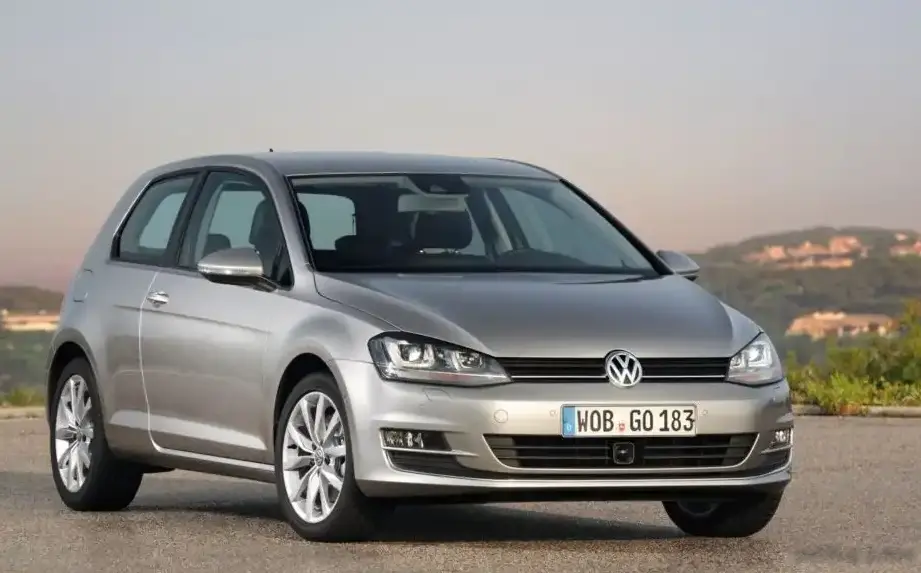
The Volkswagen Golf VII 1.6 TDI 90 hp 3-door, launched in 2012, was a key component of the seventh-generation Golf range. Built on the MQB (Modular Transverse Matrix) platform – designated 1HX0 for the 3-door variant – it aimed to deliver a balance of practicality, fuel efficiency, and affordability. This model was particularly popular in Europe, where diesel engines dominated the compact hatchback segment. The 3-door body style offered a slightly sportier aesthetic compared to the more common 5-door version, appealing to a younger demographic or those prioritizing a more compact footprint.
Powertrain & Engine Architecture
At the heart of this Golf variant lies the 1.6-liter, four-cylinder diesel engine, identified by engine codes CRKA or CLHB. This engine is a common-rail direct injection (CRDI) unit, utilizing piezo injectors for precise fuel delivery. The engine features a turbocharger with an intercooler to boost power and efficiency. The valvetrain employs a dual overhead camshaft (DOHC) configuration with four valves per cylinder. The 90 hp output is achieved at 2750-4800 rpm, while peak torque of 230 Nm (169.64 lb-ft) is available from 1400-2700 rpm. This engine was paired with a five-speed automatic transmission, offering smooth shifts but prioritizing fuel economy over rapid acceleration. The automatic transmission was a conventional torque converter type, known for its reliability but not its sportiness.
Driving Characteristics
The 1.6 TDI 90 hp automatic Golf offered a comfortable, if not particularly exhilarating, driving experience. Acceleration from 0-60 mph took around 11.3 seconds, and top speed was limited to 185 km/h (114.95 mph). The automatic transmission, while smooth, could feel somewhat sluggish, especially when attempting quick overtaking maneuvers. The gear ratios were optimized for fuel efficiency, meaning the engine often operated at lower RPMs. Compared to the more powerful Golf variants, such as those equipped with the 2.0 TDI or petrol engines, this version felt noticeably slower. However, its strength lay in its fuel economy and relaxed cruising ability. The relatively low power output also meant that the chassis didn’t feel overly stressed, contributing to a comfortable ride.
Equipment & Trim Levels
The 1.6 TDI 90 hp automatic typically came with a reasonable level of standard equipment. This included air conditioning, electric front windows, central locking, and a basic audio system. Safety features such as ABS, ESP (Electronic Stability Program), and multiple airbags were also standard. Interior upholstery was typically cloth, with a functional but not luxurious design. Optional extras included alloy wheels, a touchscreen infotainment system, parking sensors, and cruise control. Trim levels varied depending on the market, but generally, this variant occupied the lower to mid-range of the Golf VII lineup.
Chassis & Braking
The Golf VII 1.6 TDI 90 hp utilized an independent McPherson strut suspension at the front and a torsion beam suspension at the rear. This setup provided a good balance of ride comfort and handling. The front brakes were ventilated discs, while the rear brakes were solid discs. The steering was electric power-assisted, offering light and precise control. The suspension was tuned for comfort, prioritizing a smooth ride over sporty handling. Stabilizer bars were fitted to both the front and rear axles to reduce body roll during cornering.
Market Reception & Comparison
The Golf VII 1.6 TDI 90 hp automatic was generally well-received by critics as a practical and economical choice. It was praised for its fuel efficiency, comfortable ride, and build quality. However, it was often criticized for its lack of performance and the somewhat dated feel of the automatic transmission. Compared to other trims in the Golf VII lineup, such as the 2.0 TDI, it offered significantly less power but at a lower price point. Its fuel economy was competitive with other diesel hatchbacks in its class, and its reliability was generally considered good.
Legacy
The 1.6 TDI engine, while not known for being particularly exciting, proved to be a reliable and durable unit. Many examples of the Golf VII 1.6 TDI are still on the road today, testament to its robust construction. On the used car market, this variant represents an affordable entry point into Golf ownership. However, potential buyers should be aware of the potential for diesel particulate filter (DPF) issues, particularly if the vehicle has primarily been used for short journeys. Overall, the Golf VII 1.6 TDI 90 hp automatic remains a sensible and economical choice for those seeking a practical and reliable hatchback.