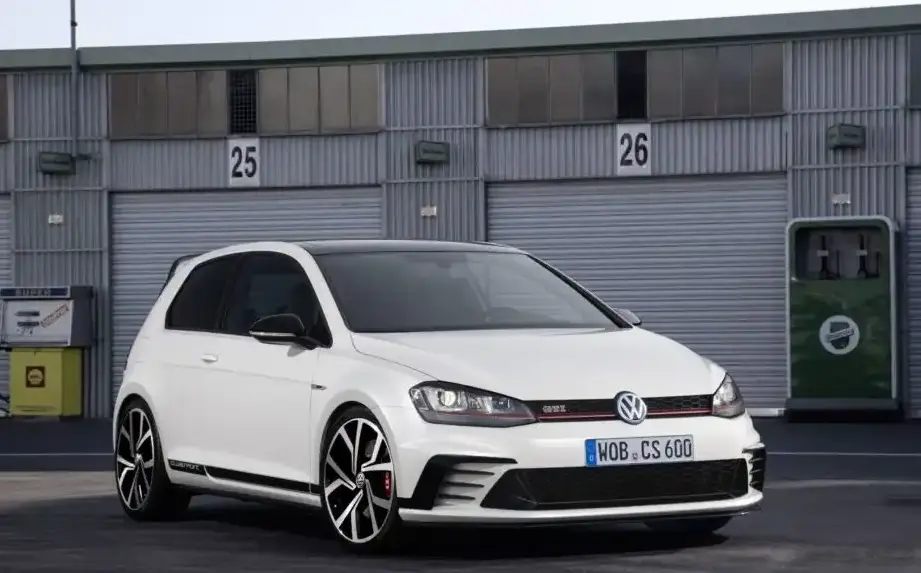
The Volkswagen Golf VII GTI Clubsport, produced in limited numbers between February and December 2016, represented a performance-focused iteration of the already sporty Golf GTI. Available exclusively as a 3-door hatchback, the Clubsport was designed to bridge the gap between the standard GTI and the more hardcore Golf R. This specific variant featured a 2.0-liter TSI engine producing 265 horsepower, and was primarily aimed at enthusiasts seeking a more engaging driving experience than the standard GTI offered, without the higher price tag and all-wheel-drive system of the Golf R. It was positioned as a special edition model, celebrating the Golf GTI’s legacy and showcasing Volkswagen’s performance engineering capabilities.
Technical Specifications
| Brand | Volkswagen |
| Model | Golf |
| Generation | Golf VII (3-door) |
| Type (Engine) | GTI Clubsport 2.0 TSI (265 Hp) |
| Start of production | February, 2016 |
| End of production | December, 2016 |
| Powertrain Architecture | Internal Combustion engine |
| Body type | Hatchback |
| Seats | 5 |
| Doors | 3 |
| Fuel consumption (economy) – urban (NEDC) | 9.1 l/100 km (25.8 US mpg, 31 UK mpg, 11 km/l) |
| Fuel consumption (economy) – extra urban (NEDC) | 5.9 l/100 km (39.9 US mpg, 47.9 UK mpg, 16.9 km/l) |
| Fuel consumption (economy) – combined (NEDC) | 7 l/100 km (33.6 US mpg, 40.4 UK mpg, 14.3 km/l) |
| CO2 emissions (NEDC) | 162 g/km |
| Fuel Type | Petrol (Gasoline) |
| Acceleration 0 – 100 km/h | 6.3 sec |
| Acceleration 0 – 62 mph | 6.3 sec |
| Acceleration 0 – 60 mph | 6 sec (Calculated) |
| Maximum speed | 250 km/h (155.34 mph), Electronically limited |
| Emission standard | Euro 6 |
| Weight-to-power ratio | 4.9 kg/Hp, 203.8 Hp/tonne |
| Weight-to-torque ratio | 3.7 kg/Nm, 269.2 Nm/tonne |
| Power | 265 Hp @ 5350-6600 rpm |
| Power per litre | 133.6 Hp/l |
| Torque | 350 Nm @ 1700-5300 rpm (258.15 lb.-ft. @ 1700-5300 rpm) |
| Engine layout | Front, Transverse |
| Engine Model/Code | EA888 / CJXE |
| Engine displacement | 1984 cm3 (121.07 cu. in.) |
| Number of cylinders | 4 |
| Engine configuration | Inline |
| Cylinder Bore | 82.5 mm (3.25 in.) |
| Piston Stroke | 92.8 mm (3.65 in.) |
| Compression ratio | 9.6:1 |
| Number of valves per cylinder | 4 |
| Fuel injection system | Direct injection and Multi-port manifold injection |
| Engine aspiration | Turbocharger, Intercooler |
| Valvetrain | DOHC |
| Engine oil capacity | 5.7 l (6.02 US qt | 5.02 UK qt) |
| Kerb Weight | 1300 kg (2866.01 lbs.) |
| Max. weight | 1850 kg (4078.55 lbs.) |
| Max load | 550 kg (1212.54 lbs.) |
| Trunk (boot) space – minimum | 380 l (13.42 cu. ft.) |
| Trunk (boot) space – maximum | 1270 l (44.85 cu. ft.) |
| Fuel tank capacity | 50 l (13.21 US gal | 11 UK gal) |
| Max. roof load | 75 kg (165.35 lbs.) |
| Permitted towbar download | 80 kg (176.37 lbs.) |
| Length | 4268 mm (168.03 in.) |
| Width | 1799 mm (70.83 in.) |
| Width including mirrors | 2027 mm (79.8 in.) |
| Height | 1442 mm (56.77 in.) |
| Wheelbase | 2631 mm (103.58 in.) |
| Front track | 1538 mm (60.55 in.) |
| Rear (Back) track | 1516 mm (59.69 in.) |
| Ride height (ground clearance) | 133 mm (5.24 in.) |
| Minimum turning circle | 10.9 m (35.76 ft.) |
| Front suspension | Independent, type McPherson with coil spring and anti-roll bar |
| Rear suspension | Independent multi-link spring suspension with stabilizer |
| Front brakes | Ventilated discs |
| Rear brakes | Ventilated discs |
| Assisting systems | ABS (Anti-lock braking system) |
| Steering type | Steering rack and pinion |
| Power steering | Electric Steering |
| Tires size | 225/40 R18; 225/35 R19; 235/35 R19 |
| Wheel rims size | 7.5J x 18; 7.5J x 19; 8J x 19 |
| Drivetrain | Front wheel drive |
| Number of gears and type of gearbox | 6 gears, manual transmission |
Powertrain & Engine Architecture
The heart of the Golf VII GTI Clubsport is the EA888 2.0-liter turbocharged four-cylinder engine, specifically the CJXE engine code. This engine builds upon the established EA888 family, known for its robust construction and tuning potential. The CJXE features a revised turbocharger, upgraded pistons, and a strengthened crankshaft compared to the standard GTI engine. It utilizes both direct injection and multi-port fuel injection, a combination designed to optimize both performance and fuel efficiency. Direct injection provides precise fuel delivery for power, while multi-port injection helps to reduce carbon buildup on the intake valves. The engine employs a dual overhead camshaft (DOHC) valvetrain with four valves per cylinder, maximizing airflow. The six-speed manual transmission was the only transmission option available, chosen for its driver engagement and quicker shifts compared to a dual-clutch automatic. The engine also incorporated a start/stop system to further improve fuel economy.
Driving Characteristics
The 265 horsepower and 350 Nm (258 lb-ft) of torque delivered by the CJXE engine provide a noticeable performance increase over the standard GTI. Acceleration from 0 to 60 mph takes approximately 6 seconds, and the electronically limited top speed of 155 mph is readily achievable. The manual transmission allows for precise control, and the engine’s broad torque curve ensures strong acceleration throughout the rev range. While not as brutally fast as the Golf R, the Clubsport offers a more balanced and engaging driving experience, with a focus on driver involvement. The suspension is tuned for a slightly firmer ride than the standard GTI, providing improved handling and reduced body roll. The gear ratios are optimized for both acceleration and highway cruising, offering a good balance between performance and efficiency.
Equipment & Trim Levels
The GTI Clubsport came standard with a comprehensive list of features, including sport seats upholstered in a unique plaid fabric, a leather-wrapped steering wheel, and stainless steel pedal caps. Exterior styling cues included a more aggressive front bumper with larger air intakes, a rear spoiler, and unique alloy wheel designs. Optional extras included adaptive dampers (DCC), a panoramic sunroof, and a premium sound system. The interior featured subtle red accents, further differentiating it from the standard GTI. Navigation and parking sensors were also commonly equipped.
Chassis & Braking
The Clubsport utilizes the standard Golf VII’s independent suspension setup, with a McPherson strut front suspension and a multi-link rear suspension. However, the springs and dampers were retuned for a sportier driving experience. The braking system consists of ventilated discs on all four wheels, providing ample stopping power. ABS (Anti-lock Braking System) is standard. The chassis benefits from a slightly lowered ride height compared to the standard GTI, further enhancing handling and stability.
Market Reception & Comparison
The Golf VII GTI Clubsport was generally well-received by automotive critics, who praised its improved performance, engaging driving dynamics, and distinctive styling. It was seen as a compelling alternative to the Golf R for drivers who prioritized a more traditional driving experience. Fuel economy was comparable to the standard GTI, averaging around 33.6 mpg in combined driving. Reliability was generally good, although the turbocharged engine requires regular maintenance to ensure optimal performance. Compared to the standard GTI, the Clubsport offered a significant performance upgrade for a relatively modest price increase. Compared to the Golf R, it offered a similar level of performance but with front-wheel drive and a manual transmission, appealing to a different type of enthusiast.
Legacy
The Golf VII GTI Clubsport remains a sought-after model among Volkswagen enthusiasts. The EA888 engine, in its CJXE iteration, is known for its durability and tuning potential. Well-maintained examples command a premium in the used car market. The Clubsport’s limited production run and unique features contribute to its collectibility. It represents a high point in the Golf GTI lineage, showcasing Volkswagen’s commitment to performance and driving enjoyment. The engine’s robust design means that with proper servicing, it can continue to provide reliable performance for many years to come.