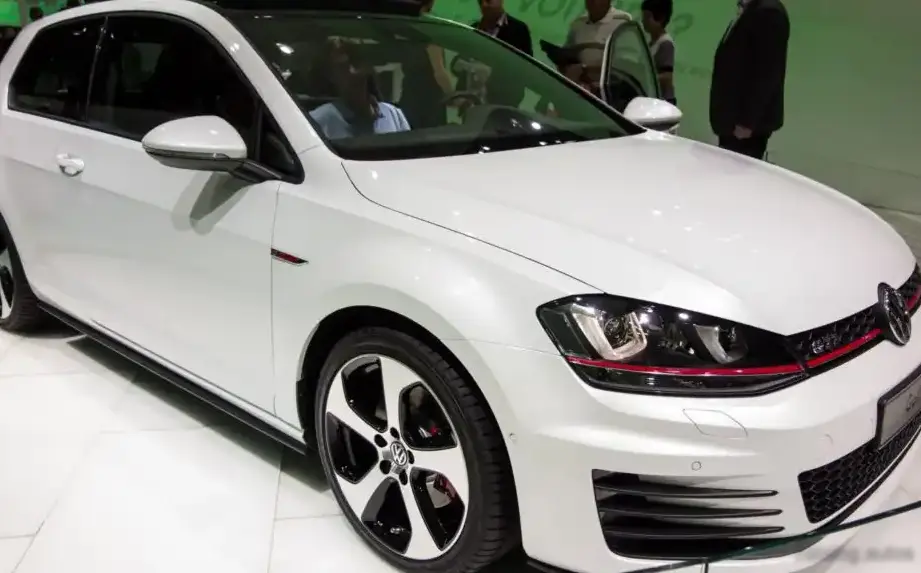
The Volkswagen Golf VII GTI Performance, specifically the 3-door variant equipped with the 2.0 TSI 230 horsepower engine, represents a focused iteration of the seventh-generation Golf. Produced from March 2013 through December 2016, this model aimed to bridge the gap between the standard GTI and the more extreme Golf R, offering a significant performance upgrade while maintaining a degree of everyday usability. It was positioned as the enthusiast’s choice within the Golf VII lineup, appealing to drivers seeking a more engaging experience than the base GTI but without the higher price tag and all-wheel-drive system of the R.
Technical Specifications
| Brand | Volkswagen |
| Model | Golf |
| Generation | Golf VII (3-door) |
| Type (Engine) | GTI Performance 2.0 TSI (230 Hp) |
| Start of production | March, 2013 |
| End of production | December, 2016 |
| Powertrain Architecture | Internal Combustion engine |
| Body type | Hatchback |
| Seats | 5 |
| Doors | 3 |
| Fuel consumption (economy) – urban (NEDC) | 7.5 l/100 km (31.4 US mpg, 37.7 UK mpg, 13.3 km/l) |
| Fuel consumption (economy) – extra urban (NEDC) | 5.1 l/100 km (46.1 US mpg, 55.4 UK mpg, 19.6 km/l) |
| Fuel consumption (economy) – combined (NEDC) | 6 l/100 km (39.2 US mpg, 47.1 UK mpg, 16.7 km/l) |
| CO2 emissions (NEDC) | 139 g/km |
| Fuel Type | Petrol (Gasoline) |
| Acceleration 0 – 100 km/h | 6.4 sec |
| Acceleration 0 – 62 mph | 6.4 sec |
| Acceleration 0 – 60 mph | 6.1 sec |
| Maximum speed | 250 km/h (155.34 mph), Electronically limited |
| Emission standard | Euro 6 |
| Weight-to-power ratio | 5.7 kg/Hp, 176 Hp/tonne |
| Weight-to-torque ratio | 3.7 kg/Nm, 267.8 Nm/tonne |
| Power | 230 Hp @ 4700-6200 rpm |
| Power per litre | 115.9 Hp/l |
| Torque | 350 Nm @ 1500-4600 rpm (258.15 lb.-ft. @ 1500-4600 rpm) |
| Engine layout | Front, Transverse |
| Engine Model/Code | EA888 / CHHA |
| Engine displacement | 1984 cm3 (121.07 cu. in.) |
| Number of cylinders | 4 |
| Engine configuration | Inline |
| Cylinder Bore | 82.5 mm (3.25 in.) |
| Piston Stroke | 92.8 mm (3.65 in.) |
| Compression ratio | 9.6:1 |
| Number of valves per cylinder | 4 |
| Fuel injection system | Direct injection and Multi-port manifold injection |
| Engine aspiration | Turbocharger, Intercooler |
| Valvetrain | DOHC |
| Engine oil capacity | 5.7 l (6.02 US qt | 5.02 UK qt) |
| Kerb Weight | 1307 kg (2881.44 lbs.) |
| Max. weight | 1850 kg (4078.55 lbs.) |
| Max load | 543 kg (1197.11 lbs.) |
| Trunk (boot) space – minimum | 380 l (13.42 cu. ft.) |
| Trunk (boot) space – maximum | 1270 l (44.85 cu. ft.) |
| Fuel tank capacity | 50 l (13.21 US gal | 11 UK gal) |
| Max. roof load | 75 kg (165.35 lbs.) |
| Permitted trailer load with brakes (12%) | 1600 kg (3527.4 lbs.) |
| Permitted trailer load without brakes | 690 kg (1521.19 lbs.) |
| Permitted towbar download | 80 kg (176.37 lbs.) |
| Length | 4268 mm (168.03 in.) |
| Width | 1799 mm (70.83 in.) |
| Width including mirrors | 2027 mm (79.8 in.) |
| Height | 1442 mm (56.77 in.) |
| Wheelbase | 2631 mm (103.58 in.) |
| Front track | 1538 mm (60.55 in.) |
| Rear (Back) track | 1516 mm (59.69 in.) |
| Ride height (ground clearance) | 133 mm (5.24 in.) |
| Minimum turning circle (turning diameter) | 10.9 m (35.76 ft.) |
| Front suspension | Independent, type McPherson with coil spring and anti-roll bar |
| Rear suspension | Independent multi-link spring suspension with stabilizer |
| Front brakes | Ventilated discs, 340 mm |
| Rear brakes | Ventilated discs, 310 mm |
| Drive wheel | Front wheel drive |
| Number of gears and type of gearbox | 6 gears, manual transmission |
INTRODUCTION
The Golf VII GTI Performance 2.0 TSI (230 Hp) built upon the success of the standard GTI, offering a more potent driving experience. Introduced as part of the mid-cycle refresh of the Golf VII, it aimed to deliver increased performance through engine upgrades and chassis enhancements. The “Performance” designation signified a step up from the standard GTI, targeting drivers who desired a sportier feel without the added complexity and cost of the Golf R’s all-wheel-drive system. This variant was primarily sold in Europe and other international markets, with limited availability in the United States.
Powertrain & Engine Architecture
At the heart of the GTI Performance lies the EA888 2.0-liter turbocharged four-cylinder engine, specifically the CHHA engine code. This engine builds upon the standard GTI’s powerplant, but with significant modifications to increase output. Key upgrades included a larger turbocharger, revised pistons, strengthened connecting rods, and an improved cooling system. The engine utilizes both direct injection and multi-port fuel injection, a combination that optimizes both performance and fuel efficiency. The direct injection system delivers fuel directly into the combustion chamber for precise control, while the multi-port injection system supplements it during higher loads to improve cooling and reduce the risk of knock. The engine’s valvetrain features a dual overhead camshaft (DOHC) design with four valves per cylinder, maximizing airflow and contributing to its high-revving nature. The standard transmission for this model was a 6-speed manual, although a 6-speed dual-clutch transmission (DSG) was also available as an option.
Driving Characteristics
The 230 horsepower and 350 Nm (258 lb-ft) of torque delivered by the GTI Performance engine provide a noticeable step up in performance compared to the standard 210 hp GTI. Acceleration from 0 to 60 mph takes approximately 6.1 seconds, and the electronically limited top speed of 155 mph is readily achievable. The engine’s torque curve is broad and flat, providing strong pull throughout the rev range. The manual transmission offers precise shifts and a satisfyingly direct feel, enhancing driver engagement. While the standard GTI is already known for its balanced handling, the Performance model benefits from subtle chassis tweaks, including a slightly stiffer suspension and larger brakes, resulting in improved cornering stability and stopping power. Compared to the Golf R, the front-wheel-drive GTI Performance exhibits more pronounced torque steer under hard acceleration, but this can be seen as part of its character by some enthusiasts.
Equipment & Trim Levels
The GTI Performance typically came standard with a comprehensive list of features, including sport seats upholstered in the classic GTI plaid fabric, a leather-wrapped steering wheel, and a touchscreen infotainment system. Additional standard equipment included automatic climate control, alloy wheels (typically 18-inch), and a suite of safety features. Optional extras included adaptive dampers (DCC), a panoramic sunroof, and upgraded audio systems. The interior trim was generally sporty and functional, with a focus on providing a comfortable and engaging driving environment. The exterior styling was also enhanced with unique badging, a subtle rear spoiler, and larger exhaust outlets.
Chassis & Braking
The GTI Performance utilizes an independent suspension setup at all four corners. The front suspension employs a McPherson strut design with coil springs and an anti-roll bar, while the rear suspension features a multi-link setup, also with coil springs and an anti-roll bar. This configuration provides a good balance between ride comfort and handling precision. Braking duties are handled by ventilated disc brakes at all four corners, with larger discs fitted to the front axle compared to the standard GTI. The GTI Performance also benefits from ABS (Anti-lock Braking System) and electronic stability control, enhancing safety and control in various driving conditions.
Market Reception & Comparison
The GTI Performance was generally well-received by automotive critics, who praised its increased performance, engaging driving dynamics, and relatively affordable price point. It was often seen as a sweet spot in the Golf VII lineup, offering a significant performance upgrade over the standard GTI without the added cost and complexity of the Golf R. Fuel economy was respectable, averaging around 39.2 US mpg in combined driving. Compared to the 1.8L TSI and 2.0 TDI variants, the GTI Performance offered significantly more power and a more sporty driving experience, but at the expense of slightly higher fuel consumption. The 1.8L TSI was positioned as the entry-level option, while the 2.0 TDI catered to drivers prioritizing fuel efficiency.
Legacy
The EA888 engine found in the GTI Performance has proven to be a robust and reliable powerplant, with many examples exceeding high mileage without major issues. The GTI Performance remains a popular choice in the used car market, appealing to enthusiasts seeking a well-rounded and engaging hot hatch. Its combination of performance, practicality, and affordability has cemented its place as a modern classic. While some maintenance items, such as the timing chain, may require attention at higher mileage, the GTI Performance generally offers good long-term reliability and remains a compelling option for drivers seeking a fun and capable vehicle.