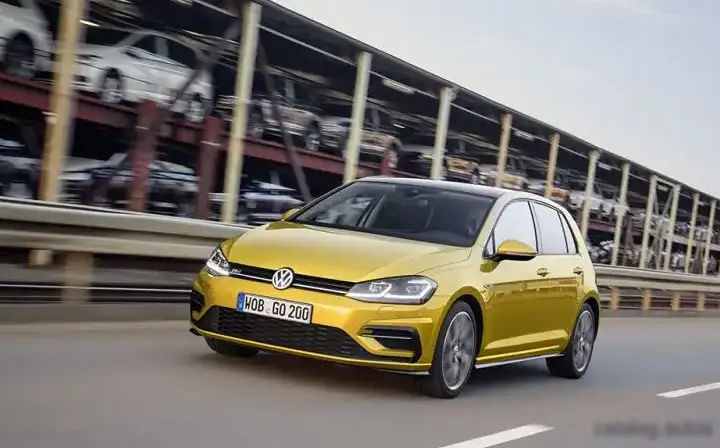
The Volkswagen Golf VII, specifically the 5-door hatchback produced during the 2017 facelift and continuing through 2019, represented a significant evolution of Volkswagen’s iconic compact car. Among the various engine and transmission options offered, the 1.0 TSI (116 horsepower) variant with a 6-speed manual transmission occupied an important position as an entry-level offering, prioritizing fuel efficiency and affordability within the Golf VII range. This model aimed to broaden the Golf’s appeal to buyers seeking a practical and economical daily driver, while still benefiting from the Golf’s renowned build quality and refinement. It was positioned below the more powerful 1.5 TSI and 2.0 TDI models, and served as the gateway into the Golf VII lineup.
Technical Specifications
| Brand | Volkswagen |
| Model | Golf |
| Generation | Golf VII (5-door, facelift 2017) |
| Type (Engine) | 1.0 TSI (116 Hp) |
| Start of production | 2018 |
| End of production | 2019 |
| Powertrain Architecture | Internal Combustion engine |
| Body type | Hatchback |
| Seats | 5 |
| Doors | 5 |
| Fuel consumption (urban) | 5.4-5.7 l/100 km (43.6 – 41.3 US mpg, 52.3 – 49.6 UK mpg, 18.5 – 17.5 km/l) |
| Fuel consumption (extra urban) | 4.4-4.6 l/100 km (53.5 – 51.1 US mpg, 64.2 – 61.4 UK mpg, 22.7 – 21.7 km/l) |
| Fuel consumption (combined) | 4.8-5.0 l/100 km (49 – 47 US mpg, 58.9 – 56.5 UK mpg, 20.8 – 20 km/l) |
| CO2 emissions | 109-113 g/km |
| Fuel Type | Petrol (Gasoline) |
| Acceleration 0 – 100 km/h | 9.8 sec |
| Acceleration 0 – 62 mph | 9.8 sec |
| Acceleration 0 – 60 mph | 9.3 sec |
| Maximum speed | 198 km/h (123.03 mph) |
| Emission standard | Euro 6d-TEMP |
| Weight-to-power ratio | 10.7 kg/Hp, 93.2 Hp/tonne |
| Weight-to-torque ratio | 6.2 kg/Nm, 160.6 Nm/tonne |
| Power | 116 Hp |
| Power per litre | 116.1 Hp/l |
| Torque | 200 Nm @ 2000-3500 rpm (147.51 lb.-ft. @ 2000-3500 rpm) |
| Engine layout | Front, Transverse |
| Engine Model/Code | DKRA, DKRF |
| Engine displacement | 999 cm3 (60.96 cu. in.) |
| Number of cylinders | 3 |
| Engine configuration | Inline |
| Number of valves per cylinder | 4 |
| Fuel injection system | Direct injection |
| Engine aspiration | Turbocharger, Intercooler |
| Engine oil capacity | 4 l (4.23 US qt | 3.52 UK qt) |
| Kerb Weight | 1245 kg (2744.76 lbs.) |
| Max. weight | 1760 kg (3880.14 lbs.) |
| Max load | 515 kg (1135.38 lbs.) |
| Trunk (boot) space – minimum | 380 l (13.42 cu. ft.) |
| Trunk (boot) space – maximum | 1270 l (44.85 cu. ft.) |
| Fuel tank capacity | 50 l (13.21 US gal | 11 UK gal) |
| Max. roof load | 75 kg (165.35 lbs.) |
| Permitted trailer load with brakes (8%) | 1500 kg (3306.93 lbs.) |
| Permitted trailer load with brakes (12%) | 1300 kg (2866.01 lbs.) |
| Permitted trailer load without brakes | 620 kg (1366.87 lbs.) |
| Permitted towbar download | 80 kg (176.37 lbs.) |
| Length | 4258 mm (167.64 in.) |
| Width | 1790-1799 mm (70.47 – 70.83 in.) |
| Width including mirrors | 2027 mm (79.8 in.) |
| Height | 1492 mm (58.74 in.) |
| Wheelbase | 2620 mm (103.15 in.) |
| Front track | 1533-1549 mm (60.35 – 60.98 in.) |
| Rear (Back) track | 1504-1521 mm (59.21 – 59.88 in.) |
| Ride height (ground clearance) | 142 mm (5.59 in.) |
| Minimum turning circle (turning diameter) | 10.9 m (35.76 ft.) |
| Drive wheel | Front wheel drive |
| Number of gears and type of gearbox | 6 gears, manual transmission |
| Assisting systems | ABS (Anti-lock braking system) |
| Steering type | Steering rack and pinion |
| Power steering | Electric Steering |
| Tires size | 205/55 R16 |
| Wheel rims size | 6.5J x 16 |
Powertrain & Engine Architecture
The heart of this Golf variant is the 1.0 TSI engine, specifically the DKRA or DKRF engine code. This is a three-cylinder, inline petrol engine featuring direct fuel injection and a single turbocharger with an intercooler. The direct injection system allows for precise fuel delivery, optimizing combustion efficiency and power output. The turbocharger, a key component, provides a boost in power and torque, mitigating the inherent limitations of a small-displacement engine. The engine produces 116 horsepower and 200 Nm (147.51 lb-ft) of torque between 2000 and 3500 rpm. This engine is part of Volkswagen’s EA211 engine family, known for its compact design and efficiency. The 6-speed manual transmission was the standard offering, providing drivers with full control over gear selection. The transmission’s gear ratios were tuned to balance fuel economy with acceptable acceleration.
Driving Characteristics
The 1.0 TSI Golf VII offers a surprisingly refined driving experience, despite its modest power output. Acceleration from 0-60 mph takes approximately 9.3 seconds, and top speed is rated at 198 km/h (123.03 mph). While not particularly sporty, the engine provides adequate power for everyday driving situations, including highway merging and overtaking. The turbocharger does introduce a slight amount of turbo lag, but the power delivery is generally smooth and linear once the turbo spools up. Compared to the more powerful 1.5 TSI or 2.0 TDI models, the 1.0 TSI feels less responsive, particularly at higher speeds. However, its lighter weight contributes to nimble handling and a comfortable ride. The 6-speed manual transmission is precise and easy to use, enhancing driver engagement.
Equipment & Trim Levels
The 1.0 TSI variant typically came equipped with a reasonable level of standard features. These included air conditioning, a touchscreen infotainment system with Bluetooth connectivity, alloy wheels, and a suite of safety features such as ABS, ESC (Electronic Stability Control), and multiple airbags. Higher trim levels offered additional features such as automatic climate control, a larger touchscreen display, parking sensors, and adaptive cruise control. Interior upholstery was typically cloth, with options for upgraded materials available. The dashboard layout was consistent across the Golf VII range, featuring a clean and modern design.
Chassis & Braking
The Golf VII’s chassis is a sophisticated design, featuring a MacPherson strut front suspension and a multi-link rear suspension. This setup provides a good balance of ride comfort and handling precision. The 1.0 TSI variant typically used disc brakes on the front wheels and drum brakes on the rear wheels, which were adequate for its weight and power. The steering system is an electric power steering system, providing light and precise steering feel. Stabilizer bars were fitted to both the front and rear axles to reduce body roll during cornering.
Market Reception & Comparison
The 1.0 TSI Golf VII was generally well-received by critics as a practical and economical option. It was praised for its fuel efficiency, comfortable ride, and refined interior. However, some reviewers noted that the engine could feel underpowered, particularly when fully loaded or driving uphill. Compared to the 1.5 TSI, the 1.0 TSI offered lower running costs but less performance. The 2.0 TDI provided superior fuel economy and torque but came with a higher purchase price and potential maintenance costs associated with diesel technology. The 1.0 TSI appealed to buyers who prioritized affordability and fuel efficiency over outright performance.
Legacy
The 1.0 TSI engine has proven to be a relatively reliable powertrain, although some owners have reported issues with the timing chain. Regular maintenance, including oil changes and timing chain inspections, is crucial for ensuring long-term reliability. In the used car market, the 1.0 TSI Golf VII represents a good value proposition, offering a well-built and practical car at an affordable price. Its fuel efficiency and low running costs make it an attractive option for budget-conscious buyers. The Golf VII, in general, has established a strong reputation for reliability and durability, contributing to its continued popularity in the used car market.