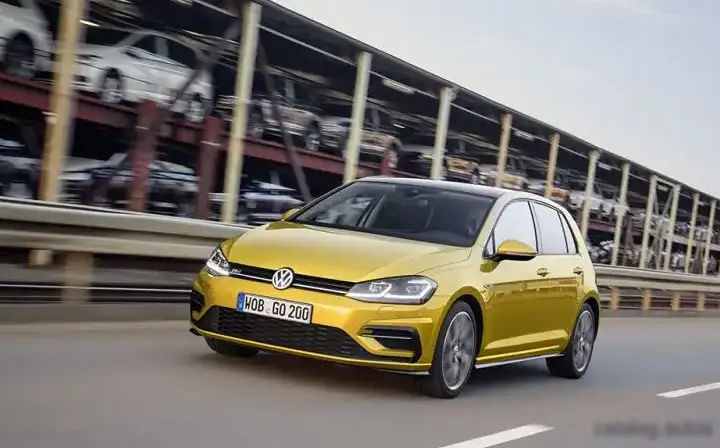
The Volkswagen Golf VII, specifically the 5-door hatchback produced from 2017-2019 with the 1.0 TSI 85 horsepower engine, represents an entry point into the seventh generation of Volkswagen’s iconic Golf model. Introduced as part of the facelifted Golf VII range, this variant aimed to provide a fuel-efficient and affordable option for buyers, particularly in European markets where smaller displacement engines were favored due to tax incentives and running costs. It occupied the lower end of the Golf VII lineup, positioned below the more powerful 1.5 TSI and 2.0 TDI models.
Technical Specifications
| Brand | Volkswagen |
| Model | Golf |
| Generation | Golf VII (5-door, facelift 2017) |
| Type (Engine) | 1.0 TSI (85 Hp) |
| Start of production | 2017 |
| End of production | 2019 |
| Powertrain Architecture | Internal Combustion engine |
| Body type | Hatchback |
| Seats | 5 |
| Doors | 5 |
| Fuel consumption (urban) | 5.9-6.0 l/100 km (39.9 – 39.2 US mpg, 47.9 – 47.1 UK mpg, 16.9 – 16.7 km/l) |
| Fuel consumption (extra urban) | 4.1-4.2 l/100 km (57.4 – 56 US mpg, 68.9 – 67.3 UK mpg, 24.4 – 23.8 km/l) |
| Fuel consumption (combined) | 4.8-4.9 l/100 km (49 – 48 US mpg, 58.9 – 57.6 UK mpg, 20.8 – 20.4 km/l) |
| CO2 emissions | 108-111 g/km |
| Fuel Type | Petrol (Gasoline) |
| Acceleration 0 – 100 km/h | 11.9 sec |
| Acceleration 0 – 62 mph | 11.9 sec |
| Acceleration 0 – 60 mph | 11.3 sec |
| Maximum speed | 180 km/h (111.85 mph) |
| Emission standard | Euro 6 |
| Weight-to-power ratio | 13.3 kg/Hp, 75.2 Hp/tonne |
| Weight-to-torque ratio | 6.5 kg/Nm, 154.7 Nm/tonne |
| Power | 85 Hp @ 5000-5500 rpm |
| Power per litre | 85.1 Hp/l |
| Torque | 175 Nm @ 2000-3000 rpm (129.07 lb.-ft. @ 2000-3000 rpm) |
| Engine layout | Front, Transverse |
| Engine Model/Code | CHZK, DKLB |
| Engine displacement | 999 cm3 (60.96 cu. in.) |
| Number of cylinders | 3 |
| Engine configuration | Inline |
| Number of valves per cylinder | 4 |
| Fuel injection system | Direct injection |
| Engine aspiration | Turbocharger, Intercooler |
| Engine oil capacity | 4 l (4.23 US qt | 3.52 UK qt) |
| Kerb Weight | 1131 kg (2493.43 lbs.) |
| Max. weight | 1720 kg (3791.95 lbs.) |
| Max load | 589 kg (1298.52 lbs.) |
| Trunk (boot) space – minimum | 380 l (13.42 cu. ft.) |
| Trunk (boot) space – maximum | 1270 l (44.85 cu. ft.) |
| Fuel tank capacity | 50 l (13.21 US gal | 11 UK gal) |
| Max. roof load | 75 kg (165.35 lbs.) |
| Permitted trailer load with brakes (8%) | 1300 kg (2866.01 lbs.) |
| Permitted trailer load with brakes (12%) | 1100 kg (2425.08 lbs.) |
| Permitted trailer load without brakes | 600 kg (1322.77 lbs.) |
| Permitted towbar download | 80 kg (176.37 lbs.) |
| Length | 4258 mm (167.64 in.) |
| Width | 1799 mm (70.83 in.) |
| Height | 1492 mm (58.74 in.) |
| Wheelbase | 2620 mm (103.15 in.) |
| Front track | 1549 mm (60.98 in.) |
| Rear (Back) track | 1521 mm (59.88 in.) |
| Ride height (ground clearance) | 133 mm (5.24 in.) |
| Minimum turning circle (turning diameter) | 10.9 m (35.76 ft.) |
| Drive wheel | Front wheel drive |
| Number of gears and type of gearbox | 5 gears, manual transmission |
| Front brakes | Disc |
| Rear brakes | Disc |
| Assisting systems | ABS (Anti-lock braking system) |
| Steering type | Steering rack and pinion |
| Power steering | Electric Steering |
| Tires size | 205/55 R16 |
| Wheel rims size | 6.5 J x 16 |
Powertrain & Engine Architecture
The heart of this Golf variant is the 1.0 TSI (Turbocharged Stratified Injection) three-cylinder engine, specifically the CHZK or DKLB engine code depending on the specific market and production date. This engine is part of Volkswagen’s EA211 engine family, known for its compact design and efficiency. The 1.0 TSI utilizes direct fuel injection, delivering fuel directly into the combustion chamber for improved combustion efficiency and reduced emissions. A single turbocharger with an intercooler provides forced induction, boosting power output despite the small displacement. The engine features four valves per cylinder and a timing chain for durability. This particular 85 horsepower version of the 1.0 TSI is tuned for fuel economy rather than outright performance. The engine is paired with a five-speed manual transmission, which was the standard offering. While a seven-speed DSG dual-clutch transmission was available on higher-spec Golf VII models, it wasn’t typically offered with this base engine and power output.
Driving Characteristics
The 1.8L TSI 85 hp Golf VII offers modest performance. Acceleration from 0-60 mph takes around 11.3 seconds, and top speed is limited to 111.85 mph. The engine delivers its peak torque of 175 Nm (129 lb-ft) between 2000 and 3000 rpm, providing adequate pulling power for everyday driving situations. However, it requires frequent downshifts when overtaking or climbing hills. Compared to the more powerful Golf variants, such as the 1.5 TSI or 2.0 TDI, this version feels noticeably slower. The five-speed manual transmission is well-matched to the engine’s characteristics, offering a relatively smooth and precise shift action. The gear ratios are optimized for fuel efficiency, rather than maximizing acceleration. The overall driving experience is comfortable and refined, typical of the Golf lineage, but lacks the dynamic punch of higher-performance models.
Equipment & Trim Levels
The 1.0 TSI 85 hp Golf VII typically came with a relatively basic level of equipment, reflecting its position as an entry-level model. Standard features generally included air conditioning, power windows, central locking, and a basic infotainment system with a touchscreen display. Safety features such as ABS, ESC (Electronic Stability Control), and multiple airbags were standard. Interior upholstery was typically cloth, and the dashboard featured a functional but understated design. Optional extras included alloy wheels, upgraded infotainment systems with navigation, parking sensors, and climate control. Trim levels varied slightly depending on the market, but generally followed a progressive structure, with higher trims adding more features and cosmetic enhancements.
Chassis & Braking
The Golf VII’s chassis is based on the MQB (Modular Transverse Matrix) platform, providing a rigid and lightweight structure. The front suspension utilizes MacPherson struts, while the rear suspension employs a multi-link setup. This configuration delivers a good balance of ride comfort and handling. The 1.0 TSI 85 hp model typically featured disc brakes on all four wheels, providing adequate stopping power for its performance level. ABS (Anti-lock Braking System) was standard, enhancing braking safety. Stabilizer bars were fitted to both the front and rear axles to reduce body roll during cornering. The suspension tuning was generally geared towards comfort, rather than sporty handling.
Market Reception & Comparison
The 1.0 TSI 85 hp Golf VII was generally well-received by critics as a practical and fuel-efficient option. However, its performance was often criticized as being underwhelming, particularly when compared to more powerful Golf variants. Fuel economy was a key selling point, with combined fuel consumption figures ranging from 4.8 to 4.9 l/100 km (49-48 US mpg). In terms of reliability, the 1.0 TSI engine has proven to be generally reliable, although some reports of timing chain issues have surfaced. Compared to the 1.5 TSI and 2.0 TDI models, the 1.0 TSI offered lower running costs but sacrificed performance and refinement.
Legacy
The 1.0 TSI 85 hp Golf VII remains a popular choice in the used car market, particularly for buyers seeking an affordable and fuel-efficient hatchback. The engine’s relatively simple design and proven reliability make it a relatively low-risk purchase. While it may not offer the same level of performance as higher-spec Golf models, it provides a comfortable and practical driving experience for everyday use. As with any used car, it’s important to have a thorough inspection carried out before purchase, paying particular attention to the engine’s service history and any potential timing chain issues.