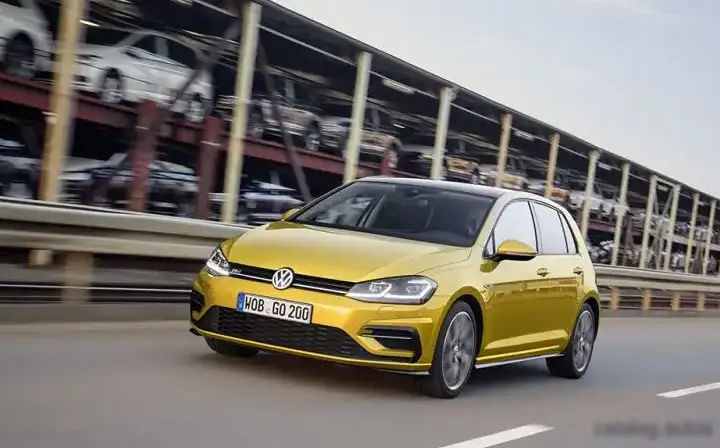
The Volkswagen Golf VII, specifically the 5-door hatchback produced during the 2017 facelift and continuing through 2019, offered a diverse range of powertrains. Among these, the 1.5 TGI (130 hp) variant represented a compelling option for buyers seeking fuel efficiency and a reduced environmental impact, thanks to its bi-fuel capability – running on both gasoline and Compressed Natural Gas (CNG). This model year saw Volkswagen refine the seventh generation Golf, introducing updated styling, enhanced technology, and improved engine options. The 1.5 TGI positioned itself as a mid-range offering, bridging the gap between the base petrol engines and the more powerful TSI variants.
Technical Specifications
| Brand | Volkswagen |
| Model | Golf |
| Generation | Golf VII (5-door, facelift 2017) |
| Type (Engine) | 1.5 TGI (130 Hp) |
| Start of production | January, 2019 |
| End of production | 2019 |
| Powertrain Architecture | Internal Combustion engine |
| Body type | Hatchback |
| Seats | 5 |
| Doors | 5 |
| Fuel consumption (urban) | 4.7 l/100 km (50 US mpg, 60.1 UK mpg, 21.3 km/l) |
| Fuel consumption (extra urban) | 2.9 l/100 km (81.1 US mpg, 97.4 UK mpg, 34.5 km/l) |
| Fuel consumption (combined) | 3.6 l/100 km (65.3 US mpg, 78.5 UK mpg, 27.8 km/l) |
| CO2 emissions | 98 g/km |
| Fuel Type | Petrol / CNG |
| Acceleration 0 – 100 km/h | 9.6 sec |
| Acceleration 0 – 62 mph | 9.6 sec |
| Acceleration 0 – 60 mph | 9.1 sec |
| Maximum speed | 206 km/h (128 mph) |
| Emission standard | Euro 6 |
| Weight-to-power ratio | 9.8 kg/Hp, 102 Hp/tonne |
| Weight-to-torque ratio | 6.4 kg/Nm, 156.9 Nm/tonne |
| Power | 130 Hp |
| Power per litre | 86.8 Hp/l |
| Torque | 200 Nm @ 1400-4000 rpm (147.51 lb.-ft. @ 1400-4000 rpm) |
| Engine layout | Front, Transverse |
| Engine Model/Code | DHFA |
| Engine displacement | 1498 cm3 (91.41 cu. in.) |
| Number of cylinders | 4 |
| Engine configuration | Inline |
| Number of valves per cylinder | 4 |
| Fuel injection system | Direct injection |
| Engine aspiration | Turbocharger |
| Engine oil capacity | 4.3 l (4.54 US qt | 3.78 UK qt) |
| Kerb Weight | 1275 kg (2810.89 lbs.) |
| Max. weight | 1860 kg (4100.6 lbs.) |
| Max load | 585 kg (1289.7 lbs.) |
| Trunk (boot) space – minimum | 380 l (13.42 cu. ft.) |
| Trunk (boot) space – maximum | 1270 l (44.85 cu. ft.) |
| Fuel tank capacity | 9 l (2.38 US gal | 1.98 UK gal) |
| CNG cylinder capacity | 17.3 kg |
| Max. roof load | 75 kg (165.35 lbs.) |
| Permitted trailer load with brakes (8%) | 1700 kg (3747.86 lbs.) |
| Permitted trailer load with brakes (12%) | 1400 kg (3086.47 lbs.) |
| Permitted trailer load without brakes | 670 kg (1477.1 lbs.) |
| Permitted towbar download | 80 kg (176.37 lbs.) |
| Length | 4258 mm (167.64 in.) |
| Width | 1790-1799 mm (70.47 – 70.83 in.) |
| Width including mirrors | 2027 mm (79.8 in.) |
| Height | 1492 mm (58.74 in.) |
| Wheelbase | 2620 mm (103.15 in.) |
| Front track | 1533-1549 mm (60.35 – 60.98 in.) |
| Rear (Back) track | 1504-1521 mm (59.21 – 59.88 in.) |
| Ride height (ground clearance) | 142 mm (5.59 in.) |
| Drive wheel | Front wheel drive |
| Number of gears and type of gearbox | 6 gears, manual transmission |
| Front brakes | Disc |
| Rear brakes | Disc |
| Assisting systems | ABS (Anti-lock braking system) |
| Steering type | Steering rack and pinion |
| Power steering | Electric Steering |
| Tires size | 195/65 R15; 205/55 R16; 225/45 R17 |
| Wheel rims size | 6J x 15; 6.5J x 16; 7J x 17 |
INTRODUCTION
The Volkswagen Golf VII facelift, introduced in 2017, represented a significant refresh of the already popular seventh-generation Golf. The 1.5 TGI (130 hp) variant, launched in January 2019, was a key component of Volkswagen’s strategy to offer more environmentally conscious options. This model combined a 1.5-liter turbocharged gasoline engine with the ability to run on Compressed Natural Gas (CNG), offering reduced emissions and lower running costs. Built on the MQB (Modular Transverse Matrix) platform – specifically the A3 variant – the Golf VII facelift aimed to improve upon the existing model’s strengths in terms of practicality, comfort, and technology. The 1.5 TGI was positioned as a sensible choice for drivers prioritizing fuel economy and environmental responsibility without sacrificing everyday usability.
Powertrain & Engine Architecture
The heart of the Golf VII 1.5 TGI is the DHFA engine code, a 1.5-liter inline-four cylinder gasoline engine. This engine utilizes direct fuel injection and a single turbocharger to deliver a balance of power and efficiency. A key feature is its ability to switch between gasoline and CNG operation. When running on CNG, the engine’s output is slightly reduced to optimize for the alternative fuel. The engine employs a Miller cycle combustion process, enhancing thermal efficiency. The 1.5 TGI is paired with a six-speed manual transmission, contributing to its fuel-saving characteristics. The fuel injection system is a Bosch-supplied direct injection system, ensuring precise fuel delivery and optimized combustion. The engine’s valvetrain features variable valve timing on both the intake and exhaust sides, further enhancing efficiency and responsiveness.
Driving Characteristics
The 130 hp output of the 1.5 TGI, coupled with the six-speed manual transmission, provides adequate performance for everyday driving. Acceleration from 0-60 mph takes approximately 9.1 seconds, and top speed is rated at 128 mph. While not a performance-oriented variant, the engine delivers a usable amount of torque (200 Nm or 147.51 lb-ft) between 1400 and 4000 rpm, making it reasonably responsive in typical driving situations. Compared to the more powerful TSI variants, the 1.5 TGI feels less eager to rev, but its fuel economy advantage is significant. The manual transmission offers precise shifts, and the gear ratios are well-suited for both city and highway driving. The CNG mode slightly reduces power output, but the difference is generally not noticeable during normal driving.
Equipment & Trim Levels
The Golf VII 1.5 TGI typically came equipped with a respectable level of standard features. These included air conditioning, a touchscreen infotainment system with Bluetooth connectivity, alloy wheels, and a suite of safety features such as ABS, ESC, and multiple airbags. Higher trim levels offered additional features like automatic climate control, a larger touchscreen display, navigation system, parking sensors, and adaptive cruise control. Interior upholstery was typically cloth, with optional leather upgrades available. The dashboard layout was consistent with other Golf VII models, featuring a clean and functional design. Optional extras included a panoramic sunroof, upgraded sound system, and various driver assistance packages.
Chassis & Braking
The Golf VII 1.5 TGI utilizes a MacPherson strut front suspension and a multi-link rear suspension, providing a comfortable and controlled ride. The suspension setup is tuned to balance handling and comfort, making it suitable for a wide range of driving conditions. Braking duties are handled by disc brakes on all four wheels, providing ample stopping power. ABS (Anti-lock Braking System) and ESC (Electronic Stability Control) are standard features, enhancing safety and stability. The steering is electrically assisted, offering a light and precise feel. Stabilizer bars are fitted to both the front and rear axles to reduce body roll during cornering.
Market Reception & Comparison
The Golf VII 1.5 TGI was generally well-received by critics for its fuel efficiency and reduced emissions. It offered a compelling alternative to traditional gasoline-powered vehicles, particularly in markets where CNG infrastructure was well-developed. Compared to the 1.0 TSI and 1.6 TDI variants, the 1.5 TGI offered a good balance of performance and economy. While the 1.6 TDI provided superior fuel economy, the 1.5 TGI offered a smoother and more refined driving experience. The 1.0 TSI was more affordable but lacked the CNG capability. Reliability reports suggest that the 1.5 TGI powertrain is generally reliable, with few common issues reported.
Legacy
The Volkswagen Golf VII 1.5 TGI represents an important step in Volkswagen’s efforts to offer more sustainable transportation options. While CNG infrastructure remains limited in some regions, the 1.5 TGI provided a viable alternative for environmentally conscious drivers. On the used car market, these models are often sought after for their fuel efficiency and lower running costs. The DHFA engine has proven to be relatively durable, and maintenance costs are comparable to other Golf VII variants. As environmental regulations become increasingly stringent, the Golf VII 1.5 TGI’s legacy as a pioneering bi-fuel vehicle is likely to grow.