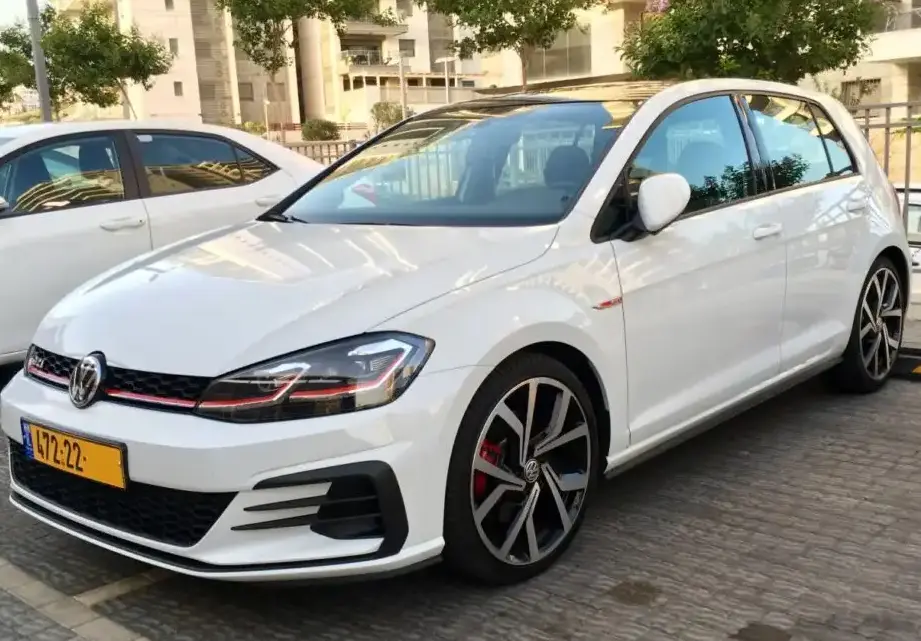
The Volkswagen Golf VII, specifically the 5-door hatchback produced from 2018 to 2021 following the 2017 facelift, represents a significant evolution of Volkswagen’s iconic compact car. Within the Golf VII range, the GTI 2.0 TSI variant, producing 228 horsepower, occupied a sweet spot, offering a substantial performance upgrade over the base models while remaining more accessible than the range-topping performance trims. This model was primarily aimed at enthusiasts seeking a sporty driving experience combined with the Golf’s renowned practicality and refinement, and was a key offering in European and North American markets.
Technical Specifications
| Brand | Volkswagen |
| Model | Golf |
| Generation | Golf VII (5-door, facelift 2017) |
| Type (Engine) | GTI 2.0 TSI (228 Hp) |
| Start of production | 2018 |
| End of production | 2021 |
| Powertrain Architecture | Internal Combustion engine |
| Body type | Hatchback |
| Seats | 5 |
| Doors | 5 |
| Fuel consumption (urban) | 9.8 l/100 km (24 US mpg, 28.8 UK mpg, 10.2 km/l) |
| Fuel consumption (extra urban) | 7.4 l/100 km (31.8 US mpg, 38.2 UK mpg, 13.5 km/l) |
| Fuel consumption (combined) | 8.7 l/100 km (27 US mpg, 32.5 UK mpg, 11.5 km/l) |
| Fuel Type | Petrol (Gasoline) |
| Weight-to-power ratio | 6.1 kg/Hp, 164.1 Hp/tonne |
| Weight-to-torque ratio | 4 kg/Nm, 252 Nm/tonne |
| Power | 228 Hp @ 4700 rpm |
| Power per litre | 114.9 Hp/l |
| Torque | 350 Nm @ 1500-4600 rpm (258.15 lb.-ft. @ 1500-4600 rpm) |
| Engine layout | Front, Transverse |
| Engine Model/Code | EA888 / DKFA |
| Engine displacement | 1984 cm3 (121.07 cu. in.) |
| Number of cylinders | 4 |
| Engine configuration | Inline |
| Cylinder Bore | 82.5 mm (3.25 in.) |
| Piston Stroke | 92.8 mm (3.65 in.) |
| Compression ratio | 9.6:1 |
| Number of valves per cylinder | 4 |
| Fuel injection system | Direct injection |
| Engine aspiration | Turbocharger, Intercooler |
| Valvetrain | DOHC |
| Engine oil capacity | 5.7 l (6.02 US qt | 5.02 UK qt) |
| Coolant | 10 l (10.57 US qt | 8.8 UK qt) |
| Kerb Weight | 1389 kg (3062.22 lbs.) |
| Max. weight | 1920 kg (4232.88 lbs.) |
| Max load | 531 kg (1170.65 lbs.) |
| Trunk (boot) space – minimum | 493 l (17.41 cu. ft.) |
| Trunk (boot) space – maximum | 1521 l (53.71 cu. ft.) |
| Fuel tank capacity | 50 l (13.21 US gal | 11 UK gal) |
| Length | 4268 mm (168.03 in.) |
| Width | 1799 mm (70.83 in.) |
| Height | 1467 mm (57.76 in.) |
| Wheelbase | 2631 mm (103.58 in.) |
| Front track | 1538 mm (60.55 in.) |
| Rear (Back) track | 1516 mm (59.69 in.) |
| Ride height (ground clearance) | 129 mm (5.08 in.) |
| Drag coefficient (Cd) | 0.31 |
| Minimum turning circle (turning diameter) | 10.9 m (35.76 ft.) |
| Drivetrain Architecture | Front wheel drive |
| Number of gears and type of gearbox | 6 gears, manual transmission |
| Front suspension | Independent type McPherson |
| Rear suspension | Independent multi-link suspension |
| Front brakes | Ventilated discs, 340×30 mm |
| Rear brakes | Disc, 310×23 mm |
| Assisting systems | ABS (Anti-lock braking system) |
| Steering type | Steering rack and pinion |
| Power steering | Electric Steering |
| Tires size | 225/40 R18 |
| Wheel rims size | 7.5J x 18 |
Powertrain & Engine Architecture
The heart of the Golf VII GTI 2.0 TSI is the EA888 engine, specifically the DKFA variant. This 1984cc (121.07 cu. in.) turbocharged and direct-injected inline-four engine is a cornerstone of Volkswagen Group’s performance offerings. The direct injection system, coupled with a sophisticated turbocharger and intercooler setup, allows for precise fuel delivery and efficient combustion, resulting in a responsive and powerful engine. The engine utilizes a dual overhead camshaft (DOHC) valvetrain with four valves per cylinder, optimizing airflow for increased performance. The 6-speed manual transmission was standard, providing drivers with full control over the engine’s power. The engine’s torque curve is particularly noteworthy, delivering 350 Nm (258.15 lb.-ft.) of torque from a low 1500 rpm all the way to 4600 rpm, providing strong acceleration in everyday driving situations.
Driving Characteristics
The 228 hp GTI with a manual transmission offers a noticeably more engaging driving experience than the lower-powered Golf variants. Acceleration is brisk, with the car feeling confident during highway merges and overtaking maneuvers. The manual gearbox is precise and provides a satisfying tactile feel. While not as raw or focused as the more powerful GTI Performance model, the 2.0 TSI strikes a good balance between performance and usability. The suspension, tuned for sporty handling, provides good body control without sacrificing too much ride comfort. The steering is accurate and well-weighted, contributing to a confident feel behind the wheel. The gear ratios are well-chosen to maximize the engine’s torque, making it easy to maintain momentum in various driving conditions.
Equipment & Trim Levels
The GTI 2.0 TSI typically came well-equipped as standard. Key features included sport seats upholstered in the classic GTI plaid fabric, a leather-wrapped multi-function steering wheel, and stainless steel pedal caps. Infotainment was usually handled by Volkswagen’s Composition Media system, featuring a touchscreen display, Bluetooth connectivity, and USB ports. Optional extras included features like a panoramic sunroof, adaptive dampers (DCC), and a premium sound system. Exterior styling cues included unique GTI bumpers, side skirts, and a rear spoiler, along with distinctive red trim accents.
Chassis & Braking
The Golf VII GTI utilizes an independent McPherson strut suspension at the front and a multi-link suspension at the rear, providing a good balance of comfort and handling. The GTI also benefits from a slightly lowered ride height compared to standard Golf models. Braking duties are handled by ventilated discs at the front and solid discs at the rear. The anti-lock braking system (ABS) is standard, enhancing safety and control during hard braking. The GTI also features electronic stability control (ESC), which helps to prevent skidding and maintain directional stability.
Market Reception & Comparison
The Golf VII GTI 2.0 TSI was widely praised by automotive critics for its blend of performance, practicality, and refinement. It was often lauded as a benchmark in the hot hatch segment. Compared to the base Golf models, the GTI offered a significant performance boost and a more engaging driving experience. Compared to the higher-output GTI Performance model, the 2.0 TSI offered a more affordable entry point into the GTI world, albeit with slightly less power and performance. Fuel economy was respectable for a performance car, averaging around 27 US mpg in combined driving. Reliability was generally good, although some owners reported minor issues with the turbocharger and direct injection system.
Legacy
The Golf VII GTI 2.0 TSI has established itself as a popular and well-regarded used car. The EA888 engine, while requiring regular maintenance, is generally considered to be durable and reliable. The GTI’s timeless design and engaging driving dynamics continue to appeal to enthusiasts. As a result, well-maintained examples of the Golf VII GTI 2.0 TSI hold their value relatively well in the used car market, making it a compelling option for those seeking a sporty and practical compact car.