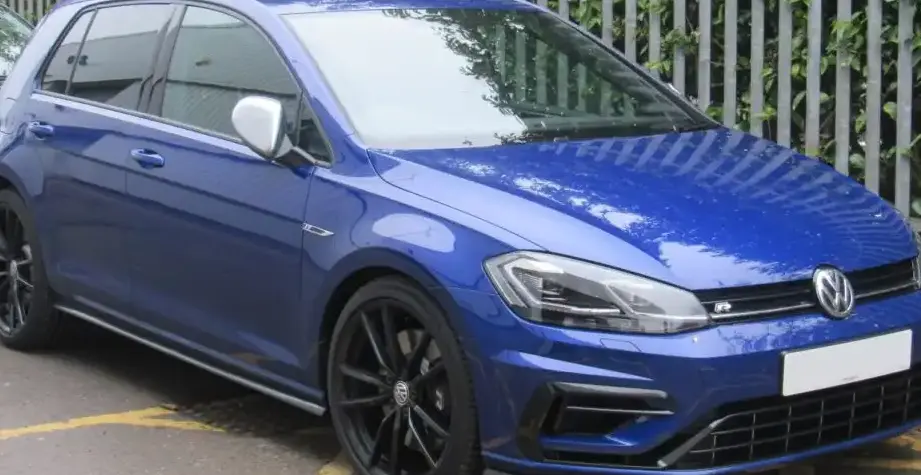
The Volkswagen Golf VII R, specifically the 5-door hatchback produced from February 2017 to August 2018, represents the high-performance pinnacle of the seventh-generation Golf lineup. This variant, designated by its 2.0 TSI 310 HP engine coupled with a 4MOTION all-wheel-drive system and a 7-speed DSG (Direct-Shift Gearbox) transmission, was positioned as the flagship model, offering a significant step up in performance and handling compared to other Golf VII trims. It arrived during the facelift of the VII generation (often referred to as the 7.5), incorporating styling updates and technological enhancements. The Golf R aimed to compete directly with performance hatchbacks like the Audi S3, BMW M140i, and Mercedes-AMG A35.
Technical Specifications
| Brand | Volkswagen |
| Model | Golf |
| Generation | Golf VII (5-door, facelift 2017) |
| Type (Engine) | R 2.0 TSI (310 Hp) 4MOTION DSG |
| Start of production | February, 2017 |
| End of production | August, 2018 |
| Powertrain Architecture | Internal Combustion engine |
| Body type | Hatchback |
| Seats | 5 |
| Doors | 5 |
| Fuel consumption (urban) | 8.6-8.9 l/100 km (27.4 – 26.4 US mpg, 32.8 – 31.7 UK mpg, 11.6 – 11.2 km/l) |
| Fuel consumption (extra urban) | 5.9-6.2 l/100 km (39.9 – 37.9 US mpg, 47.9 – 45.6 UK mpg, 16.9 – 16.1 km/l) |
| Fuel consumption (combined) | 6.9-7.2 l/100 km (34.1 – 32.7 US mpg, 40.9 – 39.2 UK mpg, 14.5 – 13.9 km/l) |
| CO2 emissions | 157-165 g/km |
| Fuel Type | Petrol (Gasoline) |
| Acceleration 0 – 100 km/h | 4.6 sec |
| Acceleration 0 – 62 mph | 4.6 sec |
| Acceleration 0 – 60 mph | 4.4 sec |
| Maximum speed | 250 km/h (155.34 mph), Electronically limited |
| Emission standard | Euro 6 |
| Weight-to-power ratio | 4.7 kg/Hp, 212.3 Hp/tonne |
| Weight-to-torque ratio | 3.7 kg/Nm, 274 Nm/tonne |
| Power | 310 Hp @ 5500-6500 rpm |
| Power per litre | 156.3 Hp/l |
| Torque | 400 Nm @ 2000-5400 rpm (295.02 lb.-ft. @ 2000-5400 rpm) |
| Engine layout | Front, Transverse |
| Engine Model/Code | EA888 / DJHA |
| Engine displacement | 1984 cm3 (121.07 cu. in.) |
| Number of cylinders | 4 |
| Engine configuration | Inline |
| Cylinder Bore | 82.5 mm (3.25 in.) |
| Piston Stroke | 92.8 mm (3.65 in.) |
| Compression ratio | 9.3:1 |
| Number of valves per cylinder | 4 |
| Fuel injection system | Direct injection and Multi-port manifold injection |
| Engine aspiration | Turbocharger, Intercooler |
| Valvetrain | DOHC |
| Engine oil capacity | 5.7 l (6.02 US qt | 5.02 UK qt) |
| Kerb Weight | 1460 kg (3218.75 lbs.) |
| Max. weight | 1990 kg (4387.2 lbs.) |
| Max load | 530 kg (1168.45 lbs.) |
| Trunk (boot) space – minimum | 343 l (12.11 cu. ft.) |
| Trunk (boot) space – maximum | 1233 l (43.54 cu. ft.) |
| Fuel tank capacity | 55 l (14.53 US gal | 12.1 UK gal) |
| Max. roof load | 75 kg (165.35 lbs.) |
| Length | 4263 mm (167.83 in.) |
| Width | 1799 mm (70.83 in.) |
| Width including mirrors | 2027 mm (79.8 in.) |
| Height | 1465 mm (57.68 in.) |
| Wheelbase | 2626 mm (103.39 in.) |
| Front track | 1533-1549 mm (60.35 – 60.98 in.) |
| Rear (Back) track | 1503-1521 mm (59.17 – 59.88 in.) |
| Ride height (ground clearance) | 128 mm (5.04 in.) |
| Minimum turning circle | 10.9 m (35.76 ft.) |
| Drivetrain Architecture | All wheel drive (4×4). ICE drives front wheels, rear driven via clutch. |
| Number of gears | 7 |
| Gearbox type | Automatic transmission DSG |
| Front suspension | Independent, McPherson with coil spring and anti-roll bar |
| Rear suspension | Independent multi-link spring suspension with stabilizer |
| Front brakes | Ventilated discs |
| Rear brakes | Disc |
Powertrain & Engine Architecture
The heart of the Golf VII R is the EA888 2.0-liter turbocharged four-cylinder engine, specifically the DJHA variant. This engine utilizes a combination of direct injection and multi-port fuel injection to optimize combustion efficiency and power delivery. The engine features a cast iron block and an aluminum cylinder head, incorporating double overhead camshafts (DOHC) and four valves per cylinder. The turbocharger, with an integrated intercooler, provides significant boost, contributing to the engine’s 310 horsepower output at 5500-6500 rpm and 295 lb-ft of torque available from 2000-5400 rpm. The 7-speed DSG dual-clutch transmission offers rapid and precise gear changes, enhancing both acceleration and fuel efficiency. The 4MOTION all-wheel-drive system utilizes a Haldex multi-plate clutch to distribute torque between the front and rear axles, providing enhanced traction and stability, particularly in adverse weather conditions.
Driving Characteristics
The Golf R’s 310 hp and all-wheel-drive system deliver exhilarating performance. Acceleration from 0 to 60 mph takes just 4.4 seconds, and the electronically limited top speed of 155 mph is readily achievable. The DSG transmission provides seamless shifts, and the 4MOTION system ensures confident handling in a variety of conditions. Compared to lower-powered Golf VII variants, such as the 1.8T, the R offers a significantly more responsive and engaging driving experience. While the 1.8T prioritizes fuel economy and comfort, the R focuses on performance and driver involvement. The R’s suspension is firmer than that of the standard Golf, providing better body control but potentially sacrificing some ride comfort. The gear ratios in the DSG are optimized for both acceleration and highway cruising.
Equipment & Trim Levels
The Golf R came standard with a comprehensive list of features, including sport seats upholstered in cloth and Alcantara, a leather-wrapped steering wheel, automatic climate control, and a touchscreen infotainment system with Apple CarPlay and Android Auto compatibility. Optional extras included leather upholstery, a panoramic sunroof, adaptive dampers (DCC), and a premium sound system. Visually, the R was distinguished by its unique front and rear bumpers, side skirts, a rear spoiler, and quad exhaust outlets. The interior featured R-specific badging and trim accents.
Chassis & Braking
The Golf R’s chassis was specifically tuned to handle the increased power and performance. It features a stiffer suspension setup compared to other Golf VII models, with upgraded shock absorbers and stabilizer bars. The braking system consists of ventilated discs on all four wheels, providing ample stopping power. The R also benefits from a progressive brake servo, which adjusts braking assistance based on driving conditions. The standard tire size is 225/40 R18 or 235/35 R19, providing good grip and handling.
Market Reception & Comparison
The Golf R was widely praised by automotive critics for its performance, handling, and practicality. It was consistently ranked among the best performance hatchbacks on the market. While its fuel economy wasn’t as impressive as some of the lower-powered Golf variants (around 34 mpg combined), it was still respectable for a car of its performance level. Compared to the Golf GTI, the R offered a significant increase in power and all-wheel-drive capability, but at a higher price point. The R’s reliability was generally good, although some owners reported minor issues with the DSG transmission.
Legacy
The Golf VII R has established itself as a highly desirable performance car in the used car market. Its combination of performance, practicality, and refinement has made it a popular choice among enthusiasts. The EA888 engine, while known for requiring regular oil changes, has proven to be relatively durable. The DSG transmission, if properly maintained, is also generally reliable. The Golf VII R represents a sweet spot in the Golf lineage, offering a compelling blend of performance and everyday usability that continues to appeal to drivers today.