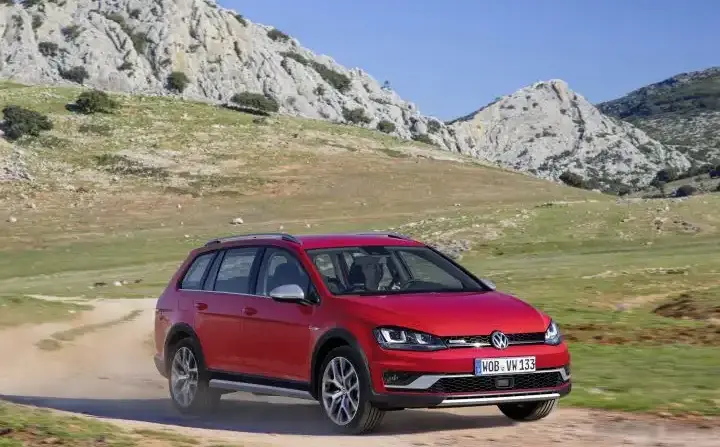
The Volkswagen Golf VII Alltrack 2.0 TDI (150 hp) 4MOTION, produced from April 2014 to 2017, represents Volkswagen’s foray into the compact crossover segment, blending the practicality of a station wagon with the all-weather capability of all-wheel drive. Positioned as a more rugged and versatile alternative to the standard Golf VII estate, the Alltrack aimed to appeal to drivers seeking a vehicle capable of handling both daily commutes and weekend adventures. It’s built on the MQB (Modular Transverse Matrix) platform, specifically the A5 variant, shared with other models in the Volkswagen Group like the Audi A3 and SEAT Leon. This particular variant, equipped with the 2.0-liter TDI engine and a six-speed manual transmission, occupied a mid-range position within the Alltrack lineup, offering a balance of performance, fuel efficiency, and price.
Technical Specifications
| Brand | Volkswagen |
| Model | Golf |
| Generation | Golf VII Alltrack |
| Type (Engine) | 2.0 TDI (150 Hp) 4MOTION |
| Start of production | April, 2014 |
| End of production | 2017 |
| Powertrain Architecture | Internal Combustion engine |
| Body type | Station wagon (estate), Crossover |
| Seats | 5 |
| Doors | 5 |
| Fuel consumption (economy) – urban | 5.9 l/100 km (39.9 US mpg, 47.9 UK mpg, 16.9 km/l) |
| Fuel consumption (economy) – extra urban | 4.4 l/100 km (53.5 US mpg, 64.2 UK mpg, 22.7 km/l) |
| Fuel consumption (economy) – combined | 4.9 l/100 km (48 US mpg, 57.6 UK mpg, 20.4 km/l) |
| CO2 emissions | 127 g/km |
| Fuel Type | Diesel |
| Acceleration 0 – 100 km/h | 8.9 sec |
| Acceleration 0 – 62 mph | 8.9 sec |
| Acceleration 0 – 60 mph | 8.5 sec |
| Maximum speed | 207 km/h (128.62 mph) |
| Emission standard | Euro 6 |
| Weight-to-power ratio | 10.4 kg/Hp, 96.5 Hp/tonne |
| Weight-to-torque ratio | 4.6 kg/Nm, 218.6 Nm/tonne |
| Power | 150 Hp @ 3500-4000 rpm |
| Power per litre | 76.2 Hp/l |
| Torque | 340 Nm @ 1750-3000 rpm (250.77 lb.-ft. @ 1750-3000 rpm) |
| Engine layout | Front, Transverse |
| Engine Model/Code | CRMB, DCYA, DEJA, CRLB |
| Engine displacement | 1968 cm3 (120.09 cu. in.) |
| Number of cylinders | 4 |
| Engine configuration | Inline |
| Number of valves per cylinder | 4 |
| Fuel injection system | Diesel Commonrail |
| Engine aspiration | Turbocharger, Intercooler |
| Engine oil capacity | 4.7 l (4.97 US qt | 4.14 UK qt) |
| Kerb Weight | 1555 kg (3428.19 lbs.) |
| Max. weight | 2050 kg (4519.48 lbs.) |
| Max load | 495 kg (1091.29 lbs.) |
| Trunk (boot) space – minimum | 605 l (21.37 cu. ft.) |
| Trunk (boot) space – maximum | 1620 l (57.21 cu. ft.) |
| Fuel tank capacity | 55 l (14.53 US gal | 12.1 UK gal) |
| Length | 4578 mm (180.24 in.) |
| Width | 1799 mm (70.83 in.) |
| Height | 1515 mm (59.65 in.) |
| Wheelbase | 2630 mm (103.54 in.) |
| Front track | 1546 mm (60.87 in.) |
| Rear (Back) track | 1517 mm (59.72 in.) |
| Minimum turning circle | 10.9 m (35.76 ft.) |
| Drive wheel | All wheel drive (4×4) |
| Number of gears and type of gearbox | 6 gears, manual transmission |
| Front brakes | Ventilated discs |
| Assisting systems | ABS (Anti-lock braking system) |
| Steering type | Steering rack and pinion |
| Tires size | 205/55 R17 |
| Wheel rims size | 6.5J x 17 |
Powertrain & Engine Architecture
The heart of the Golf VII Alltrack 2.0 TDI (150 hp) is the EA189 series 2.0-liter four-cylinder diesel engine. Depending on the production year, this engine could be found with different codes – CRMB, DCYA, DEJA, or CRLB – but all shared a common architecture. These engines utilized a common rail direct injection system, delivering fuel at extremely high pressures for optimized combustion. A turbocharger with an intercooler was standard, providing increased air density and boosting power output. The engine featured four valves per cylinder and a single overhead camshaft. The 150 hp output was achieved through careful calibration of the engine management system, balancing performance with fuel economy and emissions. The six-speed manual transmission was the standard offering, providing precise gear changes and a direct connection to the engine. The 4MOTION all-wheel-drive system employed a Haldex multi-plate clutch, automatically distributing torque between the front and rear axles as needed, enhancing traction in slippery conditions.
Driving Characteristics
The 150 hp 2.0 TDI engine, coupled with the six-speed manual transmission, provided a respectable, if not exhilarating, driving experience. Acceleration from 0-60 mph took around 8.5 seconds, making it competitive within its class. The engine delivered a broad torque curve, with 340 Nm (250.77 lb-ft) available from 1750-3000 rpm, providing ample pulling power for everyday driving and overtaking maneuvers. Compared to the higher-output 184 hp version of the same engine, the 150 hp variant felt slightly less responsive, particularly at higher engine speeds. However, it offered improved fuel economy. The manual transmission allowed for greater driver control, while the 4MOTION system instilled confidence in challenging weather conditions. The gear ratios were well-chosen, providing a balance between acceleration and cruising efficiency.
Equipment & Trim Levels
The Golf VII Alltrack 2.0 TDI (150 hp) 4MOTION typically came well-equipped as standard. Features included air conditioning, a touchscreen infotainment system, alloy wheels, and a leather-wrapped steering wheel. Safety features such as ABS, electronic stability control, and multiple airbags were also standard. Optional extras included navigation, parking sensors, heated seats, and a panoramic sunroof. Interior upholstery was typically cloth, with the option of leather upgrades. The dashboard layout was consistent with other Golf VII models, offering a clean and functional design. Trim levels varied slightly depending on the market, but generally offered progressive upgrades in terms of comfort and convenience features.
Chassis & Braking
The Alltrack featured a slightly raised suspension compared to the standard Golf estate, providing increased ground clearance for off-road excursions. The front suspension utilized MacPherson struts, while the rear employed a multi-link setup, offering a comfortable ride and good handling characteristics. Brakes were ventilated discs on the front axle and solid discs on the rear. The ABS system worked in conjunction with the electronic stability control to provide enhanced braking performance and stability. Stabilizer bars were fitted to both the front and rear axles to reduce body roll during cornering.
Market Reception & Comparison
The Golf VII Alltrack was generally well-received by automotive critics, who praised its versatility, practicality, and all-weather capability. The 150 hp TDI engine was considered a good compromise between performance and fuel economy. Compared to the more powerful 184 hp TDI, the 150 hp version offered lower running costs and was often favored by drivers prioritizing efficiency. Against competitors like the Audi A4 Allroad and Volvo V60 Cross Country, the Golf Alltrack offered a more affordable entry point into the compact crossover segment. Fuel economy was a strong point, with combined figures around 4.9 l/100 km (48 US mpg), making it an attractive option for long-distance drivers.
Legacy
The Golf VII Alltrack 2.0 TDI (150 hp) 4MOTION has proven to be a reliable and durable vehicle. The 2.0 TDI engine, while not without its share of potential issues (such as DPF clogging and EGR valve failures), is generally considered robust when properly maintained. The 4MOTION system has also proven to be dependable. On the used car market, these models hold their value reasonably well, particularly those with lower mileage and a full service history. The Alltrack’s blend of practicality, capability, and fuel efficiency continues to appeal to buyers seeking a versatile and dependable compact crossover.