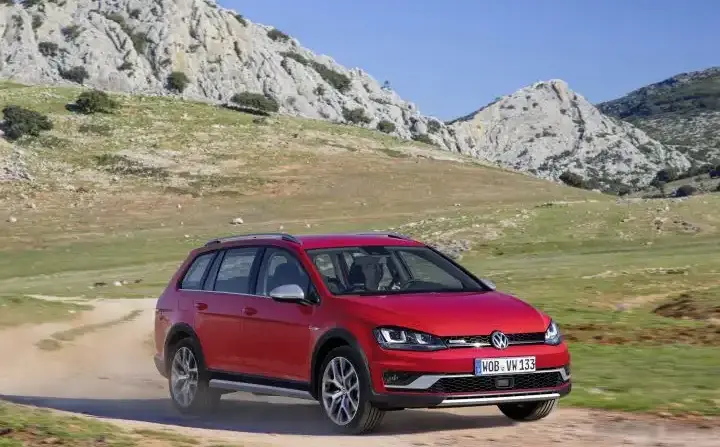
The Volkswagen Golf VII Alltrack 2.0 TDI (184 hp) 4MOTION DSG, produced from March 2013 to 2017, represents Volkswagen’s foray into the compact crossover segment, blending the practicality of a station wagon with the all-weather capability of all-wheel drive. Positioned as a more rugged and versatile alternative to the standard Golf VII estate, the Alltrack aimed to appeal to drivers seeking a vehicle capable of handling both daily commutes and weekend adventures. It’s built on the Volkswagen Group’s MQB platform (A7 iteration), shared with the seventh-generation Golf, Audi A3, and SEAT Leon. This particular variant, equipped with the 2.0-liter TDI engine and a dual-clutch DSG transmission, occupied a mid-to-upper position within the Alltrack lineup, offering a balance of performance, fuel efficiency, and features.
Technical Specifications
| Brand | Volkswagen |
| Model | Golf |
| Generation | Golf VII Alltrack |
| Type (Engine) | 2.0 TDI (184 Hp) 4MOTION DSG |
| Start of production | March, 2013 |
| End of production | 2017 |
| Powertrain Architecture | Internal Combustion engine |
| Body type | Station wagon (estate), Crossover |
| Seats | 5 |
| Doors | 5 |
| Fuel consumption (economy) – urban | 5.7 l/100 km (41.3 US mpg, 49.6 UK mpg, 17.5 km/l) |
| Fuel consumption (economy) – extra urban | 4.6 l/100 km (51.1 US mpg, 61.4 UK mpg, 21.7 km/l) |
| Fuel consumption (economy) – combined | 5 l/100 km (47 US mpg, 56.5 UK mpg, 20 km/l) |
| CO2 emissions | 124 g/km |
| Fuel Type | Diesel |
| Acceleration 0 – 100 km/h | 7.8 sec |
| Acceleration 0 – 62 mph | 7.8 sec |
| Acceleration 0 – 60 mph | 7.4 sec |
| Maximum speed | 219 km/h (136.08 mph) |
| Emission standard | Euro 6 |
| Weight-to-power ratio | 8.6 kg/Hp, 116.2 Hp/tonne |
| Weight-to-torque ratio | 4.2 kg/Nm, 239.9 Nm/tonne |
| Power | 184 Hp @ 3500-4000 rpm |
| Power per litre | 93.5 Hp/l |
| Torque | 380 Nm @ 1750-3250 rpm (280.27 lb.-ft. @ 1750-3250 rpm) |
| Engine layout | Front, Transverse |
| Engine Model/Code | CUNA |
| Engine displacement | 1968 cm3 (120.09 cu. in.) |
| Number of cylinders | 4 |
| Engine configuration | Inline |
| Number of valves per cylinder | 4 |
| Fuel injection system | Diesel Commonrail |
| Engine aspiration | Turbocharger, Intercooler |
| Engine oil capacity | 4.7 l (4.97 US qt | 4.14 UK qt) |
| Kerb Weight | 1584 kg (3492.12 lbs.) |
| Max. weight | 2080 kg (4585.62 lbs.) |
| Max load | 496 kg (1093.49 lbs.) |
| Trunk (boot) space – minimum | 605 l (21.37 cu. ft.) |
| Trunk (boot) space – maximum | 1620 l (57.21 cu. ft.) |
| Fuel tank capacity | 55 l (14.53 US gal | 12.1 UK gal) |
| Length | 4578 mm (180.24 in.) |
| Width | 1799 mm (70.83 in.) |
| Height | 1515 mm (59.65 in.) |
| Wheelbase | 2630 mm (103.54 in.) |
| Front track | 1546 mm (60.87 in.) |
| Rear (Back) track | 1517 mm (59.72 in.) |
| Minimum turning circle | 10.9 m (35.76 ft.) |
| Drive wheel | All wheel drive (4×4) |
| Number of gears and type of gearbox | 6 gears, automatic transmission DSG |
| Front brakes | Ventilated discs |
| Assisting systems | ABS (Anti-lock braking system) |
| Steering type | Steering rack and pinion |
| Tires size | 205/55 R17 |
| Wheel rims size | 6.5J x 17 |
Powertrain & Engine Architecture
The heart of the Golf VII Alltrack 2.0 TDI (184 hp) is the CUNA engine code, a 2.0-liter four-cylinder diesel engine. This engine is part of the Volkswagen Group’s modular engine family and features common-rail direct injection, a turbocharger with intercooling, and four valves per cylinder. The common-rail system, operating at extremely high pressures, ensures precise fuel delivery for optimized combustion and reduced emissions. The turbocharger provides a significant boost in power and torque, while the intercooler cools the intake air, further enhancing performance. The engine produces 184 horsepower at 3500-4000 rpm and a substantial 380 Nm (280 lb-ft) of torque between 1750 and 3250 rpm. This torque output is a key characteristic of modern diesel engines, providing strong pulling power and excellent mid-range acceleration. Paired with the engine is a six-speed dual-clutch transmission (DSG). The DSG offers quick and smooth gear changes, contributing to both performance and fuel efficiency. The 4MOTION all-wheel-drive system utilizes a Haldex multi-plate clutch, automatically distributing torque between the front and rear axles as needed, providing enhanced traction in various conditions.
Driving Characteristics
The 184 hp TDI engine and DSG transmission combination in the Alltrack delivers a refined and capable driving experience. While not overtly sporty, the engine provides ample power for everyday driving and confident overtaking. The DSG transmission shifts quickly and seamlessly, minimizing power interruption. The 4MOTION system provides excellent grip, particularly on slippery surfaces, inspiring confidence in adverse weather conditions. Compared to the lower-powered 1.6 TDI Alltrack variants, the 2.0 TDI offers noticeably stronger acceleration and a more relaxed driving experience, especially when fully loaded or tackling inclines. Compared to the petrol-powered Golf Alltrack variants, the 2.0 TDI prioritizes fuel economy and torque delivery over outright horsepower. The gear ratios in the DSG are tuned to maximize fuel efficiency while still providing responsive acceleration.
Equipment & Trim Levels
The Golf VII Alltrack 2.0 TDI (184 hp) 4MOTION DSG typically came well-equipped as standard. Features included alloy wheels, roof rails, off-road-specific bumpers and side sills, and a raised ride height compared to the standard Golf estate. Inside, the Alltrack featured comfortable seats, often upholstered in a durable fabric or optional leather. Standard equipment also included air conditioning, a touchscreen infotainment system with Bluetooth connectivity, and a suite of safety features such as ABS, ESP, and multiple airbags. Optional extras included navigation, parking sensors, adaptive cruise control, and a panoramic sunroof. Trim levels varied slightly depending on the market, but generally offered progressive upgrades in terms of interior materials, technology, and convenience features.
Chassis & Braking
The Alltrack’s chassis is based on the standard Golf VII estate, but with modifications to accommodate the increased ride height and all-wheel-drive system. The suspension utilizes independent suspension all around, with MacPherson struts at the front and a multi-link setup at the rear. The suspension is tuned to provide a comfortable ride while maintaining good handling characteristics. Braking duties are handled by ventilated disc brakes at the front and either disc or drum brakes at the rear, depending on the specific trim level and market. The Alltrack also features ABS (Anti-lock Braking System) and ESP (Electronic Stability Program) as standard, enhancing safety and control.
Market Reception & Comparison
The Golf VII Alltrack was generally well-received by automotive critics, who praised its versatility, practicality, and all-weather capability. The 2.0 TDI (184 hp) variant was often highlighted as the sweet spot in the lineup, offering a good balance of performance and fuel economy. Compared to other compact crossovers, such as the Audi Q3 or BMW X1, the Alltrack offered a more affordable price point and a more practical, estate-car-based design. Fuel economy was a strong point, with combined figures around 5.0 l/100 km (47 US mpg), making it an attractive option for drivers covering long distances. Reliability was generally good, although, like all modern diesel engines, the Alltrack’s emissions control systems (particularly the diesel particulate filter) required careful maintenance.
Legacy
The Golf VII Alltrack 2.0 TDI (184 hp) 4MOTION DSG remains a popular choice in the used car market. Its combination of practicality, capability, and fuel efficiency continues to appeal to buyers seeking a versatile and reliable vehicle. The 2.0 TDI engine, while subject to scrutiny regarding diesel emissions, has proven to be durable and long-lasting when properly maintained. The DSG transmission, while requiring occasional servicing, is generally reliable. However, potential buyers should be aware of the importance of maintaining the diesel particulate filter and ensuring that all software updates have been applied to address any potential emissions-related issues. The Alltrack’s blend of Golf practicality and crossover capability has cemented its place as a niche but highly regarded model within the Volkswagen lineup.