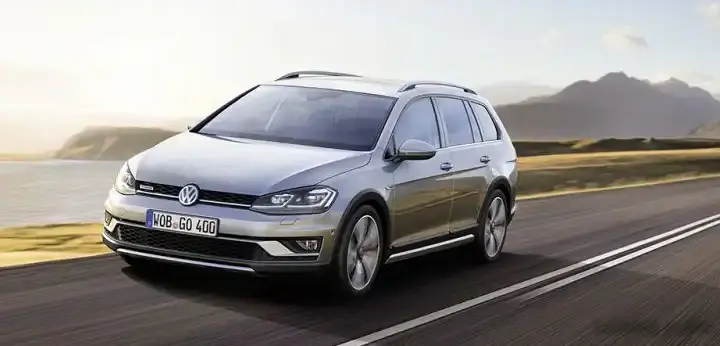
The Volkswagen Golf VII Alltrack (facelift, produced 2017-2019) 2.0 TDI 150 hp with 4MOTION all-wheel drive represents a niche offering within the broader Golf VII range. Positioned as a compact crossover estate, the Alltrack aimed to blend the practicality of a station wagon with the rugged appeal and all-weather capability of an all-wheel-drive system. This variant, introduced with the mid-cycle facelift of the Golf VII, targeted buyers seeking a versatile vehicle for both daily commuting and active lifestyles. It built upon the Golf’s established reputation for build quality and refinement, adding increased ground clearance and distinctive styling cues to differentiate it from the standard Golf estate.
Technical Specifications
| Brand | Volkswagen |
| Model | Golf |
| Generation | Golf VII Alltrack (facelift 2017) |
| Type (Engine) | 2.0 TDI (150 Hp) 4MOTION |
| Start of production | 2017 |
| End of production | 2019 |
| Powertrain Architecture | Internal Combustion engine |
| Body type | Station wagon (estate), Crossover |
| Seats | 5 |
| Doors | 5 |
| Fuel consumption (urban) | 6.0-6.1 l/100 km (39.2 – 38.6 US mpg, 47.1 – 46.3 UK mpg, 16.7 – 16.4 km/l) |
| Fuel consumption (extra urban) | 4.5-4.6 l/100 km (52.3 – 51.1 US mpg, 62.8 – 61.4 UK mpg, 22.2 – 21.7 km/l) |
| Fuel consumption (combined) | 5.1-5.2 l/100 km (46.1 – 45.2 US mpg, 55.4 – 54.3 UK mpg, 19.6 – 19.2 km/l) |
| CO2 emissions | 133-135 g/km |
| Fuel Type | Diesel |
| Acceleration 0 – 100 km/h | 8.9 sec |
| Acceleration 0 – 62 mph | 8.9 sec |
| Acceleration 0 – 60 mph | 8.5 sec |
| Maximum speed | 207 km/h (128.62 mph) |
| Emission standard | Euro 6 |
| Weight-to-power ratio | 9.8 kg/Hp, 102.3 Hp/tonne |
| Weight-to-torque ratio | 4.3 kg/Nm, 231.9 Nm/tonne |
| Power | 150 Hp @ 3500-4000 rpm |
| Power per litre | 76.2 Hp/l |
| Torque | 340 Nm @ 1750-3000 rpm (250.77 lb.-ft. @ 1750-3000 rpm) |
| Engine layout | Front, Transverse |
| Engine Model/Code | CRLB, DCYA, DEJA |
| Engine displacement | 1968 cm3 (120.09 cu. in.) |
| Number of cylinders | 4 |
| Engine configuration | Inline |
| Number of valves per cylinder | 4 |
| Fuel injection system | Diesel Commonrail |
| Engine aspiration | Turbocharger, Intercooler |
| Engine oil capacity | 4.7 l (4.97 US qt | 4.14 UK qt) |
| Kerb Weight | 1466 kg (3231.98 lbs.) |
| Max. weight | 2050 kg (4519.48 lbs.) |
| Max load | 584 kg (1287.5 lbs.) |
| Trunk (boot) space – minimum | 605 l (21.37 cu. ft.) |
| Trunk (boot) space – maximum | 1620 l (57.21 cu. ft.) |
| Fuel tank capacity | 55 l (14.53 US gal | 12.1 UK gal) |
| Max. roof load | 75 kg (165.35 lbs.) |
| Permitted trailer load with brakes (8%) | 2000 kg (4409.25 lbs.) |
| Permitted trailer load with brakes (12%) | 2000 kg (4409.25 lbs.) |
| Permitted trailer load without brakes | 750 kg (1653.47 lbs.) |
| Permitted towbar download | 80 kg (176.37 lbs.) |
| Length | 4679 mm (184.21 in.) |
| Width | 1799 mm (70.83 in.) |
| Height | 1515 mm (59.65 in.) |
| Wheelbase | 2629 mm (103.5 in.) |
| Front track | 1549 mm (60.98 in.) |
| Rear (Back) track | 1520 mm (59.84 in.) |
| Minimum turning circle | 10.9 m (35.76 ft.) |
| Drive wheel | All wheel drive (4×4) |
| Number of gears and type of gearbox | 6 gears, manual transmission |
| Front brakes | Ventilated discs |
| Rear brakes | Disc |
| Assisting systems | ABS (Anti-lock braking system) |
| Steering type | Steering rack and pinion |
| Power steering | Electric Steering |
| Tires size | 205/55 R17 |
| Wheel rims size | 7 J x 17 |
INTRODUCTION
The Golf VII Alltrack 2.0 TDI 150 hp 4MOTION, produced from 2017 to 2019, is a variant of the seventh-generation Volkswagen Golf. It sits within the Golf VII lifecycle, benefitting from the facelift updates introduced in 2017. The Alltrack model specifically is a crossover estate, designed to offer increased versatility and all-weather capability compared to the standard Golf estate. It’s built on the Volkswagen Group’s MQB platform (specifically the A5 variant), shared with models like the Audi A3, SEAT Leon, and Skoda Octavia. This 2.0 TDI 150 hp 4MOTION configuration represented a mid-range offering within the Alltrack lineup, balancing performance, fuel economy, and price.
Powertrain & Engine Architecture
At the heart of the Golf VII Alltrack 2.0 TDI 150 hp is the Volkswagen Group’s EA288 series of diesel engines. The specific engine codes used for this variant include CRLB, DCYA, and DEJA, depending on the production year and market. This is a common rail direct injection diesel engine, featuring a turbocharger with an intercooler to enhance power and efficiency. The 1968cc inline-four cylinder engine produces 150 horsepower at 3500-4000 rpm and 340 Nm (250.77 lb.-ft.) of torque between 1750 and 3000 rpm. The engine utilizes four valves per cylinder and benefits from advanced technologies like variable geometry turbocharging (VGT) to optimize performance across the rev range. The 6-speed manual transmission was standard, providing a balance between fuel efficiency and driver engagement. The 4MOTION system is a Haldex all-wheel-drive system, which is primarily front-wheel drive but can dynamically distribute torque to the rear wheels when traction is lost.
Driving Characteristics
The 2.0 TDI 150 hp Alltrack offers a composed and refined driving experience. While not overtly sporty, the engine provides ample torque for everyday driving and overtaking maneuvers. The 0-60 mph acceleration time of around 8.5 seconds is respectable for a diesel estate. The 6-speed manual transmission is well-matched to the engine’s characteristics, offering smooth gear changes. The 4MOTION system provides enhanced traction in slippery conditions, making it a confident performer in rain, snow, or on loose surfaces. Compared to the higher-output 2.0 TDI variants (typically 184 hp), this 150 hp version feels less urgent in its acceleration, but it compensates with improved fuel economy. Compared to the petrol-powered Golf Alltracks, the diesel offers significantly better fuel efficiency and a broader torque curve, making it more suitable for long-distance driving and towing.
Equipment & Trim Levels
The Golf VII Alltrack 2.0 TDI 150 hp 4MOTION typically came well-equipped as standard. Features included alloy wheels, roof rails, off-road styling cues (such as black plastic cladding around the wheel arches and sills), and a raised ride height. Inside, the Alltrack featured comfortable seats, a leather-wrapped steering wheel, and a touchscreen infotainment system with Bluetooth connectivity. Optional extras included navigation, adaptive cruise control, parking sensors, and a panoramic sunroof. Trim levels varied by market, but generally offered upgrades to the interior upholstery, audio system, and driver assistance features. The Alltrack aimed for a balance between practicality and comfort, offering a more premium feel than the standard Golf estate.
Chassis & Braking
The Golf VII Alltrack features a MacPherson strut front suspension and a multi-link rear suspension. The suspension is tuned to provide a comfortable ride while maintaining good handling characteristics. The Alltrack’s raised ride height (approximately 20mm higher than the standard Golf estate) provides increased ground clearance for tackling rougher terrain. The braking system consists of ventilated discs at the front and solid discs at the rear. ABS (Anti-lock Braking System) is standard, along with electronic stability control (ESC) and traction control. The Alltrack’s chassis is designed to handle the added weight and all-wheel-drive system without compromising its dynamic capabilities.
Market Reception & Comparison
The Golf VII Alltrack 2.0 TDI 150 hp 4MOTION was generally well-received by automotive critics. It was praised for its versatility, practicality, and all-weather capability. The diesel engine was noted for its fuel efficiency and strong torque output. However, some critics found the styling to be somewhat understated and the driving experience less engaging than some of its rivals. Compared to other trims in the Golf VII lineup, the Alltrack offered a unique combination of features and capabilities. It was more expensive than the standard Golf estate, but it provided added value for buyers who needed all-wheel drive and increased ground clearance. Compared to competitors like the Audi A4 Allroad and Volvo V60 Cross Country, the Golf Alltrack offered a more affordable entry point into the crossover estate segment.
Legacy
The Golf VII Alltrack 2.0 TDI 150 hp 4MOTION has proven to be a reliable and durable vehicle. The EA288 diesel engine is generally considered to be robust, although it is important to ensure regular maintenance, including oil changes and filter replacements. The 4MOTION system is also known for its reliability. On the used car market, these models hold their value reasonably well, particularly those with low mileage and a full service history. The Golf VII Alltrack remains a popular choice for buyers seeking a practical, versatile, and all-weather capable vehicle. Its blend of comfort, efficiency, and capability ensures its continued relevance in the used car market for years to come.